
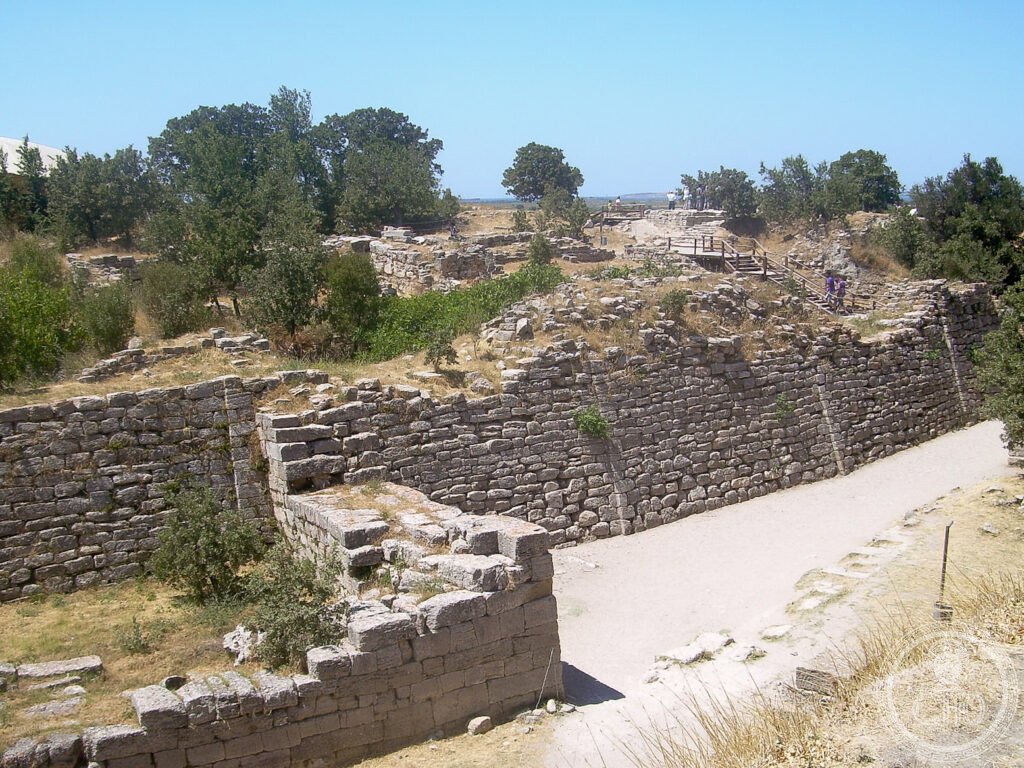
Troy (Hisarlik)
The most mythologically resonant archaeological site in the Western tradition and the city that a German businessman proved real — Troy (Hisarlik; Çanakkale Province, Turkey; UNESCO WHS 1998) is a tell of 9 major settlement layers accumulated over 3,500 years, from the Early Bronze Age (approximately 3000 BCE) to the Byzantine period (circa 500 CE), at a strategic crossing of the Dardanelles that made it the most fought-over location in ancient Anatolia.
At a glance
Troy (the most precisely TroyHisarlik single Bronze Age 3000 BCE 9 levels stratigraphy Schliemann 1871 Iliad Agamemnon Priam wooden horse Troy VI walls Mycenaean 1700 BCE Troy VIIa fire destruction 1200 BCE Trojan War Sea Peoples Bronze Age Collapse UNESCO heritage: the site (the tell of Hisarlik (Hisarlik means “place of fortresses” in Turkish) is a low artificial hill (approximately 32m above the surrounding plain) created by 3,500 years of human settlement; each generation built over the ruins of the previous city; the 9 major phases (from Troy I (3000-2600 BCE, small Early Bronze Age town) to Troy IX (85 BCE-400 CE, Greco-Roman Ilion; the largest settlement in area, extending well beyond the tell into the surrounding plain)); the Trojan War question (the most debated question in archaeology: which layer of Troy corresponds to the city in Homer’s Iliad?; the current consensus among archaeologists (Troy VIIa (approximately 1260-1180 BCE) is the most likely candidate (it shows destruction by fire and the period corresponds to the general time of the Bronze Age Collapse and the period when Mycenaean Greek palatial culture was at its height)); the Priam’s Treasure misidentification (Schliemann found “Priam’s Treasure” in 1873 CE in the Troy II layer (approximately 2300 BCE) — but Troy II is approximately 1,000 years earlier than the Trojan War period; Schliemann had dug through the actual Bronze Age layers he was looking for)) — the most precisely TroyHisarlik single Bronze Age 3000 BCE 9 levels stratigraphy Schliemann 1871 Iliad Agamemnon Priam wooden horse Troy VI walls Mycenaean 1700 BCE Troy VIIa fire destruction 1200 BCE Trojan War Sea Peoples Bronze Age Collapse UNESCO heritage in any UNESCO world heritage site)).
Key facts
- Schliemann’s Treasure: the most precisely TroyHisarlik single Schliemann 1871 1873 Priam Treasure gold diadems necklaces 8833 pieces smuggled out Turkey Berlin Pushkin UNESCO heritage — the most dramatic archaeological find of the 19th century: the Treasure of Priam (Heinrich Schliemann (1822-1890 CE; a German merchant who became a millionaire in the Russian tea trade and then devoted himself to proving Homer was historically accurate; he excavated Troy from 1871 CE with permission from the Ottoman government; in May 1873 CE, near the end of the season, he found a large cache of gold objects (8,833 individual pieces: diadems, bracelets, necklaces, earrings, sauceboats, cups, and weapons) in the Troy II layer (approximately 2300 BCE); he named it “Priam’s Treasure” and smuggled it out of Turkey in violation of his excavation permit; the treasure passed to the Berlin Ethnological Museum (1882 CE) → vanished at the end of WWII (1945 CE) → in Soviet trophy collections → revealed in 1991 CE to be in the Pushkin Museum, Moscow, where it remains; Turkey, Germany, and Greece all claim the treasure))
- GPS: 39.9572° N, 26.2390° E
History
From Bronze Age to Roman Ilion (the most precisely TroyHisarlik single Troy I 3000 BCE Troy II Priam Treasure 2300 BCE Troy VI Mycenaean walls 1700 BCE Troy VIIa fire 1180 BCE Trojan War Homer Iliad Greek Roman Ilion Julius Caesar Augustus Caracalla Mehmed II 1462 CE Ottoman UNESCO heritage: the Bronze Age levels (Troy I-IX is not nine separate cities but nine major phases of a single site; the key phases: Troy I (3000-2600 BCE; a small Anatolian Early Bronze Age town; 100m in diameter; the fortification wall); Troy II (2600-2300 BCE; the era of “Priam’s Treasure” as Schliemann wrongly believed; the largest Early Bronze Age settlement in northwest Anatolia; destroyed by fire); Troy VI (1700-1250 BCE; the most impressive Bronze Age city; the great limestone walls (some still 9m high); the city has a population of approximately 8,000-10,000; contemporary with Mycenaean Greece); Troy VIIa (1250-1180 BCE; the most likely “Homeric” Troy; the city shows evidence of a violent destruction by fire; the storage vessels buried in the floors of houses (suggesting the population was preparing for a siege); the period corresponds to the Bronze Age Collapse (approximately 1200 BCE) when the entire eastern Mediterranean world collapsed (the Mycenaean palatial culture, the Hittite empire, and the Egyptian New Kingdom all weakened simultaneously)); the Greco-Roman period (Troy IX; 85 BCE-400 CE; the Romans called the city Ilion (in Greek) or Ilium (in Latin); Julius Caesar visited in 48 BCE and was deeply moved by the sight of the ruins; he planned a new city here; Augustus founded the Roman city of Alexandria Troas 30 km south; the emperor Caracalla (217 CE) visited Troy, sacrificed to the spirit of Achilles, and built a tomb for the spirit of his murdered friend Festus (comparing himself to Achilles mourning Patroclus)); the Ottoman and modern period (Mehmed II (the conqueror of Constantinople) visited the ruins in 1462 CE and declared that he had avenged the Trojans against the Greeks (viewing himself as an heir to the pre-Greek peoples of Anatolia))) — the most precisely TroyHisarlik single Troy I 3000 BCE Troy II Priam Treasure 2300 BCE Troy VI Mycenaean walls 1700 BCE Troy VIIa fire 1180 BCE Trojan War Homer Iliad Greek Roman Ilion Julius Caesar Augustus Caracalla Mehmed II 1462 CE Ottoman UNESCO heritage in any UNESCO world heritage site)).
What you see
The overlapping city layers and the Troy VI walls (the most precisely TroyHisarlik single Schliemann trench Dörpfeld scarp Troy VI northeast bastion massive limestone walls Mycenaean ashlar Bouleuterion odeon Demetrios Phalereus Trojan Horse replica UNESCO heritage: the visitor experience: the Trojan Horse (a large wooden horse replica stands at the car park entrance; entirely modern; no connection to anything ancient; a visual cue for visitors unfamiliar with the site); the main tell (the walking circuit around the tell passes through multiple time periods simultaneously; the most impressive visible remains: the Troy VI northeast tower (a Cyclopean limestone tower with massive ashlar blocks, well-fitted without mortar; the widest surviving section of the Troy VI fortification); the Schliemann trench (the great north-south cut through the tell that Schliemann dug in 1871-73 CE to reach the deep Bronze Age levels; the trench cut through everything, destroying the Homeric-period layers (the irony of the Trojan excavation)); the Troy IX odeon (a small Roman theatre of the Ilion period; 50-meter diameter; still identifiable); the Bouleuterion (the Roman council house of the Ilion city; a small rectangular meeting hall); the Troy Museum (the national museum of Troy; opened 2018 CE; 1.5 km from the site; one of the most technologically sophisticated archaeological museums in Turkey; the complete story of the site with reproductions of the Schliemann Treasure)) — the most precisely TroyHisarlik single Schliemann trench Dörpfeld scarp Troy VI northeast bastion massive limestone walls Mycenaean ashlar Bouleuterion odeon Demetrios Phalereus Trojan Horse replica UNESCO heritage in any UNESCO world heritage site)).
Practical information
- Getting there: from Istanbul (the most common starting point; the Çanakkale Otogarı (bus station) is connected by direct overnight buses from Istanbul (Büyük Otogar; 5h; multiple companies (Metro Turizm, Kamil Koç)); alternatively from Istanbul via the Çanakkale ferry (the 1915 Çanakkale Bridge (2022 CE; the longest suspension bridge span in the world (2,023m main span); the İstanbul-Çanakkale drive is approximately 3h30m with the bridge)); from Çanakkale to Troy (30 km south; dolmuş minibus from the bus station (every 30-40 min; ₺50) or taxi (approximately ₺200 one way)); the site hours (08:30-19:00 in summer; 08:30-17:30 in winter); the site visit (allow 2-3 hours for the tell + the Troy Museum; the museum is 1.5 km from the archaeological site and requires separate transport; many visitors see the site in the morning and the museum in the afternoon)); the Gallipoli Peninsula (30 km north of Troy; the ANZAC battlefields of WWI (1915 CE; the Gallipoli Campaign; the Australian and New Zealand Army Corps; approximately 130,000 Allied deaths and 253,000 Ottoman deaths; the most visited memorial site in Australia))
Getting there
Bus from Istanbul to Çanakkale (5h), then dolmuş to Troy (30 km, 30 min). Museum 1.5 km from site. Open 08:30-19:00. GPS: 39.9572, 26.2390.
Nearby
- Gallipoli (Gelibolu) Peninsula — 50 km north (the 1915 Gallipoli Campaign battlefields; the most visited memorial site in Australia and New Zealand; the ANZAC Cove, Lone Pine Cemetery, Chunuk Bair; the annual ANZAC Day service (April 25) draws 10,000-20,000 Australian, New Zealand, British, and Turkish visitors; the ferry across the Dardanelles from Çanakkale to Eceabat connects to the Gallipoli site))
- Assos (Behramkale) — 80 km south (the ancient Greek city founded in the 7th century BCE; the Doric Temple of Athena (6th century BCE; the remains are among the earliest surviving Doric architecture in Asia Minor); the port village of Behramkale below (one of the most photogenic villages in Turkey); the site where Aristotle taught philosophy and founded the first school of formal education in history (approximately 347-344 BCE))
Sources
- Wikipedia, Troy; Heinrich Schliemann; Treasure of Priam, accessed June 2026
- UNESCO, Archaeological Site of Troy, WHS reference 849, inscribed 1998
Find it on the map
See this place and what’s around it →📷 Diventa un fotografo di Cultural Heritage Online
Condividi le tue foto dei luoghi: restano pubblicate con la tua firma come autore. Più vengono viste, più ti fai conoscere — e presto un concorso premierà le foto più apprezzate.
Accedi o registrati gratis per aggiungere una foto