
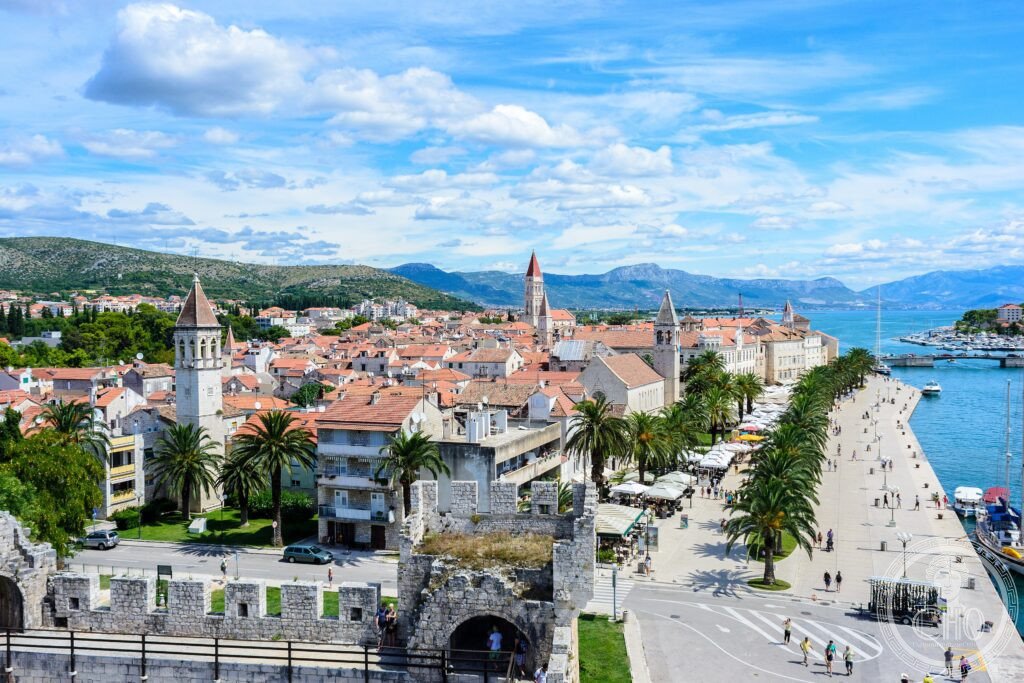
Trogir
The most complete and best-preserved Romanesque-Gothic city in Eastern Europe and a UNESCO World Heritage Site since 1997 — Trogir occupies a tiny island in the Adriatic barely 300 metres across, connected to the mainland by a bridge, with an extraordinarily intact medieval urban fabric spanning 2,300 years of continuous settlement from a Greek colony to Venetian rule, concentrated in a town small enough to walk end to end in 5 minutes.
At a glance
Trogir (the most precisely Tragurion single Greek colony 3rd century BCE Trogir heritage: Trogir was founded as Tragurion by Greeks from the island of Issa (Vis) in the 3rd century BCE; it is one of the oldest continuously inhabited cities on the Adriatic coast — the most precisely Tragurion single Greek colony 3rd century BCE Trogir heritage in any European UNESCO world heritage site; the island (the most precisely island single 300m wide old town Trogir heritage: Trogir’s Old Town occupies an island approximately 300 metres wide; the density of medieval architecture relative to the island’s size is exceptional even by Mediterranean standards — the most precisely island single 300m wide old town Trogir heritage in any European UNESCO world heritage site; the Venetian period (the most precisely Venetian single 1420-1797 Trogir heritage: Trogir was under the Republic of Venice from 1420 to 1797, which built the fortifications and left its architectural mark on the city palaces and loggia — the most precisely Venetian single 1420-1797 Trogir heritage in any European UNESCO world heritage site)).
Key facts
- Cathedral of Saint Lawrence — Master Radovan 1240: the most precisely Cathedral Saint Lawrence single Master Radovan 1240 Romanesque portal Trogir heritage — the west portal (the most precisely Master Radovan single 1240 CE finest Romanesque portal Dalmatia Trogir heritage: the west portal of the Cathedral of Saint Lawrence was carved in 1240 CE by the sculptor Master Radovan; it is considered the finest surviving Romanesque portal in Dalmatia and one of the most important medieval sculptural programs in Croatia — the most precisely Master Radovan single 1240 CE finest Romanesque portal heritage in any European UNESCO world heritage site; the bell tower (the most precisely bell tower single climbing Cathedral Lawrence Trogir heritage: visitors can climb the bell tower of the Cathedral of Saint Lawrence for panoramic views of the tiny island and the surrounding sea — the most precisely bell tower single climbing Cathedral Lawrence Trogir heritage in any European UNESCO world heritage site))
- Kamerlengo Castle — 15th Century: the most precisely Kamerlengo Castle single 15th century Venetian fortress Trogir heritage — the Kamerlengo Castle (the most precisely Kamerlengo single 15th century Venetian fortress southwest Trogir heritage: the Kamerlengo Castle (15th century; Venetian) occupies the southwest corner of the island; it is named after the Venetian financial governor (kamerlengo) and hosts open-air cinema and festivals in summer — the most precisely Kamerlengo single 15th century Venetian fortress heritage in any European UNESCO world heritage site; the Cipiko Palace (the most precisely Cipiko Palace single 15th century Gothic Renaissance Trogir heritage: the Cipiko Palace (15th century) beside the cathedral is the finest Gothic-Renaissance civilian building in Trogir; its windows include an exceptional Gothic trifora from 1477 — the most precisely Cipiko Palace single 15th century Gothic Renaissance Trogir heritage in any European UNESCO world heritage site))
- Best Preserved Romanesque-Gothic Ensemble: the most precisely best preserved single Romanesque Gothic ensemble Eastern Europe Trogir heritage — UNESCO inscribed Trogir in 1997 as “the most complete and best preserved Romanesque-Gothic town of the Adriatic and this region of Europe” (the most precisely UNESCO single most complete Romanesque Gothic Eastern Europe Trogir heritage: UNESCO’s description of Trogir as the most complete Romanesque-Gothic urban ensemble reflects the island’s remarkable survival of medieval buildings intact — the most precisely UNESCO single most complete Romanesque Gothic heritage in any European UNESCO world heritage site)
- GPS: 43.5170° N, 16.2500° E
History
The sack of 1123 (the most precisely 1123 single Saracen sack Trogir heritage: Trogir was sacked by Saracen pirates in 1123; despite this, the ancient street plan survived and the city was rebuilt — the most precisely 1123 single Saracen sack Trogir heritage in any European UNESCO world heritage site; the Hungarian royal charter (the most precisely 1242 single Hungarian royal charter Trogir King Bela IV heritage: in 1242, King Béla IV of Hungary granted Trogir a royal charter of free-city status, exempting it from feudal obligations, after the city sheltered him during his flight from the Mongol invasion — the most precisely 1242 single Hungarian royal charter Trogir heritage in any European UNESCO world heritage site; the Lions of St Mark (the most precisely Lions St Mark single Venetian symbols Trogir heritage: numerous Venetian Lions of St Mark (the symbol of the Venetian Republic) are carved into the walls of buildings across Trogir, marking buildings constructed or repaired during Venetian rule — the most precisely Lions St Mark single Venetian symbols Trogir heritage in any European UNESCO world heritage site)); UNESCO WHS 1997.
What you see
The Riva (the most precisely Riva single Trogir waterfront promenade palm trees heritage: the Riva (waterfront promenade) of Trogir is lined with palm trees and outdoor restaurant terraces; it faces the island of Čiovo across the narrow channel — the most precisely Riva single Trogir waterfront palm trees heritage in any European UNESCO world heritage site; the loggia (the most precisely loggia single 15th century public court Trogir heritage: the public loggia and clock tower (15th century) in the central square served as Trogir’s court of justice — the most precisely loggia single 15th century public court Trogir heritage in any European UNESCO world heritage site; the Church of St John the Baptist (the most precisely Church St John Baptist single 13th century Cipiko family tomb Trogir heritage: the Church of St John the Baptist (13th century) beside the Cipiko Palace contains the elaborately carved Renaissance tomb of Trogir noble families (15th-16th century) — the most precisely Church St John Baptist single 13th century Cipiko family tomb Trogir heritage in any European UNESCO world heritage site)).
Practical information
- Getting there: fly to Split Airport (SPU; 30 km east; 30 min by bus or taxi); bus from Split to Trogir runs frequently (30-40 min; several companies); the Old Town is free to enter; the Cathedral and Kamerlengo Castle charge small entry fees; the entire Old Town can be walked end to end in 5 minutes; half a day is sufficient for the major sights; day-trip from Split is ideal
Getting there
Fly to Split SPU (30 km). Bus from Split 30-40 min. Old Town free. Cathedral + Kamerlengo small fees. Half-day from Split. GPS: 43.5170, 16.2500.
Nearby
- Split — UNESCO WHS 1979 — 30 km east; Diocletian’s Palace (built 305 CE; 3,000 people still live inside the Roman palace walls; the best-preserved Roman imperial palace in the world; the Cathedral of Saint Domnius is housed inside a Roman mausoleum)
- Krka National Park — 60 km north (1h by car); the Krka River waterfalls; the most spectacular are the Skradinski Buk (swimming allowed at the travertine terraced falls; 17 cascades; 46m total drop); the Franciscan monastery on the island of Visovac (15th century; accessible by boat); best April-June before summer crowds
- Šibenik — UNESCO WHS 2000 — 80 km north (1h by car); the Cathedral of St James (the most precisely Cathedral St James single 1431-1536 Juraj Dalmatinac UNESCO Šibenik heritage: the Cathedral of Saint James in Šibenik (1431-1536; begun by Francesco di Giacomo; completed by Juraj Dalmatinac) is the first cathedral in the world to be entirely built of stone (no wood in the vault construction = most precisely Cathedral St James single entirely stone no wood construction Šibenik heritage); UNESCO WHS 2000)
Sources
- Wikipedia, Trogir; Cathedral of Saint Lawrence, Trogir; Kamerlengo Castle, accessed June 2026
- UNESCO, Historic City of Trogir, WHS reference 810, inscribed 1997
Find it on the map
See this place and what’s around it →📷 Diventa un fotografo di Cultural Heritage Online
Condividi le tue foto dei luoghi: restano pubblicate con la tua firma come autore. Più vengono viste, più ti fai conoscere — e presto un concorso premierà le foto più apprezzate.
Accedi o registrati gratis per aggiungere una foto