
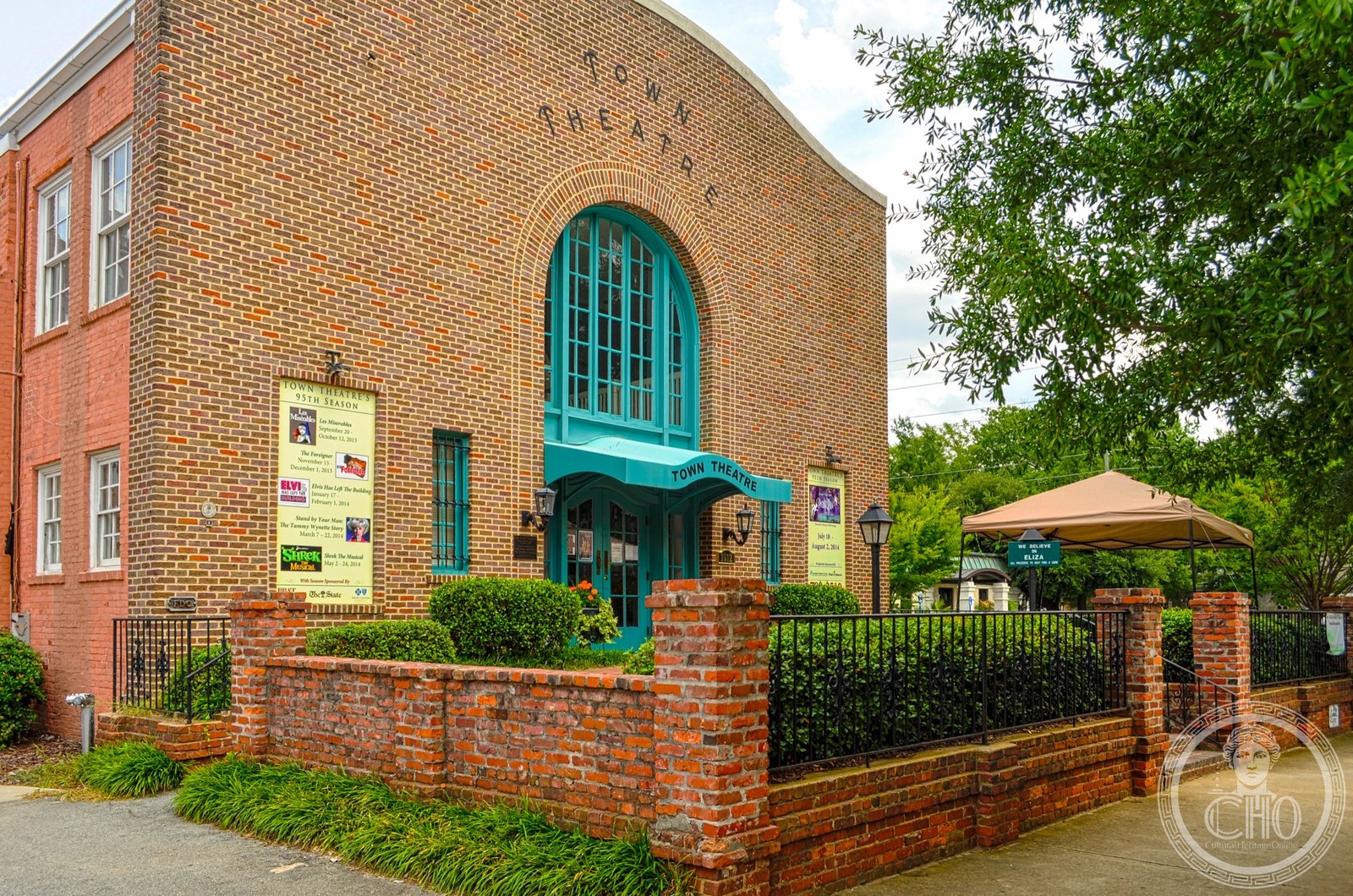
The Town Theatre on Sumter Street in Columbia is South Carolina’s oldest continuously operating theater company in its own dedicated building—a 1937 Art Moderne structure that has housed the Town Theatre organization since the company moved into this purpose-built home, giving it a claim to theatrical continuity that extends across nearly a century of American cultural history.
At a glance
The Town Theatre at 1012 Sumter Street in Columbia, South Carolina is the home of the Town Theatre company, founded in 1919 as one of the first community theater organizations in the American South and consistently recognized as South Carolina’s oldest continually producing theater. The 1937 building designed in the Art Moderne / Streamline Moderne style replaced an earlier structure and has served the company through nearly nine decades of productions, making the combination of organization and building one of the longest-running examples of community theater institutional continuity in the United States. Columbia’s status as the state capital, home to the University of South Carolina, and a city with a concentrated professional and military community has sustained the Town Theatre’s middle-class audience through successive generations of theatergoers.
Key facts
- Address: 1012 Sumter Street, Columbia, SC 29201
- GPS: 34.0006° N, 81.0357° W
- Built: 1937
- Style: Art Moderne / Streamline Moderne
- Theater company founded: 1919
- Status: Active community theater (nonprofit)
- NRHP: Listed on National Register of Historic Places
History
The Town Theatre company was founded in Columbia in 1919 as part of the “little theater” movement that swept American cities in the early 20th century—a reaction against the commercialization of professional theater that sought to create community-centered dramatic art outside the economics of Broadway and the touring circuit. The movement was enabled by the growth of middle-class leisure culture, the spread of educational institutions, and the civic infrastructure of state capitals and university cities. Columbia, as the home of South Carolina’s government and the University of South Carolina (founded 1801), was precisely the type of city where the little theater model could find an institutional base.
The 1919 company operated in various venues before the construction of the purpose-built theater at 1012 Sumter Street in 1937. The building was designed in the Art Moderne / Streamline Moderne style that was fashionable for institutional buildings in the mid-1930s: a clean facade with horizontal banding, restrained ornamental detail in the Moderne manner, and a functional interior organized around the theatrical work rather than the ornamental display of the commercial picture palace. The 1937 building was designed for a community theater—a space that needed to accommodate backstage equipment, rehearsal, and storage as well as audience seating—in contrast to the purely speculative commercial theaters of the 1920s.
The Town Theatre has operated continuously at 1012 Sumter Street through the postwar decades, producing the full range of community theater repertoire—musicals, dramas, comedies, and occasional new work—to audiences that have included generations of Columbia families, University of South Carolina students and faculty, and the professional community of a state capital. The organization’s longevity places it among the oldest community theater companies in the country, a status reinforced by the continuity of its purpose-built home.
What you see
The Sumter Street facade presents the Art Moderne vocabulary in its characteristic institutional form: a composition of horizontal banding and clean geometric ornament that strips away the historical references of the Beaux-Arts and the academic eclecticism of the 1920s in favor of a more abstracted modern aesthetic. The materials—brick and cast stone with metal lettering—were chosen for durability and economy rather than the elaborate terra cotta and marble of the commercial picture palaces. The building reads as a civic structure rather than a commercial entertainment venue, which is consistent with the community theater movement’s self-understanding as cultural institution rather than show business.
The interior is organized around the practical demands of community theater production: a stage of adequate size and fly space, backstage facilities for costumes and sets, and an auditorium that accommodates the audience relationships appropriate to intimate repertory theater. The scale is human rather than palatial, which distinguishes the Town Theatre from the grand movie palaces and creates a performance environment suited to the spoken-word drama and musical theater that is the community theater’s primary repertoire.
Practical information
- The Town Theatre produces 5-6 shows per season from September through May; check towntheatre.com for the season schedule and tickets.
- Located at 1012 Sumter Street in the Elmwood Park neighborhood of Columbia, approximately 10 blocks north of the State House.
- Street parking on Sumter Street and the surrounding blocks; Columbia’s downtown is not densely parked.
- The theater’s intimate scale (under 300 seats) means that every seat provides a close relationship to the stage; reservations for popular productions are advisable.
Getting there
The Town Theatre is at 1012 Sumter Street in Columbia, South Carolina, approximately 10 blocks north of the South Carolina State House. Columbia Metropolitan Airport (CAE) receives direct service from Atlanta, Charlotte, and Washington Dulles; from the airport, the theater is 8 miles north via I-26 and I-126. Interstate 26 connects Columbia to Charleston (130 miles southeast) and Interstate 20 connects to Charlotte (90 miles north) and Augusta, GA (80 miles west). The University of South Carolina main campus is 0.5 miles south on Sumter Street, making the theater a natural complement to university-related cultural activities in Columbia.
Nearby
- South Carolina State Museum (1 mile south): the museum at 301 Gervais Street occupies the 1893 Columbia Mill building — the first electrically powered textile mill in the world — and holds collections on South Carolina’s natural, cultural, and artistic history.
- South Carolina State House (1.5 miles south): the 1903 capitol building at Main and Gervais Streets is notable for the bronze stars embedded in the exterior walls marking the positions where Sherman’s artillery struck during the 1865 destruction of Columbia.
- University of South Carolina McKissick Museum (0.5 miles south): the museum at the head of the Horseshoe (the original USC campus green) holds collections in Southern culture, folk art, and natural history; the surrounding Historic Horseshoe is one of the finest antebellum campus landscapes in the country.
- Riverbanks Zoo and Garden (3 miles west): the zoo at 500 Wildlife Parkway spans both sides of the Saluda River; the historic Saluda Factory ruins on the river bank are a Civil War–era textile mill that was one of the primary targets of Sherman’s March.
Sources
- Town Theatre, towntheatre.com — organization history and season programming
- National Register of Historic Places, Town Theatre Columbia nomination
- Richland County Historic Preservation Commission records
- South Carolina Department of Archives and History, community theater documentation
Find it on the map
See this place and what’s around it →Record researched and written by Luigi De Marchi for Cultural Heritage Online, 2026.
📷 Become a Cultural Heritage Online photographer
Share your photos of places: they stay published under your name as the author. The more they're seen, the more you get noticed — and soon a contest will reward the most appreciated photos.
Log in or sign up free to add a photoIs this page about you?
This page is read by travellers and heritage enthusiasts who find it on Google. Tell us how you are connected to this place and we will take it from there.