
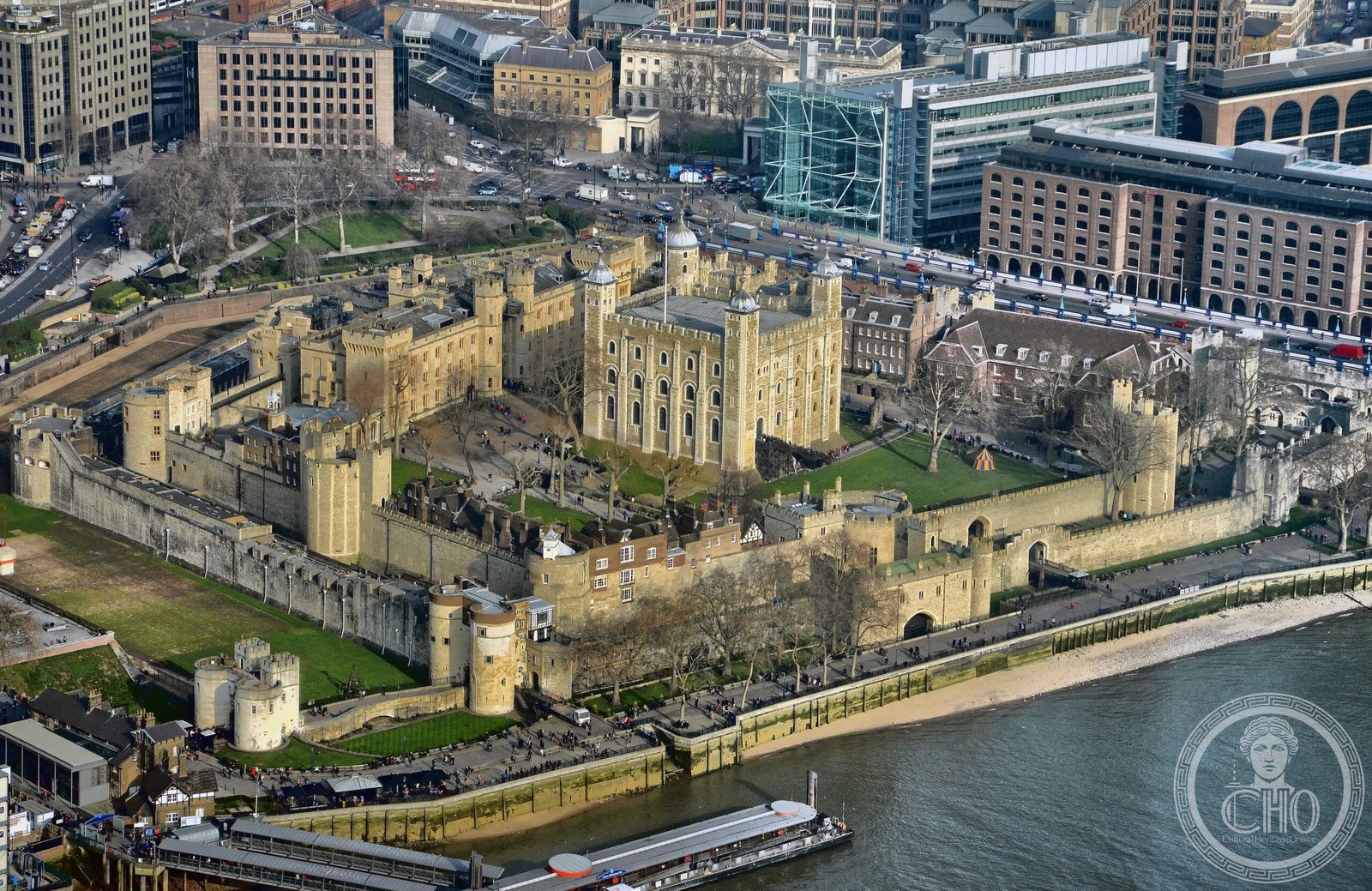
Tower of London
The Tower of London is a historic royal castle on the north bank of the Thames in central London, founded by William the Conqueror in 1066 and substantially expanded over the following centuries. A UNESCO World Heritage Site since 1988, the complex has served as a royal residence, treasury, armoury, menagerie, and — most notoriously — a state prison. Today it is one of the most visited historic monuments in the United Kingdom, housing the Crown Jewels of England and guarded by the ceremonial Yeoman Warders.
At a glance
- Type
- Royal fortress, palace, and prison; UNESCO World Heritage Site
- Period
- Founded 1066–1078; expanded 12th–14th centuries; continuously maintained to the present
- Style
- Norman Romanesque (White Tower); medieval concentric castle plan with later additions
- Location
- Tower Hill, London EC3N 4AB — 51.5081° N, 0.0781° W
Overview
The Tower of London encompasses approximately 4.9 hectares within its concentric defensive walls, containing nineteen towers, a moat (now dry), chapels, barracks, and the Watergate — the famous “Traitors’ Gate” through which prisoners arrived by barge from the Thames. The White Tower, the Norman keep at the complex’s heart, remains the oldest and most architecturally significant structure, housing the Royal Armouries collection. The Crown Jewels, displayed in the Jewel House, include the Imperial State Crown set with the 317-carat Cullinan II diamond and the Sovereign’s Sceptre containing the world’s largest clear cut diamond, the Cullinan I.
History
William the Conqueror began construction of the White Tower shortly after his victory at Hastings in 1066, using Caen stone imported from Normandy to signal the permanence of Norman rule. His successors Richard I and Henry III surrounded it with concentric curtain walls and towers, creating the fortress plan visible today. Under the Tudors the Tower became synonymous with political imprisonment: Anne Boleyn, Catherine Howard, Thomas More, Thomas Cromwell, and Lady Jane Grey were all held and executed within its walls. The last prisoner to be held in the Tower was Rudolf Hess in 1941; the last execution took place in 1941 when Josef Jakobs was shot by firing squad.
What you see
Visitors enter through the Middle Tower and cross the dry moat to reach the Byward Tower and the inner ward. The White Tower’s interior displays suits of armour belonging to Henry VIII and Charles I alongside a collection of edged weapons and firearms spanning nine centuries. The Chapel of St John the Evangelist within the White Tower is a rare and well-preserved example of 11th-century Norman ecclesiastical architecture. The daily Ceremony of the Keys — the formal locking of the Tower’s gates, performed every evening for over 700 years — can be attended by pre-booked visitors. Ravens, kept at the Tower by royal decree, are a living tradition: legend holds that the kingdom will fall if they ever leave.
Cultural significance
The Tower of London is inscribed on the UNESCO World Heritage List as a site of outstanding universal value, recognised for its role in English and British history, its architectural integrity as a Norman royal castle, and its influence on castle design across Europe. It has profoundly shaped the English cultural imagination through association with royalty, power, and political imprisonment, and remains a symbol of both national identity and historical reckoning. The Tower’s archives and collections are primary sources for over a thousand years of English history.
Practical information
The Tower of London is managed by Historic Royal Palaces and is open daily (closed 24–26 December and 1 January). Admission is charged; book tickets in advance at hrp.org.uk to avoid queues. Free Yeoman Warder tours depart regularly from the Middle Tower. The Crown Jewels queue can be long — arrive early or use the timed entry system. Address: Tower Hill, London EC3N 4AB.
Getting there
Tower Hill Underground station (Circle and District lines) is immediately adjacent to the Tower’s main entrance. Fenchurch Street rail station is a 5-minute walk. Multiple Thames Clipper river bus services stop at Tower Pier, directly below the south wall — a scenic approach. London Bridge station (Northern and Jubilee lines, Thameslink) is 10 minutes on foot across Tower Bridge.
Sources & resources
- Wikipedia — Tower of London
- Historic Royal Palaces — official website
- Cultural Heritage Online — London guides
Find it on the map
See this place and what’s around it →📷 Diventa un fotografo di Cultural Heritage Online
Condividi le tue foto dei luoghi: restano pubblicate con la tua firma come autore. Più vengono viste, più ti fai conoscere — e presto un concorso premierà le foto più apprezzate.
Accedi o registrati gratis per aggiungere una foto