
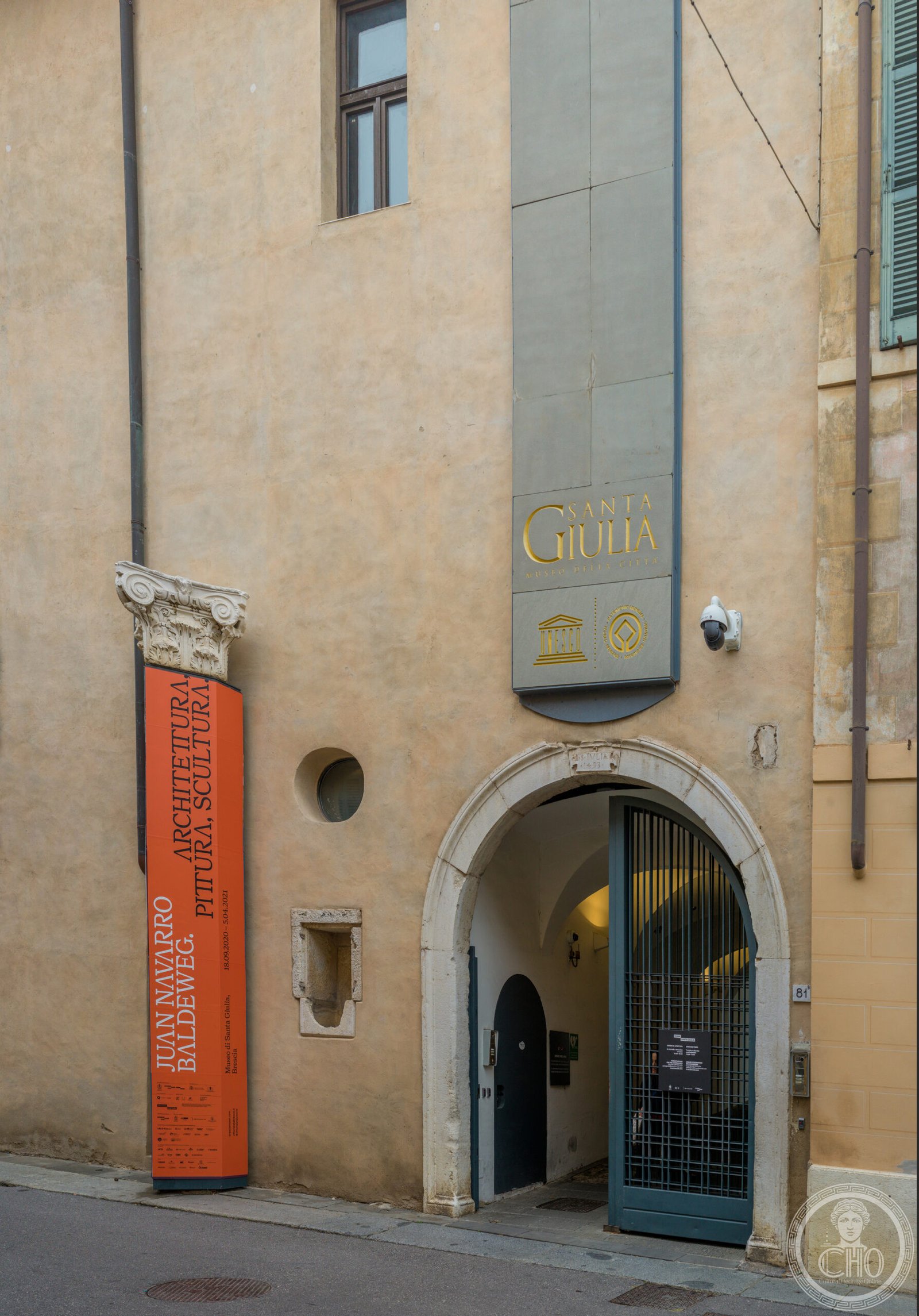
Tosio Palace — Santa Giulia Museum, Brescia
The Santa Giulia Museum in Brescia, Lombardy, is one of the most important museum complexes in northern Italy, built around a former Benedictine monastery whose origins reach back to Roman times. The monastic complex of San Salvatore and Santa Giulia, a UNESCO World Heritage Site as part of the Lombards in Italy designation, encompasses layered remains from the Roman city of Brixia through the Lombard, Carolingian, Romanesque and Renaissance periods. Palazzo Tosio, a neoclassical palace once belonging to the Brescia collector Paolo Tosio, houses part of the city’s artistic heritage and is functionally linked to the broader museum complex.
At a glance
- Type
- Museum complex in a former Benedictine monastery; neoclassical civic palace
- Period
- Roman foundations; monastery founded c. 753 AD; Palazzo Tosio: early 19th century
- Style
- Multi-period: Roman, Lombard, pre-Romanesque, Romanesque, Renaissance, Neoclassical
- Location
- Brescia, Province of Brescia, Lombardy, Italy
- Coordinates
- 45.5366° N, 10.2250° E
- UNESCO
- Part of “Longobards in Italy: Places of Power” World Heritage Site (inscribed 2011)
Overview
The Santa Giulia Museum is centred on the monastery of San Salvatore e Santa Giulia, founded around 753 AD by Desiderius, the last King of the Lombards, and his wife Ansa. The monastery complex is remarkable for incorporating Roman-era structures, including remnants of a Roman domus with well-preserved mosaics, within its medieval fabric. Today the site functions as a city museum (Museo della Città) that narrates Brescia’s history from prehistory to the modern era through its extraordinary layered architecture and archaeological collections.
History
Founded on the site of an earlier Roman residential quarter, the monastery of San Salvatore was established in the eighth century and became one of the most powerful Benedictine establishments in Lombard Italy. The complex was extended repeatedly over the following centuries, resulting in a remarkable accumulation of architectural styles. Following the suppression of the monastery under Napoleonic rule in the early nineteenth century, the buildings were converted to various civic uses before being transformed into the current city museum. Palazzo Tosio, built in the neoclassical style for the patrician collector Paolo Tosio, subsequently enriched the museum’s art holdings.
What you see
Visitors move through millennia of history as they explore the museum complex, which includes the Church of Santa Maria in Solario with its stunning Byzantine-influenced decorations, the three-nave Church of San Salvatore with Lombard friezes and pre-Romanesque capitals, Roman floor mosaics from a late-antique domus, and the Renaissance cloister. The museum’s collections include the Brescia Cross (a masterpiece of early medieval goldsmithing), Roman bronzes from the Capitolium excavations, and a major collection of Venetian and Brescian paintings.
Cultural significance
The Santa Giulia Museum complex is inscribed as part of the UNESCO World Heritage Site “Longobards in Italy: Places of Power” (2011), recognising the monastery as one of the most significant surviving witnesses to Lombard civilisation in Italy. The site’s extraordinary stratification — from Roman domus to Lombard monastery to Renaissance cloister — makes it a unique document of Brescia’s two-thousand-year continuity as an inhabited city.
Practical information
- Address
- Via dei Musei 81/b, 25121 Brescia BS, Italy
- Hours
- Check official website for current opening hours (closed Mondays)
- Admission
- Paid admission; check museibrescia.it for current prices and combined tickets
Getting there
Brescia is well connected by rail on the Milan–Venice high-speed line, approximately 45 minutes from Milan and 1 hour from Verona. From Brescia railway station, the museum is accessible by local bus or a 20-minute walk through the historic centre. The site is in the northern part of the Roman and medieval city, near the Capitolium and the Roman theatre.
Sources & resources
Find it on the map
See this place and what’s around it →📷 Diventa un fotografo di Cultural Heritage Online
Condividi le tue foto dei luoghi: restano pubblicate con la tua firma come autore. Più vengono viste, più ti fai conoscere — e presto un concorso premierà le foto più apprezzate.
Accedi o registrati gratis per aggiungere una foto