
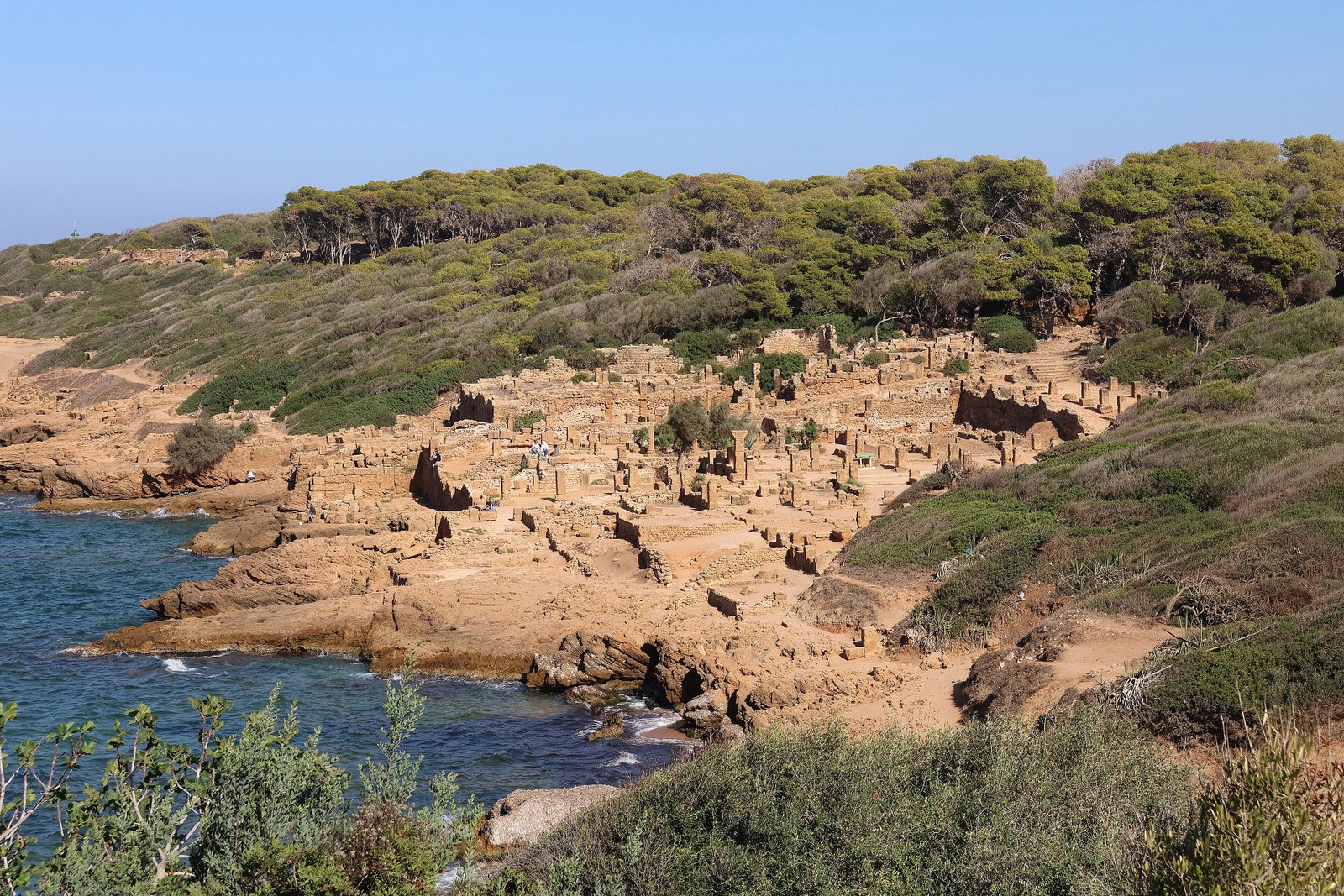
Tipasa: Where Albert Camus Heard the Gods Speak
A Roman city on the Algerian coast where violets and asphodels grow between fallen columns every spring — a place of such sensory intensity that Albert Camus made it the subject of one of his most celebrated essays.
At a Glance
Tipasa lies on the Mediterranean coast 70 km west of Algiers, where a Roman city was superimposed on a Punic settlement and later enriched by early Christian basilicas. Today its ruins are spectacularly open to the sea and sky, overgrown in spring with wildflowers whose scent drifts across fallen marble and sandstone. UNESCO inscribed the site in 1982.
History
A Phoenician trading post existed here before Rome took interest. The Romans established a formal colony under Emperor Claudius in the 1st century AD and expanded it under Hadrian. The city grew into a prosperous provincial town with the full Roman urban apparatus: forum, temple, amphitheatre, theatre, nymphaeum, and an extensive system of baths. By the 4th and 5th centuries AD it had become an important centre of North African Christianity, accumulating several basilicas including the large Basilica of Bishop Alexander. The city declined after the Vandal invasion in 430 AD and was abandoned by the 6th century.
What You See
The archaeological park occupies a coastal plateau where ruins meet olive groves and the sea. The Royal Mausoleum of Mauretania — a cylindrical stepped tower 61 metres in diameter and 32 metres tall, built around 25 BC as the tomb of King Juba II and his queen Cleopatra Selene (daughter of Marc Antony and Cleopatra, the last surviving child of the famous Egyptian queen) — stands on the approach road, one of the finest examples of late Roman funerary architecture in the Maghreb. Inside the park: a Roman theatre, the colonnade of the forum, the Basilica of Bishop Alexander (5th century AD) with apses still rising several metres, multiple domus floors with mosaic fragments, and the thermal baths. In spring, as Albert Camus described, violets, asphodels, and wild fennel press through every crack between the stones.
Albert Camus and the Literary Pilgrimage
Albert Camus, born in nearby Mondovi (now Dréan), Algeria, visited Tipasa repeatedly and in 1938 published his essay Noces (Nuptials), which opens: “In spring, Tipasa is inhabited by gods and the gods speak in the sun and the scent of absinth leaves, in the silver armour of the sea, in the raw blue sky, in the flower-covered ruins, and in the great bubbles of light among the heaps of stone.” The essay established a vision of Mediterranean pagan joy as a philosophical counterpoint to European nihilism. Camus returned in 1952 and wrote a second essay, Return to Tipasa, even more celebrated. The passage “Nuptials at Tipasa” is one of the most celebrated in 20th-century French prose.
Archaeological Significance
Tipasa is notable among Roman North African sites for the exceptional state of its early Christian monuments. The Great Basilica of Bishop Salvius (4th century AD) and the Basilica of Bishop Alexander (5th century AD) document the transition from pagan to Christian urban culture. A circular baptistery with intact mosaic paving survives. The site also preserves Punic-period funerary steles in its on-site museum that predate the Roman colony by centuries.
UNESCO and Conservation
Tipasa was among the first Algerian sites to receive UNESCO World Heritage status (1982). The site was placed on the World Heritage in Danger list from 2002 to 2006 due to urban encroachment and illicit construction; it was subsequently removed after corrective measures. The Algerian authorities manage the site through the National Centre for Archaeological and Prehistoric Research (CNRPAH).
Practical Information
Tipasa is approximately 70 km west of Algiers, reachable by shared taxi or bus from the capital (journey c. 1.5 hours). The archaeological park is open daily; a modest entrance fee applies. The small on-site museum holds finds from the excavations. Spring (March–May) is the best time to visit for the wildflowers; summer is very hot. Independent travel to Algeria requires advance visa arrangements for most nationalities.
Getting There
Fly into Houari Boumediene International Airport (Algiers). Shared taxis (taxi collectif) or buses run from Algiers western bus station toward Cherchell; alight at Tipasa town (c. 90 minutes). Tour operators in Algiers offer day trips. No direct rail service.
Nearby
- Cherchell (Caesarea) — 40 km west, the other Mauretanian royal capital with exceptional mosaics and a fine museum of Roman sculpture
- Royal Mausoleum of Mauretania — 2 km east of the main site, accessible on foot
- Algiers Casbah — 70 km east, UNESCO-listed Ottoman medina
Sources
- UNESCO World Heritage Centre — Tipasa
- Wikipedia: Tipasa
- Albert Camus, Noces (1938); L’été (1954) — “Return to Tipasa”
- Stéphane Gsell, Les monuments antiques de l’Algérie (1901)
- Susan Raven, Rome in Africa, 3rd ed. (Routledge, 1993)
Find it on the map
See this place and what’s around it →📷 Diventa un fotografo di Cultural Heritage Online
Condividi le tue foto dei luoghi: restano pubblicate con la tua firma come autore. Più vengono viste, più ti fai conoscere — e presto un concorso premierà le foto più apprezzate.
Accedi o registrati gratis per aggiungere una foto