
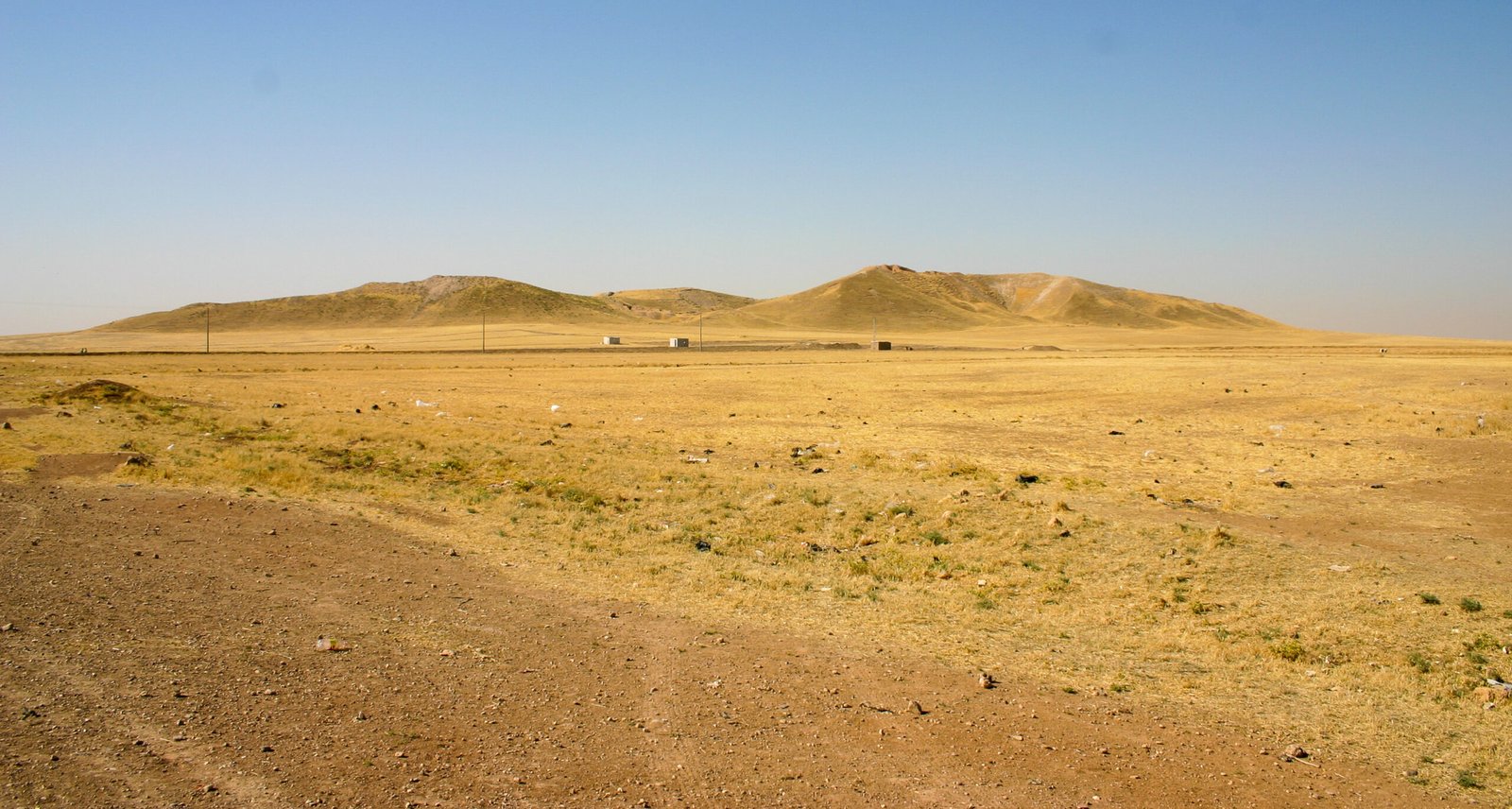
A 43-metre mound in northeastern Syria preserves one of the world's first cities, the astonishing Eye Idol votive tradition of the fourth millennium BC, and the camp of Agatha Christie's archaeologist husband — then partially destroyed by ISIS in 2014.
At a glance
Tell Brak rises 43 metres above the Khabur plains of northeastern Syria, 50 km north of Al-Hasakah. By 4000 BC it was already a substantial city with a population estimated at 10,000–30,000 people — placing it alongside Uruk in southern Mesopotamia as one of the first places in human history where large numbers of unrelated people chose to live permanently together. The site is best known for the "Eye Temple," a sequence of three successive temples from c. 3500–3300 BC in which archaeologists discovered over 30,000 small alabaster figurines with enormous incised eyes — offerings from a votive tradition unparalleled anywhere else in the ancient world. The site was excavated partly by Max Mallowan, husband of Agatha Christie, who described the dig in her memoir Come, Tell Me How You Live. In 2014, ISIS occupied the mound and used it as a military position, causing documented damage to the upper deposits.
Key facts
- Location: Khabur triangle, northeastern Syria, 50 km north of Al-Hasakah (36.6653°N, 41.0572°E)
- Size: Mound 43 m high, approximately 130 hectares
- Occupation: c. 4000–1300 BC (Chalcolithic through Late Bronze Age)
- Population at peak: Estimated 10,000–30,000 (c. 4000 BC)
- Key discovery: 30,000+ Eye Idol figurines from the Eye Temple sequence
- Excavators: Max Mallowan (1937–38); Cambridge University / University of Edinburgh (1970s–2000s)
- Damage: ISIS military occupation and looting documented in 2014
History
Tell Brak's earliest occupation phases, now dated to around 6000 BC, place it among the oldest continuously inhabited tells in northern Mesopotamia. But its most extraordinary chapter begins around 4000 BC, when the settlement underwent rapid urban growth: within a few centuries it had become one of the largest urban centres in the ancient world, with evidence of monumental architecture, specialised craft production, long-distance trade in obsidian and other prestige materials, and administrative record-keeping. This Uruk-period urban florescence at Brak was contemporary with — and possibly connected to — the emergence of the first cities in southern Mesopotamia, though the two regions appear to have developed urban forms somewhat independently.
The Eye Temple sequence (c. 3500–3300 BC) revealed the site's most famous find. Three successive temples — the White Eye Temple, the Grey Eye Temple, and the Red Eye Temple (named for the colour of their painted walls) — were filled with small alabaster figurines: flat, stylised human forms with enormous incised eyes above simplified torsos, ranging from 2 to 12 cm tall. More than 30,000 examples were recovered from the three temples, clearly representing a major institutionalised votive tradition in which pilgrims deposited "eye idols" as offerings to a deity whose primary symbol was the all-seeing eye. No other site in the ancient world has produced this tradition in this quantity or so clearly articulated. The identity of the deity remains unknown.
Max Mallowan excavated Tell Brak in 1937–38, accompanied by his wife Agatha Christie, who described the dig in her 1946 memoir Come, Tell Me How You Live — one of the most charming first-person accounts of archaeological fieldwork ever written. Cambridge University and the University of Edinburgh ran major research projects at the site from the 1970s through the 2000s, dramatically expanding understanding of the Bronze Age occupation. The Syrian civil war beginning in 2011 suspended all archaeological work; in 2014, satellite imagery confirmed that ISIS had used the summit of the mound as a military position, and subsequent field assessment documented significant damage to the upper levels and looting of the summit deposits. The deeper Uruk-period and Bronze Age levels appear to have survived.
What you see today
Tell Brak remains inaccessible to international visitors due to the ongoing Syrian conflict and post-conflict instability in northeastern Syria. Before 2011, the mound was a prominent landscape feature of the Khabur plains, visible for many kilometres, with the remains of its Bronze Age buildings exposed in excavation trenches on multiple sides. The Eye Temple foundations were consolidated and partially displayed; the broader excavation areas gave a clear sense of the site's extraordinary scale relative to the flat surrounding plain.
The Eye Idol figurines — among the most distinctive artefacts of the ancient Near East — are held across several institutions, including the British Museum in London, the National Museum of Aleppo (access uncertain given the civil war), and the Ashmolean Museum in Oxford. The British Museum's collection includes some of the finest examples and is the most accessible for European visitors.
Practical information
- Current access: Tell Brak is not currently accessible to international visitors due to the Syrian civil war and post-conflict instability in northeastern Syria
- Monitor conditions: Check UK Foreign Office, US State Department, or FCDO travel advisories for Syria before any planned visit
- Eye Idols in museums: British Museum (London), Ashmolean Museum (Oxford), and National Museum of Syria hold significant collections
- Online resources: The McDonald Institute (Cambridge) has published extensively on Tell Brak and some archives are accessible online
Getting there
Tell Brak is located approximately 50 km north of Al-Hasakah in northeastern Syria, accessible in normal times via the main road running north from Al-Hasakah toward the Turkish border. Al-Hasakah itself is served by road from Damascus (approximately 12 hours) and Deir ez-Zor. International access to northeastern Syria remains subject to significant political and security constraints that make independent travel effectively impossible at the time of writing.
Nearby
- Tell Halaf — early Chalcolithic site that gave its name to the Halaf culture (c. 120 km northwest), with extraordinary polychrome pottery and anthropomorphic sculptures
- Dura-Europos — Hellenistic-Roman-Parthian frontier city on the Euphrates with unique early synagogue and Christian church frescoes (c. 280 km south)
- Nimrud (Iraq) — Assyrian royal capital with monumental reliefs, across the Iraqi border (c. 150 km east)
Sources
- Mallowan, M.E.L. (1947). "Excavations at Brak and Chagar Bazar." Iraq 9: 1–259.
- Christie, A. (1946). Come, Tell Me How You Live. London: Collins.
- Oates, J., McMahon, A., Karsgaard, P., Qandil, S., & Urban, T. (2007). "Early Mesopotamian urbanism: a new view from the north." Antiquity 81: 585–600.
- ASOR Cultural Heritage Initiatives (2015). Damage Assessment at Tell Brak. Boston: ASOR.
- Wikipedia contributors. "Tell Brak." Wikipedia, The Free Encyclopedia.
Find it on the map
See this place and what’s around it →📷 Become a Cultural Heritage Online photographer
Share your photos of places: they stay published under your name as the author. The more they're seen, the more you get noticed — and soon a contest will reward the most appreciated photos.
Log in or sign up free to add a photo