

Sungir is an Upper Paleolithic archaeological site near Vladimir, Russia, containing some of the most extraordinary human burials ever discovered — dating to approximately 34,000 years ago. Excavated between 1955 and 1977 by Soviet archaeologist Otto Bader, the site revealed evidence of elaborate funerary ritual, inherited social status, and religious belief at a time when modern scholarship had barely imagined such complexity in Ice Age societies.
The Discovery and Excavations
Sungir was discovered in 1955 during construction work near Vladimir, approximately 200 kilometres northeast of Moscow. Soviet archaeologist Otto Bader led systematic excavations from 1956 to 1977, uncovering a settlement layer with hearths and animal bones as well as the extraordinary burials that made the site world-famous. The site is located on a terrace above the Klyazma River, in a landscape that 34,000 years ago would have been open mammoth steppe — cold, treeless grassland during the last glacial period. The find context is exceptional: the burials were undisturbed, the organic materials (ivory, bone, teeth) preserved by the cold and stable soil conditions, and the spatial arrangement of grave goods precisely recorded.
The Adult Burial: Sungir-1
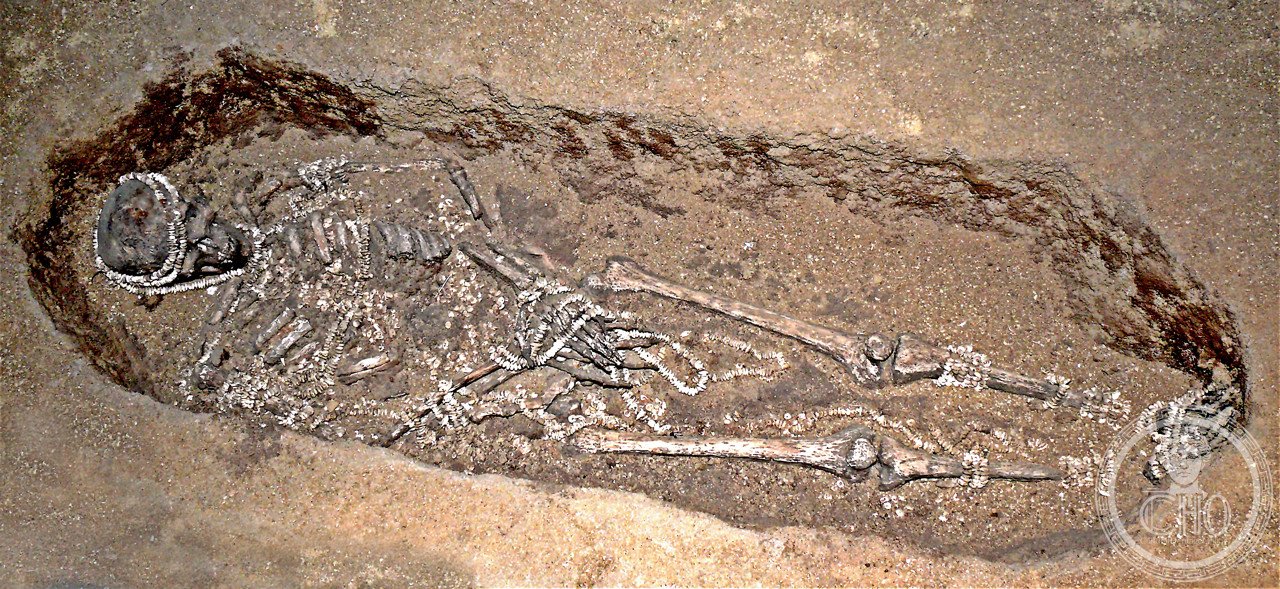
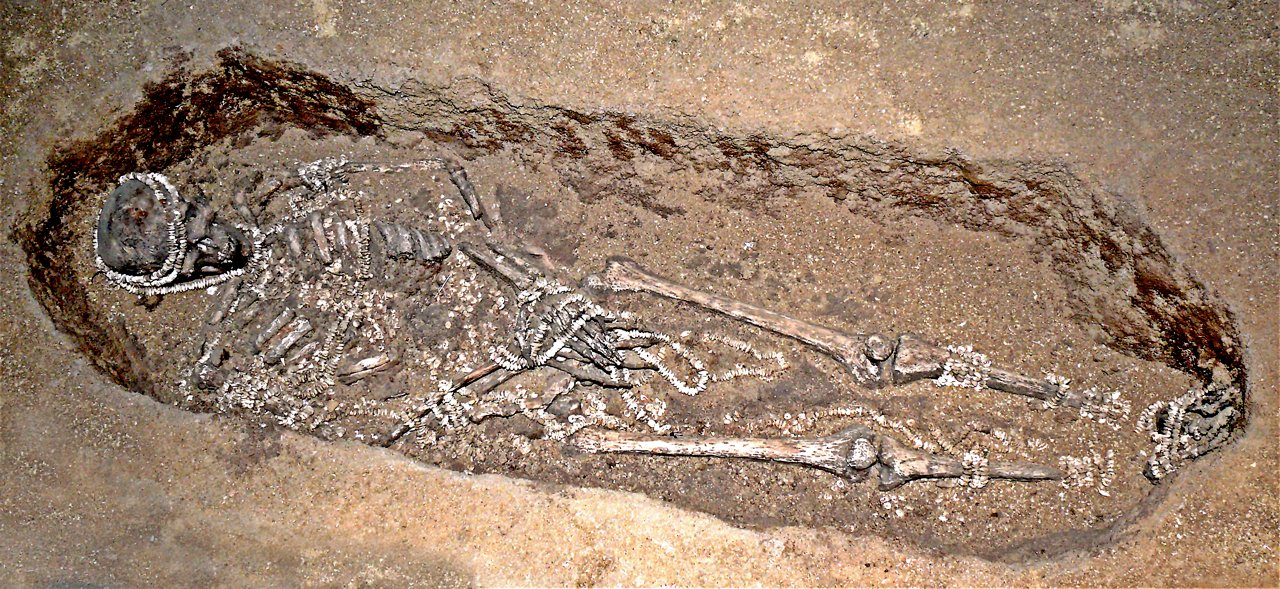
The first major burial found was an adult male, designated Sungir-1, believed to be approximately 40–50 years old at death. He was buried in an extended position, his body covered with 2,936 individually carved ivory beads arranged in rows and bands — the pattern of the beads indicates they had been sewn directly onto his clothing, preserving the ghost-outline of a decorated shirt, trousers, and moccasins. He also wore 25 polished mammoth-ivory bracelets and several fox-tooth pendants. Each bead is small (approximately 8–10 mm) and consistently shaped — a manufacturing feat requiring enormous patience and skill. Experiments have shown that carving a single bead from mammoth ivory takes approximately 45 minutes to one hour. The 2,936 beads on Sungir-1 alone represent an estimated 2,000–2,600 hours of skilled labor invested in a single burial.
The Double Child Burial: Sungir-2 and Sungir-3
The most spectacular find at Sungir is the double burial of two children, designated Sungir-2 and Sungir-3, discovered in a shared grave. Sungir-2 was a boy of approximately 12–13 years; Sungir-3 was a girl of approximately 9–10 years. They were buried head-to-head in a single elongated grave, their bodies touching at the crown. Together, the two children were buried with 13,113 individually carved ivory beads — more than four times the number buried with the adult male. The boy (Sungir-2) alone had approximately 4,903 beads sewn onto his clothing; the girl (Sungir-3) had approximately 5,274. The beads on the boy’s garments alone would have required an estimated 3,000 hours of manufacturing labor. Both children also carried ivory spears. The boy’s spear is 2.4 metres long — so large it could not possibly have been used as a practical weapon, suggesting it was made specifically for the burial. The girl had a shorter ivory spear and a carved ivory disc. Both children wore fox-tooth pendants, ivory pins, and ivory rings.
What Sungir Reveals About Paleolithic Society
The Sungir burials are among the most important archaeological finds ever made for understanding the social and spiritual life of Ice Age humans. Three major implications stand out. First: belief in an afterlife. The investment of 3,000+ hours of labor in a child’s burial goods makes no practical sense unless the community believed those goods would be useful or meaningful after death — this is the clearest early evidence we have of genuine funerary ritual driven by cosmological belief. Second: hereditary social hierarchy. Children cannot earn high status through lifetime achievement; the extraordinary richness of the children’s burials, exceeding even the adult’s, strongly implies that status was inherited — that the children were born into high social rank, not earned it. This is considered by many researchers the earliest evidence of hereditary social stratification in human prehistory. Third: sophisticated craft specialization. The precision, consistency, and scale of the ivory bead manufacture implies craftspeople who specialized in this work — not every adult making their own beads casually, but skilled workers producing objects of social value.
The Ivory Spear That Could Not Be Used
The 2.4-metre ivory spear found alongside the boy Sungir-2 deserves particular attention. Straightening a 2.4-metre length of mammoth tusk — which is naturally curved — required heating the ivory and applying sustained pressure over time. This was not accidental: it required deliberate technique and specialized knowledge. The spear is so long and its ivory so rigid that it would shatter on first impact with anything hard. It was never meant to be thrown or thrust. It was made for the grave. This tells us that 34,000 years ago, humans in this community were creating objects specifically designed for the dead — items that had no function in the living world, manufactured entirely for a ritual purpose. This level of symbolic thinking and mortuary investment places the Sungir people firmly in the behavioral modernity of contemporary Homo sapiens.
Scientific Analysis and Dating
The Sungir burials have been extensively analyzed using modern techniques. Radiocarbon dating places the burials at approximately 34,000 years before present (BP), consistent with the archaeological layer and the associated animal bones. DNA analysis published in 2017 (Fu et al., Nature) revealed that the two children buried head-to-head were not closely related — they were neither siblings nor parent-child — which has added an intriguing dimension to the social interpretation of the double burial. Why bury two unrelated children together so elaborately? The question remains open. Isotope analysis of the bones indicates the community was eating a diet heavy in animal protein, consistent with the mammoth-steppe environment. Geometric morphometric analysis of the skulls confirms the individuals were anatomically modern Homo sapiens, not Neanderthals, who were still present in parts of Europe at this period.
The Site Today and the Sungir Museum
The original excavation site near Vladimir is not publicly accessible in a developed archaeological park sense, but the finds are displayed at the Vladimir-Suzdal Museum-Reserve in Vladimir, where replicas of the burial with reconstructed garments and grave goods can be seen. The original ivory beads, spears, pendants, and bracelets are among the most studied objects in Paleolithic archaeology worldwide and have been exhibited internationally. The site itself is protected as a cultural heritage monument. Research continues: periodic re-analysis of the skeletal remains and grave goods using updated scientific methods regularly produces new insights, and the Sungir collection remains one of the most studied assemblages in all of prehistoric archaeology.
Visitor Information
- Location
- Near Vladimir, Russia — approximately 2 km from the city centre, on the Bogolyubovo road
- Main collection
- Vladimir-Suzdal Museum-Reserve, Vladimir (displays replicas and original finds)
- Getting there
- Vladimir is accessible by fast train from Moscow Kursky Station (~1h 45min); local buses from Vladimir city centre to the site area
- UNESCO status
- Not a UNESCO World Heritage Site; protected as a Russian federal cultural heritage monument
Find it on the map
See this place and what’s around it →📷 Become a Cultural Heritage Online photographer
Share your photos of places: they stay published under your name as the author. The more they're seen, the more you get noticed — and soon a contest will reward the most appreciated photos.
Log in or sign up free to add a photo