
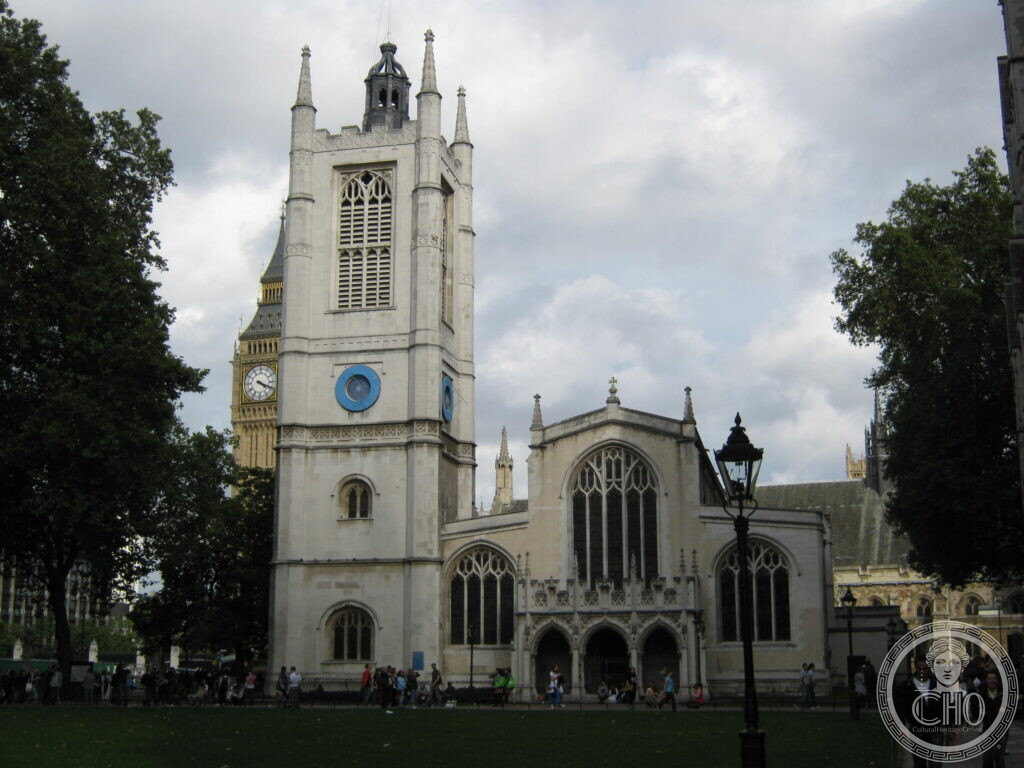
Standing between Westminster Abbey and Parliament, St Margaret’s is easy to walk past and is named, with both of them, in the World Heritage listing of 1987.
At a glance
St Margaret’s stands on the north side of Westminster Abbey, facing Parliament Square. The present building is of the early sixteenth century, the work of the Abbey’s own master masons; its west tower was largely rebuilt in the 1730s. Westminster Abbey describes it as the parish church of the House of Commons, and it is one of the three buildings named in the UNESCO World Heritage Site inscribed in 1987 as the Palace of Westminster and Westminster Abbey including Saint Margaret’s Church.
Key facts
- Nave and aisles: rebuilt about 1504
- West tower: begun 1515; most of it rebuilt 1735–37 by John James
- Chancel: about 1518
- Masons: Robert Stowell and Henry Redman, master masons of Westminster Abbey
- Material: Portland stone
- Listing: Grade I, first listed 24 February 1958 (Historic England, list entry 1226286)
- World Heritage: part of UNESCO site 426, inscribed 1987 under criteria i, ii and iv; the site was renamed in 2013
- GPS: 51.4999, -0.1267 · Open in Google Maps (OpenStreetMap)
History
The present church is the Perpendicular Gothic building put up in the first two decades of the sixteenth century: Historic England dates the nave and aisles to about 1504, the west tower to 1515 and the chancel to about 1518, and names Robert Stowell and Henry Redman, the Abbey’s master masons, as the men responsible. The tower was largely rebuilt between 1735 and 1737 by John James, which is why the body of the church and the tower do not quite read as one design.
Two burials fix the church in the national memory. William Caxton, who set up the first printing press in England, died in the early part of 1492 and was buried in St Margaret’s churchyard; the printers of London gave a memorial window in 1882, and it was destroyed by blast in 1940. Sir Walter Raleigh was beheaded on 29 October 1618 in Old Palace Yard, the courtyard next to the church, and is buried in the chancel.
What you see
A low, wide church in Portland stone, with large Perpendicular windows along the aisles, a battlemented parapet and pinnacles, and a square west tower carrying two blue clock faces and crowned by a small lantern. The east window is the thing to look for: Flemish stained glass of the transition from Gothic to Renaissance, which Historic England records as probably part of Katharine of Aragon’s dowry and originally intended for Henry VII’s Chapel in the Abbey next door. Raleigh’s grave is in the chancel.
Why it matters
St Margaret’s is the parish church of the House of Commons, and the only one of the three Westminster buildings that was built for the people of the parish rather than for a monastery or a parliament. Its presence in the World Heritage inscription is the reason the site’s official name is as long as it is: the church is named in its own right alongside the Abbey and the Palace, and it was still named in its own right when the committee reworded the title in 2013.
Nearby
- Westminster Abbey — immediately to the south, 23 metres away
- Palace of Westminster — across St Margaret Street
- Middlesex Guildhall — on the west side of Parliament Square
Sources
- Historic England, National Heritage List for England, Church of St Margaret, Westminster (list entry 1226286): Grade I, first listed 24 February 1958; nave and aisles about 1504, west tower begun 1515, chancel about 1518, masons Robert Stowell and Henry Redman, most of the tower rebuilt 1735–37 by John James, Portland stone, and the Flemish Gothic-Renaissance east window probably part of Katharine of Aragon’s dowry and intended for Henry VII’s Chapel
- Westminster Abbey, Sir Walter Raleigh and William Caxton: Raleigh beheaded in Old Palace Yard on 29 October 1618 and buried in the chancel of St Margaret’s; Caxton dead in the early part of 1492 and buried in the churchyard, with the printers’ memorial window of 1882 destroyed by blast in 1940. The Abbey’s own page for St Margaret’s calls it the parish church of the House of Commons
- UNESCO World Heritage Centre, Palace of Westminster and Westminster Abbey including Saint Margaret’s Church (ref. 426): inscribed in 1987 at the eleventh session of the World Heritage Committee under criteria i, ii and iv; the property was renamed at the thirty-seventh session in 2013
Find it on the map
See this place and what’s around it →📷 Become a Cultural Heritage Online photographer
Share your photos of places: they stay published under your name as the author. The more they're seen, the more you get noticed — and soon a contest will reward the most appreciated photos.
Log in or sign up free to add a photo