
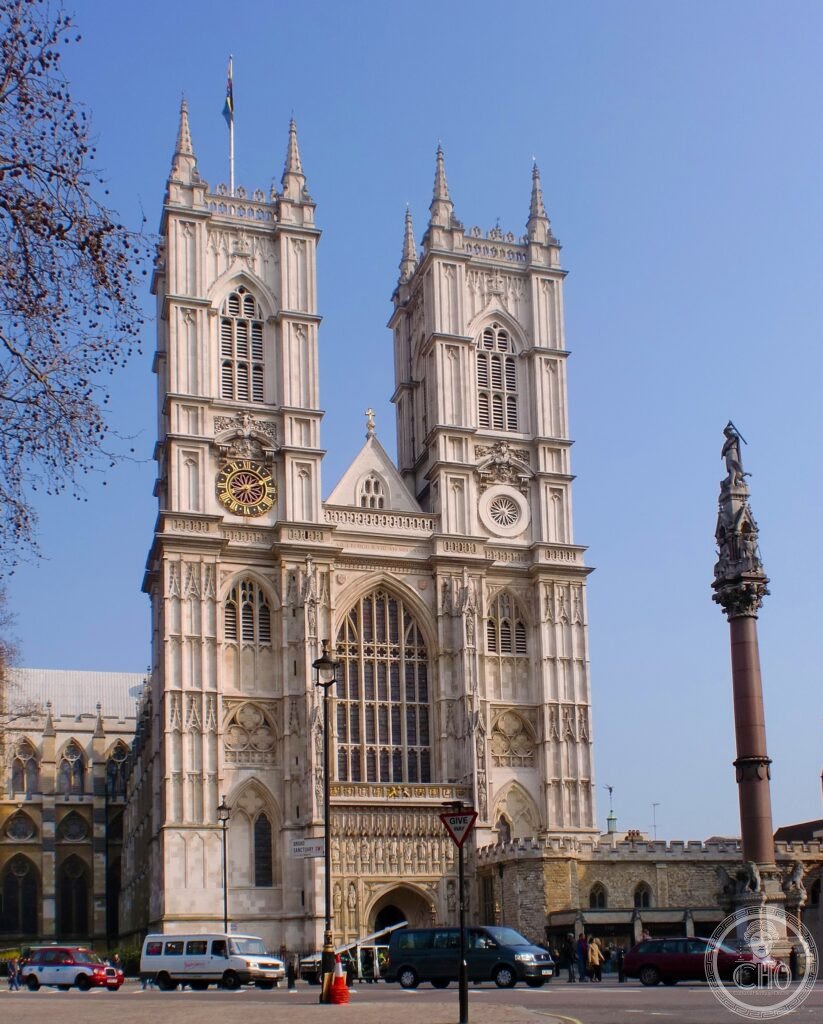
Westminster Abbey has crowned every English and British monarch since 1066 and holds more than 3,300 burials and memorials, from medieval kings to the poets of Poets’ Corner. Part royal chapel, part national mausoleum, it remains a working church at the centre of state ceremony.
At a glance
Westminster Abbey is at once a place of worship, a royal mausoleum, a national memorial to writers and thinkers, and the setting for every English and British coronation since 1066. The present building stands on the site of a church founded by Edward the Confessor, who is buried in the shrine behind the High Altar, and was largely rebuilt by Henry III from 1245 in the French Gothic style, drawing on the Sainte-Chapelle and Reims Cathedral. Its nave, at 31 metres, is the tallest Gothic nave in England.
Key facts
- Coronations: 39 since William the Conqueror in 1066, most recently Charles III on 6 May 2023.
- Burials and memorials: over 3,300, including monarchs and figures honoured in Poets’ Corner.
- Coronation Chair: made in 1297 for Edward I, used at every coronation since 1308; the Stone of Scone was placed beneath it from 1296, returned to Scotland in 1996 and brought back for the 2023 coronation.
- Henry VII Lady Chapel: built 1503–1519 by John Wastell, noted for its fan-vaulted ceiling with pendant bosses.
- West towers: designed by Nicholas Hawksmoor and completed in 1745, standing 68.5 metres.
- Heritage status: inscribed on the UNESCO World Heritage List in 1987 together with the Palace of Westminster and St Margaret’s Church.
History
A church stood on this site under Edward the Confessor, who rebuilt it in the mid-eleventh century and is buried in the shrine behind the High Altar. William the Conqueror was crowned here on Christmas Day 1066, a coronation said to have been so loudly acclaimed that the Norman guards outside, hearing the shouting, feared a riot and set fire to nearby houses.
Henry III demolished the Confessor’s church in 1245 and rebuilt it in the French Gothic style, giving the Abbey the tallest Gothic nave in England. Henry VIII dissolved it as a monastery in 1540 but preserved the church itself, and it was briefly re-established as a Benedictine monastery under Mary I between 1553 and 1556. Today it holds the status of a Royal Peculiar, meaning it falls outside diocesan jurisdiction and answers directly to the Crown rather than to a bishop. The Abbey was inscribed as a UNESCO World Heritage Site in 1987, jointly with the Palace of Westminster and St Margaret’s Church.
What you see
Visitors enter from the north door, reached via Dean’s Yard, and follow a route through the 31-metre Gothic nave and the tomb trail of English monarchs. This runs from the shrine of Edward the Confessor, stripped of its gemstones at the Reformation, past the tomb of Henry V, who died in 1422 shortly after Agincourt, to the Henry VII Lady Chapel, where Elizabeth I and Mary Queen of Scots lie buried some ten metres apart.
The Lady Chapel itself, built between 1503 and 1519, is known for its fan vaulting, with conical stone pendants, each weighing around two tonnes, appearing to hang from the ceiling by geometry alone. Henry VII and Elizabeth of York are buried here. In the south transept, Poets’ Corner has grown since Geoffrey Chaucer’s burial in 1400 into a memorial cluster for British literary figures including Spenser, Jonson, Dryden, Johnson, Byron, Keats, Tennyson, Dickens and Hardy, among others; Jane Austen is commemorated elsewhere and is in fact buried at Winchester Cathedral.
Practical information
- Entry: via the north door from Dean’s Yard; admission is charged, and current prices and opening times are best checked on the Abbey’s official website.
- Royal Peculiar: the Abbey is not part of a diocese and is administered directly under the Crown.
- Photography and services: the Abbey remains a working church, so visiting hours and access can vary around services and state occasions; check ahead of a visit.
Getting there
The Abbey is reached by the London Underground District or Circle lines to Westminster station, or the District, Circle or Jubilee lines to St James’s Park. It is also a short walk, around ten minutes, from Victoria station, which is served by National Rail and the Underground. The Houses of Parliament and St James’s Park are both within a few minutes’ walk.
Nearby
- Palace of Westminster — a short walk away; co-inscribed with the Abbey on the 1987 UNESCO listing, with Gothic Revival interiors by Charles Barry and Augustus Pugin and the Elizabeth Tower, whose bell is popularly known as Big Ben.
- St Margaret’s Church — adjoining the Abbey; the church of the House of Commons, where Samuel Pepys was married and Sir Walter Raleigh is buried.
- Buckingham Palace — around a ten-minute walk west, along the Mall towards Trafalgar Square, and the site of the Changing of the Guard.
- Tower of London — reachable by District line to Tower Hill or by river from Westminster Pier; home to the Crown Jewels and the eleventh-century White Tower, and itself a UNESCO World Heritage Site inscribed in 1988.
Sources
- Wikipedia, Westminster Abbey
- Wikipedia, Coronation of the British monarch
- Wikipedia, Poets’ Corner
- UNESCO, Palace of Westminster, Westminster Abbey and Saint Margaret’s Church, WHS reference 426
- Richard Jenkyns, Westminster Abbey, Harvard University Press, 2004
Find it on the map
See this place and what’s around it →
Events here — now on & upcoming
- Anniversary: C.S. Lewis Commemorated in Poets' Corner — November 2222 Nov 2027See the event →
- Anniversary: The Coronation of Queen Elizabeth II — June 2, 195302 Jun 2027See the event →
📷 Become a Cultural Heritage Online photographer
Share your photos of places: they stay published under your name as the author. The more they're seen, the more you get noticed — and soon a contest will reward the most appreciated photos.
Log in or sign up free to add a photoIs this page about you?
This page is read by travellers and heritage enthusiasts who find it on Google. Tell us how you are connected to this place and we will take it from there.