
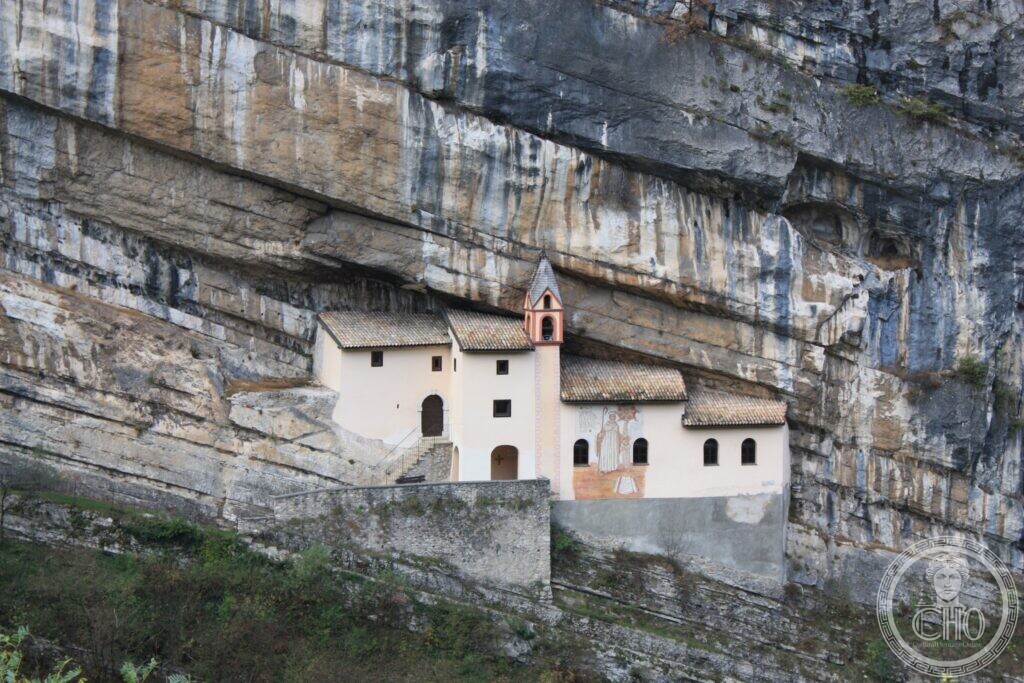
An inscription cut in the stone beside the bell-gable gives the year 753. From then until 1782 someone lived here, halfway up a cliff above a torrent, in caves a church was later built against.
At a glance
The Eremo di San Colombano stands in the municipality of Trambileno, a few kilometres from Rovereto, built onto a ledge in the rock wall of the gorge cut by the Leno di Vallarsa. It is reached on foot: a footbridge over the torrent, then 102 steps cut into the rock. It takes its name from Columban, the Irish monk (543–615) whose monastery at Bobbio, in the Apennines, is where the first hermit here is thought to have come from.
Key facts
- 753: the year cut into the stone beside the bell-gable, taken as the first hermit settlement; earlier occupation is not ruled out
- Late 10th – early 11th century: a small church built at the mouth of the cave, under the overhang
- 1319: the first documents naming the church of San Colombano — a bequest signed by Count Guglielmo di Castelbarco
- 1782: hermit life ends, abolished under Joseph II; the valley then looked after the place
- 1996: the Autonomous Province of Trento has the church refurbished, chiefly inside
- Access: on foot — a footbridge over the Leno and 102 rock-cut steps
- GPS: 45.8781, 11.0617 · Open in Google Maps (OpenStreetMap)
History
The oldest trace here is not a document but a cut in the stone: an inscription beside the bell-gable gives the year 753, and it is read as the date a hermit first took to the natural grottoes in the rock face. L’Adige notes that an earlier presence is not excluded; the hermit is thought to have come from the monastery of Bobbio, founded by Columban himself. Between the end of the tenth century and the beginning of the eleventh a small church was raised at the mouth of the cave, against the overhanging rock that still roofs it.
The first written records come much later. The earliest documents that name the church of San Colombano are of 1319 and record a bequest signed by Count Guglielmo di Castelbarco; Visit Trentino gives 1319 instead as the year the hermitage was built. Monks devoted to the Irish saint kept what was then called the Grotta dell’Eremita until 1782, when the secularising policy of Joseph II of Habsburg abolished the hermitage. After that it was the people of the valley who kept it, and in 1996 the Autonomous Province of Trento had the church restored, mostly within.
The site was closed again for works for three years and reopened to the public on 14 August 2026. The Province had announced the funding in 2021, around half a million euro, handed to the Comune di Trambileno for the stairs, the services, the plaster and a railing on the access bridge.
What you see
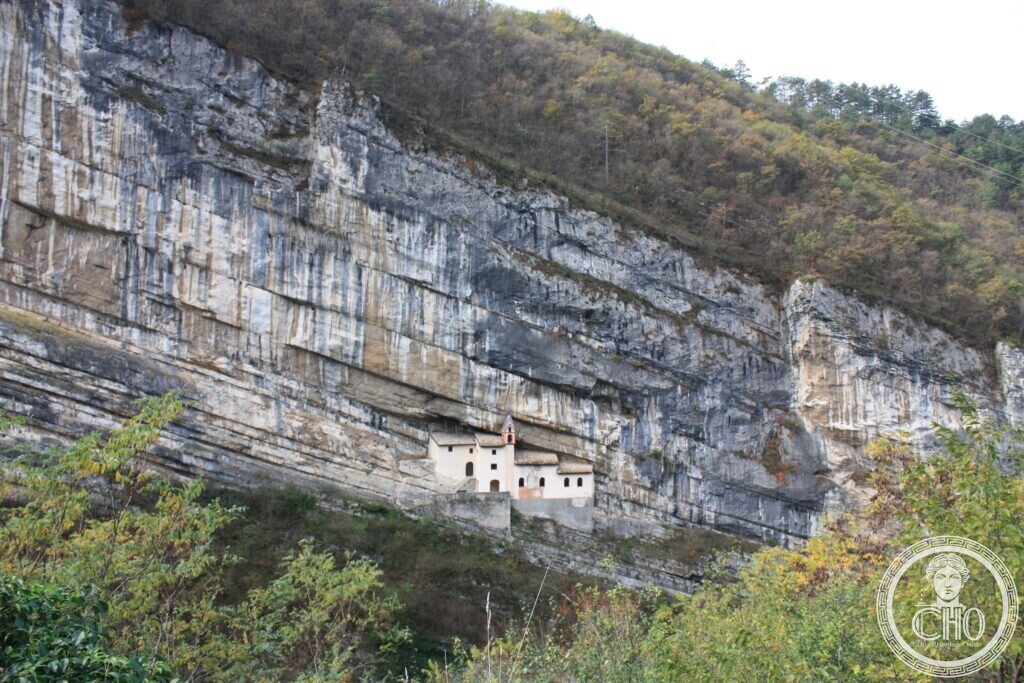
From the valley floor the building reads as a white line pressed under a grey one: a few whitewashed volumes with shallow tiled roofs, set on a built-up terrace, with the rock strata running diagonally above and below them. The bell-gable is picked out in red. On the wall of the lower block there is a painted figure of the saint. Inside, the frescoes include the struggle between Columban and the dragon and a representation of Paradise; the main altar holds a fifteenth-century Madonna with Saints, and the walls carry the graffiti of prayers left by pilgrims, and ex-votos.
The dragon
Tradition says Columban took the cave after killing a dragon that lived in it and poisoned the water of the Leno. It is a legend, not a record, and it is also the subject of one of the frescoes inside: the story and its painting are part of what the place is, which is not the same as saying it happened. At Christmas a torchlit procession climbs to the hermitage, followed by Mass.
Nearby
- Rovereto — a few kilometres down the valley
- Rovereto Castle and the Italian Historical War Museum
Gallery
Sources
- Visit Trentino (Trentino Marketing, Autonomous Province of Trento), Eremo di San Colombano: the 102 rock-cut steps, the hermit from 753 probably from Bobbio, the small church of the late 10th–early 11th century, 1319, the end of hermit life in 1782, the refurbishment of 1996, the frescoes of the dragon and of Paradise, the fifteenth-century Madonna with Saints, the pilgrims’ graffiti and ex-votos, the Christmas procession
- l’Adige, San Colombano, un eremo che è un gioiello (February 2021): the inscription of 753 beside the bell-gable and the caution that an earlier settlement is not excluded, the documents of 1319 and Guglielmo di Castelbarco, the Grotta dell’Eremita kept until 1782 and abolished by Joseph II, the last works of 1996, and the half million euro from the Province to the Comune di Trambileno
- l’Adige, Trambileno, riapre l’Eremo di San Colombano: the reopening of 14 August 2026 after three years of works
Find it on the map
See this place and what’s around it →📷 Become a Cultural Heritage Online photographer
Share your photos of places: they stay published under your name as the author. The more they're seen, the more you get noticed — and soon a contest will reward the most appreciated photos.
Log in or sign up free to add a photo