
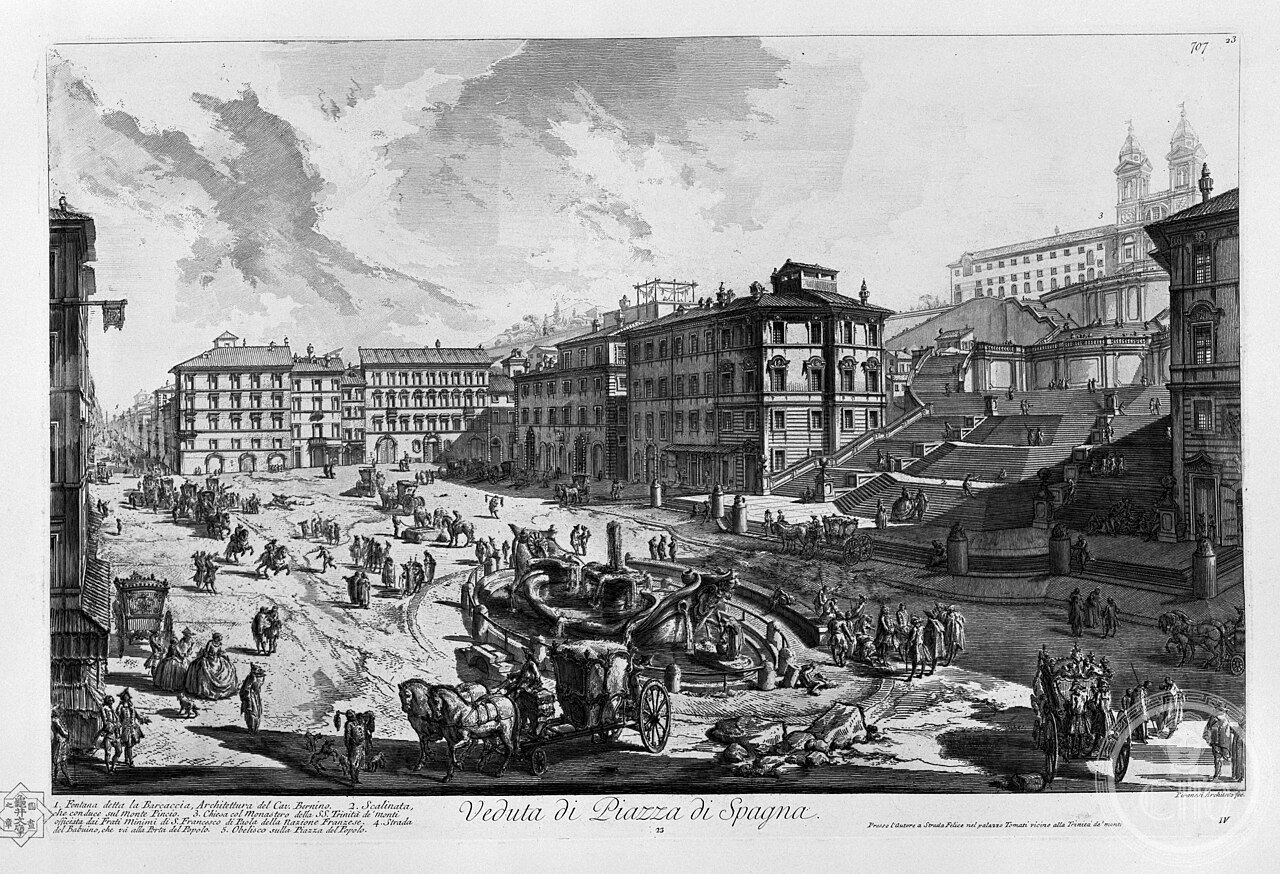
Spanish Steps
One of Rome’s most celebrated squares, the Spanish Steps centers on the Baroque Barcaccia fountain and hosts an annual papal floral tribute to the Immaculate Conception, a tradition rooted in 19th-century Catholic devotion.
At a glance
Piazza di Spagna takes its name from the Spanish embassy to the Holy See, housed in the palace overlooking the square. The plaza became a focal point of Roman life, drawing poets, visitors, and the faithful across four centuries.
History
The square was known as Piazza di Francia in the seventeenth century before acquiring its current name. The Barcaccia fountain, sculpted by Pietro Bernini and his son Gian Lorenzo Bernini, dates to the early Baroque period and anchors the piazza’s center. John Keats, the English Romantic poet, lived and died at the right corner of the staircase in 1821; his residence became a museum dedicated to his memory and that of Percy Bysshe Shelley. Babington’s Tea Room, still operating, was founded in 1893 on the left corner. The Column of the Immaculate Conception, designed by Bernini (with a side façade by Borromini), was erected following the dogma’s proclamation at the behest of King Ferdinand II of the Two Sicilies and inaugurated on December 8, 1857.
What you see
The Barcaccia fountain displays early Baroque sculptural refinement in its travertine basin and allegorical figures. Palazzo di Propaganda Fide showcases Bernini’s restrained elegance on one façade, contrasted by Borromini’s more dynamic architectural treatment on the side elevation. The Column of the Immaculate Conception rises as a marble monument topped by a gilded bronze statue. The surrounding palaces and buildings frame one of Rome’s most harmonious urban spaces.
Cultural significance
The square embodies the intersection of ecclesiastical power, artistic patronage, and international diplomacy. Since 1923, the Vigili del Fuoco (Rome’s firefighters) have offered an acrobatic floral tribute to the Immaculate Conception statue. The papal presence at this ceremony became established tradition under John XXIII in 1958 and continues with all popes, accompanied by a Marian prayer. Cesare Pavese immortalized the square in the poem “I will pass from piazza di Spagna,” with the text reproduced on a plaque near Babington’s.
Key facts
- Address: Piazza di Spagna, 00187 Rome
- Coordinates: 41.905938201454205, 12.482078075408936
- Official website: http://www.turismoroma.it/cosa-fare/piazza-di-spagna
- Phone: 06 0608
Practical information
The piazza is open year-round. The annual Immaculate Conception floral tribute typically occurs on December 8. Hours for the Keats-Shelley Museum and Babington’s Tea Room should be verified directly with each establishment.
Getting there
Spanish Steps is located in central Rome’s historic district. The Spagna metro station (Line A) provides direct access. The site is within walking distance of many major monuments and accessible via public transportation and taxi services.
Sources & resources
Find it on the map
See this place and what’s around it →Historical events at this place (1)
📷 Diventa un fotografo di Cultural Heritage Online
Condividi le tue foto dei luoghi: restano pubblicate con la tua firma come autore. Più vengono viste, più ti fai conoscere — e presto un concorso premierà le foto più apprezzate.
Accedi o registrati gratis per aggiungere una foto