
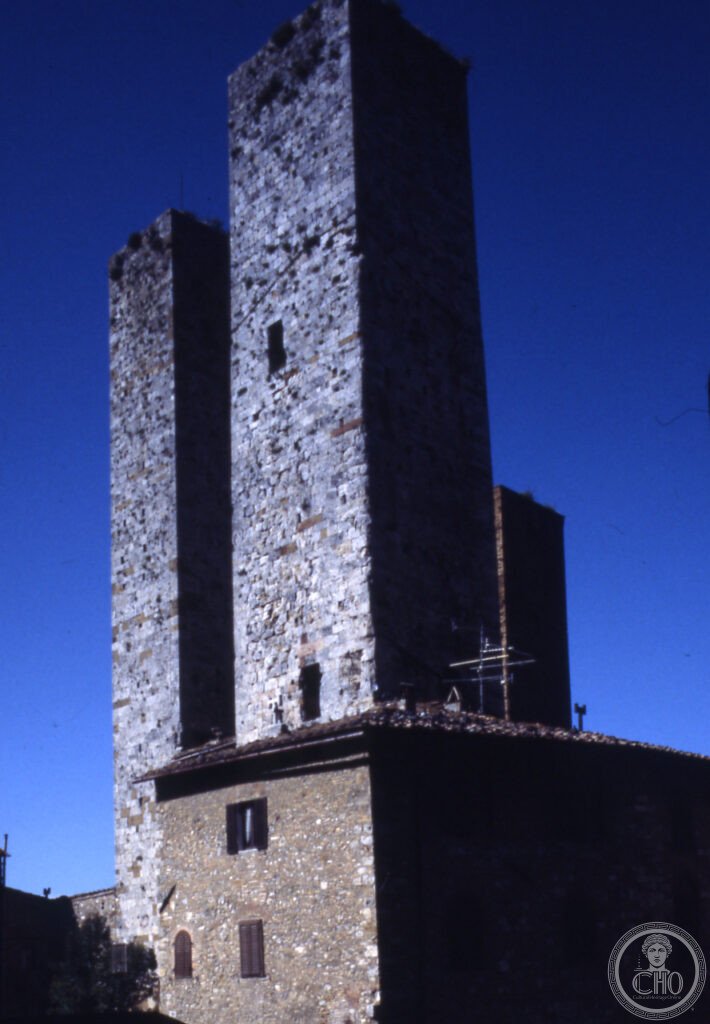
San Gimignano
The “Manhattan of the Middle Ages” and the most dramatic medieval skyline in Italy — San Gimignano (Siena Province, Tuscany; UNESCO WHS 1990) is a hilltop town of 7,900 inhabitants whose 14 surviving medieval tower-houses (of 72 originally built; the tallest 54m) create the most recognisable silhouette of any walled Italian hill town, preserve the only intact medieval urban skyline in Tuscany, and shelter one of the finest fresco cycles of the Italian Renaissance inside the Collegiata church.
At a glance
San Gimignano (the most precisely SanGimignanoItaly single Siena Province Tuscany Italy Val d Elsa valley 56 km Florence 38 km Siena walled hilltop medieval town 7900 inhabitants municipality 14 surviving towers of 72 originally built 12th 13th century CE tower houses skyscraper race noble families Torre Rognosa first public tower 51m 1200 CE law no private tower taller than Rognosa Torre Grossa 54m tallest tower 1311 CE Palazzo del Popolo municipal tower exceeded own height law 14 towers 2 main piazzas Piazza della Cisterna triangular piazza Piazza del Duomo Collegiata church UNESCO WHS 1990 Via Francigena pilgrimage route Canterbury Rome medieval pilgrimage route passed through San Gimignano Vernaccia di San Gimignano white wine DOCG first Italian DOC wine 1966 most ancient documented white wine Tuscany UNESCO heritage in any UNESCO world heritage site)).
Key facts
- The medieval tower race of San Gimignano (why 72 families tried to build the tallest tower in a small Tuscan hill town): the tower-building competition of San Gimignano (12th-13th century CE) was a form of stone arms race among the rival noble families (the Guelph-Ghibelline factional conflict between pro-Pope and pro-Emperor factions; within this, local family rivalries between the Ardinghelli (Guelph) and Salvucci (Ghibelline) lineages were expressed through tower height); the towers served three purposes: (1) military (the upper floors could be used to fire on rivals below, and the towers functioned as urban forts during factional street fights); (2) economic (the towers were used for cloth-dyeing and silk production, as the height created wind-drying conditions for fabrics — an economic origin usually overlooked); (3) social status (the taller the tower, the higher the family’s prestige, power, and marriage market value); the Torre Rognosa (51m; the public municipal tower, 1200 CE) passed an ordinance prohibiting any private tower from exceeding its height; the Palazzo del Popolo tower (54m; built as the new municipal tower in 1311 CE) promptly exceeded that height, essentially cancelling the law; the Florentine Republic absorbed San Gimignano in 1353 CE and systematically demolished most of the towers to prevent the local noble families from rebuilding their power bases
- GPS: 43.4677° N, 11.0431° E
History
From Etruscan settlement to medieval commune to Florentine subject to Tuscan hill-town (the most precisely SanGimignanoItaly single Etruscan traces area 3rd century BCE 994 CE first documented mention San Genesio early name bishop Volterra 11th 12th century CE commune period independent city state commune road Franchigena Via Francigena Canterbury Rome pilgrimage route passed through San Gimignano major stop between Siena and Lucca pilgrims 10th 14th century CE major commercial pilgrims souvenirs saffron trade San Gimignano saffron most valuable in Europe 12th 13th century CE tower building peak 72 towers built rival families 1250 1260 CE population peak 13000 inhabitants 1348 CE Black Death plague killed 55% population 1353 CE Florence absorbed San Gimignano Florentine Republic subject city towers systematically demolished except few allowed to stand as trophy monuments Florentines keeping symbol of conquest 14th 16th century CE gradual decline Via Francigena traffic declined alternative routes opened pilgrimage declined commerce declined 16th century CE population 3000 1800s CE agricultural town 19th 20th century CE rediscovery Grand Tour tourism began early 20th century CE 1990 CE UNESCO heritage: Via Francigena and the medieval pilgrimage economy that made San Gimignano wealthy (how Canterbury to Rome built 72 towers): the Via Francigena (the road from Canterbury, England to Rome; first systematically documented by Archbishop Sigeric of Canterbury in 990 CE after his journey to Rome to collect his pallium from the Pope) was one of the three great medieval pilgrimage routes (Santiago de Compostela in Spain; Jerusalem via the Crusader ports; Rome via the Via Francigena); San Gimignano was a major stop on the Via Francigena between Siena (50 km south) and Lucca (40 km north); medieval pilgrim traffic brought: inn income, money-changing income, souvenir income (lead pilgrim badges, votive candles), medical income (pilgrim hospitals — the Misericordia of San Gimignano (12th century CE) was one of the oldest hospitals on the Via Francigena route); and the saffron trade: San Gimignano produced saffron (Crocus sativus) in the surrounding fields that was considered among the finest quality in Europe and was sold to passing merchants and pilgrims; the combination of pilgrimage income and saffron trade wealth funded the tower-building competition)) — the most precisely SanGimignanoItaly single 994 CE first documented Via Francigena 990 CE Sigeric Canterbury Rome major pilgrim stop 11th 14th century CE tower building race 72 towers peak 1250 1260 CE 13000 inhabitants 1348 CE Black Death 55% killed 1353 CE Florence absorbed systematically demolished towers 14 surviving 1990 CE UNESCO heritage in any UNESCO world heritage site)).
What you see
The towers, the Collegiata frescoes, and the saffron-coloured hilltop (the most precisely SanGimignanoItaly single 14 towers visible from hilltop approach Torre Grossa 54m tallest accessible tower climb 218 steps Palazzo del Popolo interior Civic Museum collection good medieval Sienese painting view from top panoramic Val d Elsa Colleggiata church Santa Maria Assunta exterior Romanesque plain exterior interior covered frescoes 3 major fresco cycles best in any small Tuscan church Ghirlandaio cycle Santa Fina Chapel 1475 CE Domenico Ghirlandaio early work before Rome Sistine Chapel commission remarkable marble tabernacle Benedetto da Maiano 1475 CE gilded terracotta bust of the young Saint Fina Bartolo di Fredi Old Testament Nave frescoes 1367 CE 38 scenes Old Testament Adam and Eve Noah Job remarkable early 14th century CE quality Barna da Siena New Testament frescoes 1350 1381 CE opposite wall 26 New Testament scenes Barna da Siena died falling from scaffolding 1381 CE while painting this cycle Piazza della Cisterna central triangular piazza original 13th century CE well Cisterna 1273 CE travertine octagonal well medieval paving irregular medieval pattern medieval urban space Piazza del Duomo second piazza adjacent Colleggiata church baptistery towers Museum Medieval Modern Art MAMOSI 2 towers visible from exterior Vernaccia di San Gimignano DOC 1966 first Italian DOC wine white wine local DOCG now San Gimignano saffron production still active local farms UNESCO heritage: the Sant’Agostino church and Benozzo Gozzoli’s 17-panel fresco cycle (the unvisited masterpiece of San Gimignano): most visitors to San Gimignano visit the Collegiata (as they should) but skip the Augustinian church of Sant’Agostino at the north end of the town; inside Sant’Agostino, the apse is covered by a 17-panel fresco cycle depicting the Life of Saint Augustine (1463-1467 CE; Benozzo Gozzoli (1420-1497 CE); the full-height apse decoration covers approximately 120m² of fresco; Benozzo Gozzoli was the most important Florentine fresco painter of the 1450s-1470s, trained by Fra Angelico and Ghiberti; his earlier work — the Three Magi procession in the Palazzo Medici-Riccardi chapel (1459-1461 CE) in Florence — is considered his masterpiece, but the San Gimignano Augustine cycle is comparable in quality and entirely accessible without a crowd in 2026)) — the most precisely SanGimignanoItaly single 14 towers Torre Grossa 54m 218 steps Palazzo Popolo Civic Museum Ghirlandaio Santa Fina 1475 CE early Bartolo Fredi 38 Old Testament 1367 CE Barna da Siena New Testament 26 scenes died falling scaffold 1381 CE Piazza Cisterna 1273 well Vernaccia DOC 1966 first Italian DOC Sant Agostino Benozzo Gozzoli 17 panels 1463 1467 120m2 apse uncrowded masterpiece UNESCO heritage in any UNESCO world heritage site)).
Practical information
- Getting there: from Florence: bus from Florence Autostazione (SITA bus; 1h15m; €7 each way; every 30-60 min; to Poggibonsi then change for San Gimignano 25 min; or direct bus in summer); or rent a car from Florence (56 km; 1h; the most efficient as it allows visiting Volterra and the Chianti wine region in the same trip); from Siena: bus (1h15m; €5; every hour); the walled town (free entry; the town is small — the main circuit is walkable in 30-40 min); the Collegiata (€5.50; open 10 AM-5 PM Mon-Sat, 12:30-5 PM Sun; essential; the interior frescoes are the best reason to be in San Gimignano besides the towers); Torre Grossa (€9; included with Collegiata ticket if combined; 218 steps; 30 min; best view of the town and towers); Sant’Agostino church (free entry; open 7 AM-noon and 3-7 PM daily; the Gozzoli Augustine cycle rarely has more than 5-10 visitors at any time — a stark contrast with the Collegiata’s crowds); best time (October-April: the town is quieter and the light on the towers is particularly beautiful in autumn afternoon; July-August: peak crowding — San Gimignano receives 5 million tourists/year in a town of 7,900 inhabitants; the main piazzas can be shoulder-to-shoulder in summer afternoons))
Getting there
From Florence: bus 1h15m (€7) or car 56 km. From Siena: bus 1h15m (€5). Walled town free. Collegiata €5.50 (essential). Torre Grossa €9. Sant’Agostino free (Gozzoli Augustine cycle, uncrowded masterpiece). Best: October-April. GPS: 43.4677, 11.0431.
Nearby
- Volterra — 30 km south-west (the Etruscan hilltop city with the best-preserved pre-Roman city walls in Tuscany (3rd-4th century BCE Etruscan walls, 7 km circuit, several gates intact); the Porta all’Arco (Etruscan arch gate, 3rd century BCE; the oldest and largest surviving Etruscan arch; the faces of three deities carved on the voussoirs); the Museo Etrusco Guarnacci (the largest collection of Etruscan funerary urns in the world; 600+ alabaster and terracotta urns; the Ombra della Sera (the “Shadow of the Evening”; elongated bronze figure ca. 3rd century BCE; uncannily similar to Giacometti’s 20th-century sculptures — the work that convinced Giacometti he wasn’t being original))
- Siena — 38 km south (UNESCO WHS 1995; the most beautiful preserved medieval city in Italy; the Piazza del Campo (the shell-shaped sloping piazza; the setting of the Palio horse race (July 2 and August 16 each year; the most intense civic competition in Europe)); the Cathedral (the finest Gothic cathedral in Italy by most measures; the pavement (56 marble intarsia panels; the finest inlaid marble floor programme in any medieval building in the world; uncovered only August 18-October 27 each year)); the Palazzo Pubblico (the political heart of medieval Siena; the Ambrogio Lorenzetti frescoes (the “Allegory of Good and Bad Government”, 1338-1339 CE — the first secular political fresco programme in Western art)))
Sources
- Wikipedia, San Gimignano; Collegiata di Santa Maria Assunta, San Gimignano; Benozzo Gozzoli; Via Francigena, accessed June 2026
- UNESCO, Historic Centre of San Gimignano, WHS reference 550, inscribed 1990
Find it on the map
See this place and what’s around it →📷 Diventa un fotografo di Cultural Heritage Online
Condividi le tue foto dei luoghi: restano pubblicate con la tua firma come autore. Più vengono viste, più ti fai conoscere — e presto un concorso premierà le foto più apprezzate.
Accedi o registrati gratis per aggiungere una foto