
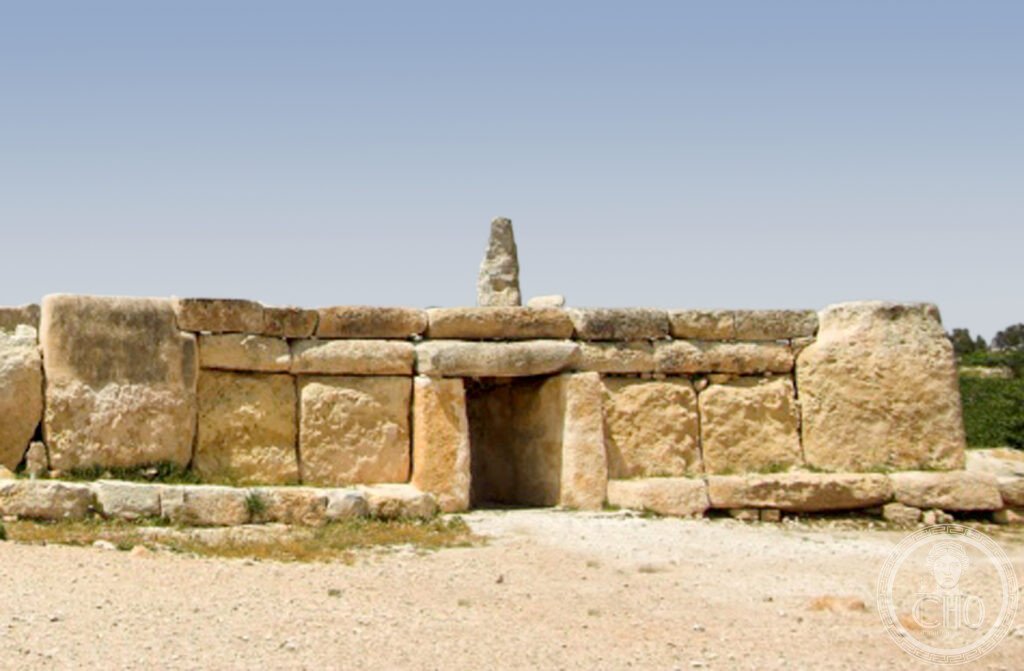
Seven stone temple complexes built on Malta and Gozo before Stonehenge or the Great Pyramid existed, raised by a Neolithic people who then vanished leaving no trace in the cultures that followed. Their honey-coloured limestone chambers, solar alignments and carved reliefs remain largely as they were left.
At a glance
The Megalithic Temples of Malta are a group of seven prehistoric stone complexes built on Malta and Gozo between roughly 3600 and 2500 BCE, making them among the oldest free-standing stone structures known. The most visited are Ħaġar Qim and Mnajdra in southern Malta, Tarxien on the edge of Valletta’s suburbs, and Ġgantija on Gozo. Ġgantija was inscribed as a UNESCO World Heritage Site in 1980; the listing was extended in 1992 to cover all seven temples across the two islands.
Key facts
- Location: Ħaġar Qim and Mnajdra in southern Malta; Tarxien near Valletta; Ġgantija on Gozo.
- Date of construction: approximately 3600-2500 BCE, with construction peaking during the Temple Phase.
- Builders: an unidentified pre-Bronze Age population, sometimes called the Temple People, who arrived in Malta from Sicily around 5200 BCE.
- UNESCO status: Ġgantija inscribed in 1980 (reference 17); the wider Megalithic Temples of Malta listing (reference 132), covering all seven sites, added in 1992.
- Material: Globigerina limestone, which weathers to a warm honey colour.
- Notable feature: a verified solar alignment at Ħaġar Qim and Mnajdra, among the earliest known anywhere.
History
The people who built the temples reached Malta from Sicily around 5200 BCE and, over roughly 2,700 years, developed an increasingly sophisticated tradition of monumental stone building. Early temple phases, associated with sites such as Skorba and Ġgantija, gave way to the full Temple Phase, when Ġgantija, Tarxien, Ħaġar Qim and Mnajdra were all built or elaborated, culminating around 3000 BCE in the highly decorated Tarxien complex.
Around 2500 BCE the temple-building civilisation disappeared abruptly. There is no evidence of gradual decline or transition: the temples were abandoned, and the Bronze Age settlers who arrived afterwards from Sicily show no trace of any knowledge that the structures existed. The prevailing explanation points to overexploitation of the island’s limited resources, including deforestation and soil erosion, compounded by drought. Successive arrivals on Malta over the following millennia, including Phoenicians, Romans, Arabs, Normans, the Knights of Saint John and later British rule, left the temples untouched and apparently forgotten, until their rediscovery in the modern era led to their protection as an archaeological site.
The same culture produced a distinctive body of figurative art, the so-called Fat Lady or Sleeping Lady figurines, carved in limestone and terracotta. More than two hundred survive, ranging from small figures to large seated forms, most missing their heads, which were made detachable. Their gender is ambiguous and their meaning remains uncertain, though they are commonly associated with fertility, death and renewal. The largest known example, the Tarxien Stone Figure, would have stood around 1.5 metres tall; its lower portion survives in place at Tarxien, making it the oldest known colossal human statue still standing in its original ritual setting.
What you see
At Ħaġar Qim, elongated oval chambers built from Globigerina limestone lead through a trilithon porch into a sequence of semicircular apses, a plan repeated with variations across the Maltese temples. Some of the megaliths here weigh up to 57 tonnes, among the largest stones used anywhere in pre-Bronze Age construction. At sunrise on the summer solstice, a disc of light passes through a small round window in the western apse and falls precisely on a carved pitted stone in the opposite chamber, a solar alignment that has been verified by researchers.
Mnajdra lies a short distance downslope from Ħaġar Qim and comprises three temple structures built across the same broad period. Its lower temple is considered the best preserved of all the Maltese temples, with limestone benches and pitted stone decoration still visible on the interior walls. Sunlight entering through different doorways marks both the equinoxes and the solstices, suggesting a considerable degree of astronomical observation built into the design.
Tarxien, set within the modern suburbs a short distance from Valletta, carries the most elaborate decoration of any Maltese temple: spiral carvings, pitted stonework, and relief panels depicting animals including bulls, goats and pigs. A long carved panel showing a running frieze of bulls is among the largest surviving prehistoric carved stone panels in the islands. The lower body of the Tarxien Stone Figure remains here in its original position.
Ġgantija, on Gozo, consists of two temples sharing a single forecourt behind an outer wall that survives in places to a considerable height, regarded as the best-preserved megalithic perimeter wall in the Mediterranean. Since 2009, large fabric shelters designed and built by Heritage Malta have covered Ħaġar Qim and Mnajdra, a response to accelerating erosion of the soft limestone from acid rain, salt spray and ultraviolet exposure; studies had recorded significant surface loss in the decade before the shelters were installed. The change to the sites’ appearance has been contentious among visitors, though it is regarded within the archaeological community as necessary. Transparent panels in the roof allow Mnajdra’s solar alignment to remain observable.
Practical information
- Managing body: the sites are cared for by Heritage Malta, which publishes current visiting arrangements on its official channels.
- Conservation: Ħaġar Qim and Mnajdra are covered by protective fabric shelters installed in 2009; visitors should expect a covered rather than fully open-air setting.
- Museum collections: the original Fat Lady figurines and related finds are held at the National Museum of Archaeology in Valletta rather than at the temple sites themselves.
- Solar alignments: the summer solstice alignment at Ħaġar Qim and the equinox and solstice alignments at Mnajdra are best confirmed with Heritage Malta directly before planning a visit around them.
Getting there
Tarxien lies close to Valletta, within its surrounding suburbs. Ħaġar Qim and Mnajdra stand near each other in southern Malta, roughly 200 metres apart. Ġgantija is on the neighbouring island of Gozo and is reached by ferry from Malta, typically via Cirkewwa.
Nearby
- Mnajdra — a short walk from Ħaġar Qim, sharing the same southern Malta setting.
- National Museum of Archaeology, Valletta — holds the surviving Fat Lady figurines and other finds from the temple sites.
- Ġgantija, Gozo — reached by ferry from Malta, the largest of the megalithic complexes.
- Tarxien — set within Valletta’s surrounding suburbs, a short distance from the capital.
Sources
- UNESCO
- Heritage Malta
- National Museum of Archaeology, Valletta
Find it on the map
See this place and what’s around it →📷 Become a Cultural Heritage Online photographer
Share your photos of places: they stay published under your name as the author. The more they're seen, the more you get noticed — and soon a contest will reward the most appreciated photos.
Log in or sign up free to add a photoIs this page about you?
This page is read by travellers and heritage enthusiasts who find it on Google. Tell us how you are connected to this place and we will take it from there.