

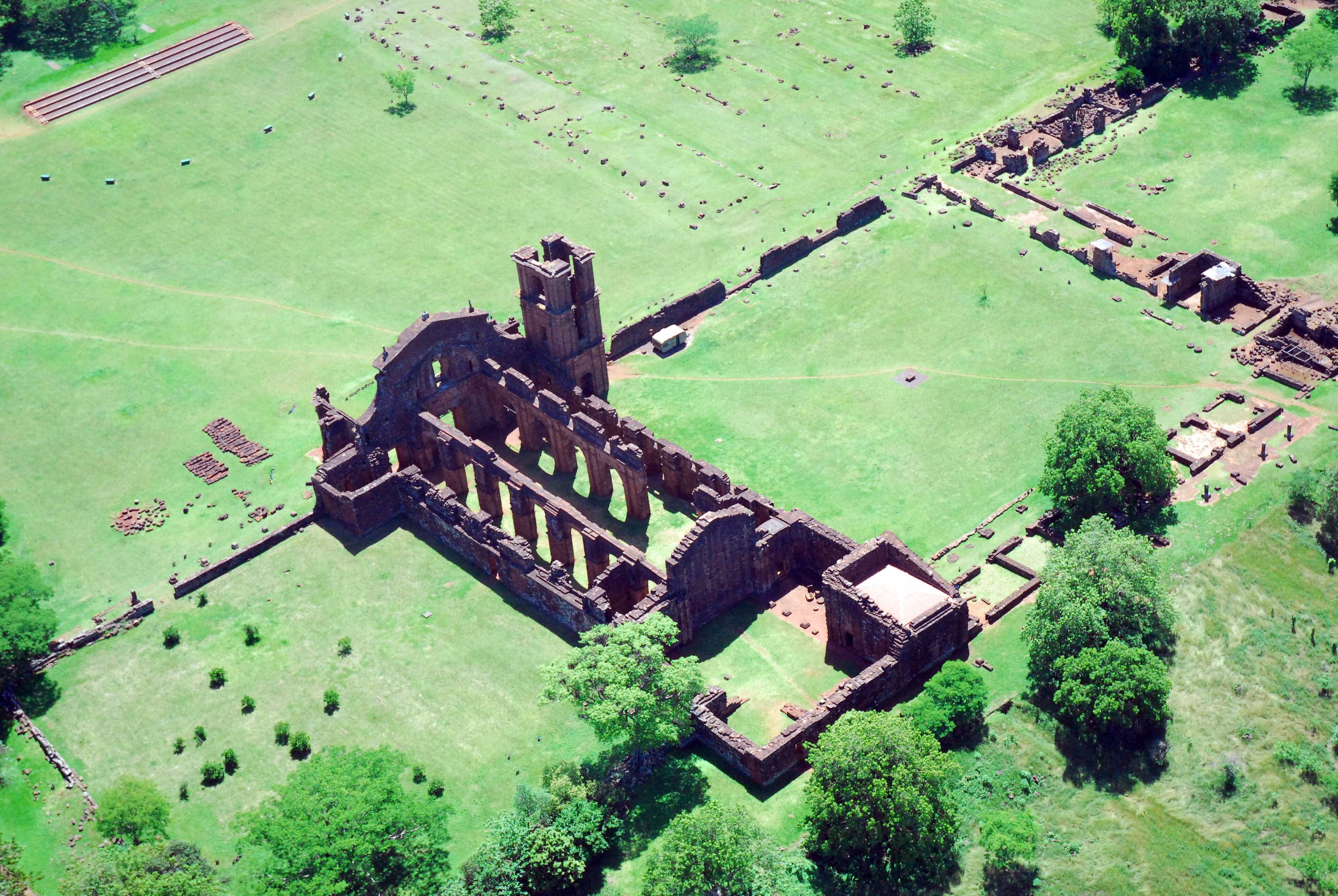
A Jesuit mission in Rio Grande do Sul whose baroque church and adjacent structures stand as testament to 18th-century evangelisation efforts and the synthesis of European and indigenous Guaraní cultures.
At a glance
São Miguel das Missões was established in 1687 as part of an expansive Jesuit programme across South America. The site represents one of the Seven Towns—a network of settlements that shaped the region’s history. Its church, constructed between 1735 and 1750, became one of the most recognisable landmarks in Rio Grande do Sul before the mission’s decline following the Guaraní War of 1756.
History
Founded during Spanish colonial rule, the mission developed into a flourishing centre where European and indigenous elements merged under Christian orientation. The community grew economically prosperous, marked by sophisticated organisation and rich cultural expression. This prosperity proved brief. Political disputes between Portugal and Spain, combined with controversy over Jesuit activities, drew the mission into the Guaraní War. It was burned and depopulated in 1756.
After partial restoration, the settlement lingered under new administration following the Jesuits’ expulsion and the Order’s suppression. Early 19th-century looting and dispersal of inhabitants sealed its fate. Complete abandonment followed until restoration began in 1925, initiating its modern recovery and transformation into a cultural landmark.
What you see
The ruins centre on the baroque church built between 1735 and 1750, whose distinctive stonework survives as the site’s most recognisable element. Adjacent structures reflect the mission’s advanced organisational design—an unusual achievement for its remote location and era. Stone foundations and architectural fragments document the layout of residential and administrative quarters.
Cultural significance
The ruins embody a pivotal moment when Jesuit evangelisation reshaped South American territories and societies. They document the blending of European religious architecture with indigenous labour and cultural contexts—a legacy complicated by colonial power dynamics and spiritual displacement. For Guaraní communities today, the site remains sacred, integral to collective memory and identity. Its church image has become emblematic of Rio Grande do Sul’s heritage.
Key facts
- Location: São Miguel das Missões, Rio Grande do Sul, Brazil
- Coordinates: −28.548°, −54.556°
- Founded: 1687
- Church constructed: 1735–1750
- UNESCO World Heritage Site: 1983 (inscribed alongside four Argentine missions)
- IPHAN listing: 1938 (National Institute of Historic and Artistic Heritage)
- Brazilian Cultural Heritage status: 2015
Practical information & getting there
The site functions as the principal landmark and cultural centre of the municipality. Restoration work has continued since 1925, with ongoing interventions supporting preservation and public engagement. The surrounding city developed around the mission’s construction and remains closely linked to its history. Visit the official heritage information centre on-site for context and guided interpretations.
Sources & resources
Find it on the map
See this place and what’s around it →
📷 Become a Cultural Heritage Online photographer
Share your photos of places: they stay published under your name as the author. The more they're seen, the more you get noticed — and soon a contest will reward the most appreciated photos.
Log in or sign up free to add a photo