
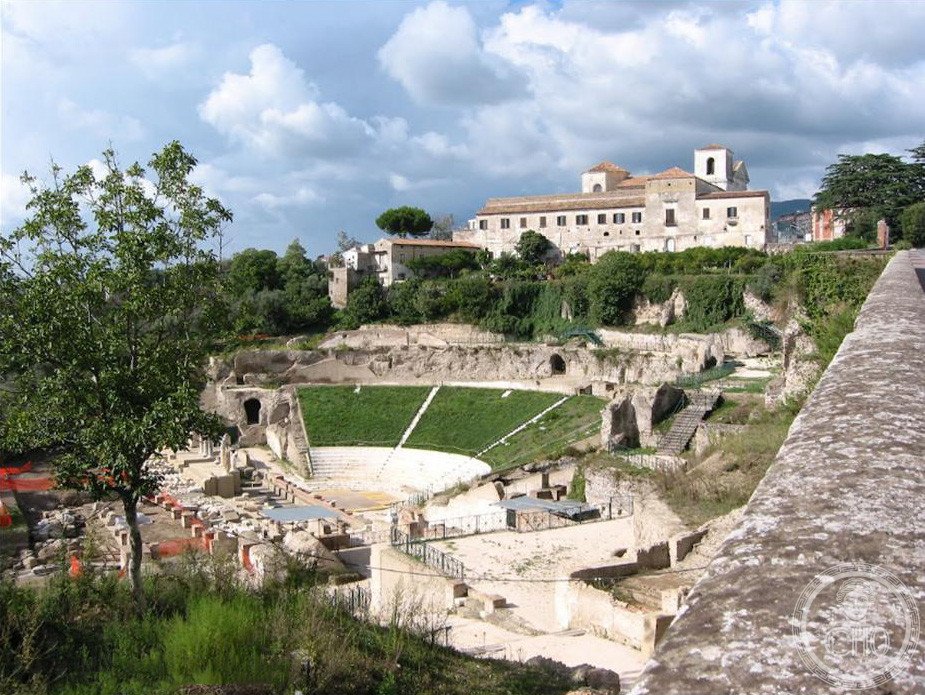
Roman Theater and Cryptoporticus of Sessa Aurunca
A rare Roman theater built to Greek structural principles, the Sessa Aurunca theater reveals the scale and sophistication of an ancient provincial city through its monumental cavea and rich sculptural program.
At a glance
The Roman theater of Sessa Aurunca stands as a testament to the architectural ambitions of the ancient city. Built in the Augustan age near the forum and expanded in the second century AD by Matidia Minore, the structure once accommodated between seven and eight thousand spectators.
History
Archaeological excavations directed by Amedeo Maiuri in the 1920s brought the theater to scholarly attention, though local historians had long recognized its existence and purpose. The building underwent significant expansion during the reign of the Caesars, reaching its fullest development in the second century AD under the patronage of Matidia Minore.
Like many Roman monuments, the theater suffered greatly following the empire’s collapse. Its materials were systematically dismantled and repurposed for medieval construction, including the city’s Cathedral, leaving only foundations and fragments for later recovery.
What you see
The theater’s most distinctive feature is its Greek-influenced design: unlike Italian Roman theaters, much of the cavea rests directly on the natural tuff bedrock rather than on constructed vaults. Recent excavations revealed sections of the media and ima cavea with steps preserved in remarkable condition.
The scaena (stage building) rose approximately twenty meters high, approached by at least two entrances. A monumental staircase on the south side connected to a marble-decorated basilica, while the north entrance consisted of a tunnel carved into the tuff, where a fresco depicting the theater’s tutelary deity was discovered. The building was enriched with varied marble types and an exceptional collection of imperial portrait statues.
Cultural significance
The Sessa theater ranks second in Campania only to the theater in Naples in its original spectator capacity, underscoring the city’s economic and political importance during the empire. The quality and diversity of surviving sculptures—including portraits of Trajan, Hadrian, and Vibia Sabina—document the cultural aspirations of a prosperous Roman community.
The theater’s Greek structural principles in an Italian context reflect the cross-currents of architectural tradition that defined Roman provincial building practices.
Key facts
- Address: Via Aldo Moro, Sessa Aurunca (CE)
- Coordinates: 41.2377089, 13.9316744
- Phone: +39.0823.972130
- Website: https://www.visitsessa.com/?page_id=70
- Admission: Free (booking mandatory)
- Booking email: sba-sa.mondragone@beniculturali.it
Practical information
Admission is free, but advance booking is required. Contact the Archaeological Office of Sessa Aurunca at +39.0823.936455 or the Archaeological Office of Mondragone at +39.0823.972130 to arrange a visit. Booking may also be made via email or fax.
Getting there
The theater is located on Via Aldo Moro in Sessa Aurunca, in the Caserta province of Campania. Details on parking and public transportation access are available through the official website or via telephone booking.
Sources & resources
Find it on the map
See this place and what’s around it →📷 Diventa un fotografo di Cultural Heritage Online
Condividi le tue foto dei luoghi: restano pubblicate con la tua firma come autore. Più vengono viste, più ti fai conoscere — e presto un concorso premierà le foto più apprezzate.
Accedi o registrati gratis per aggiungere una foto