
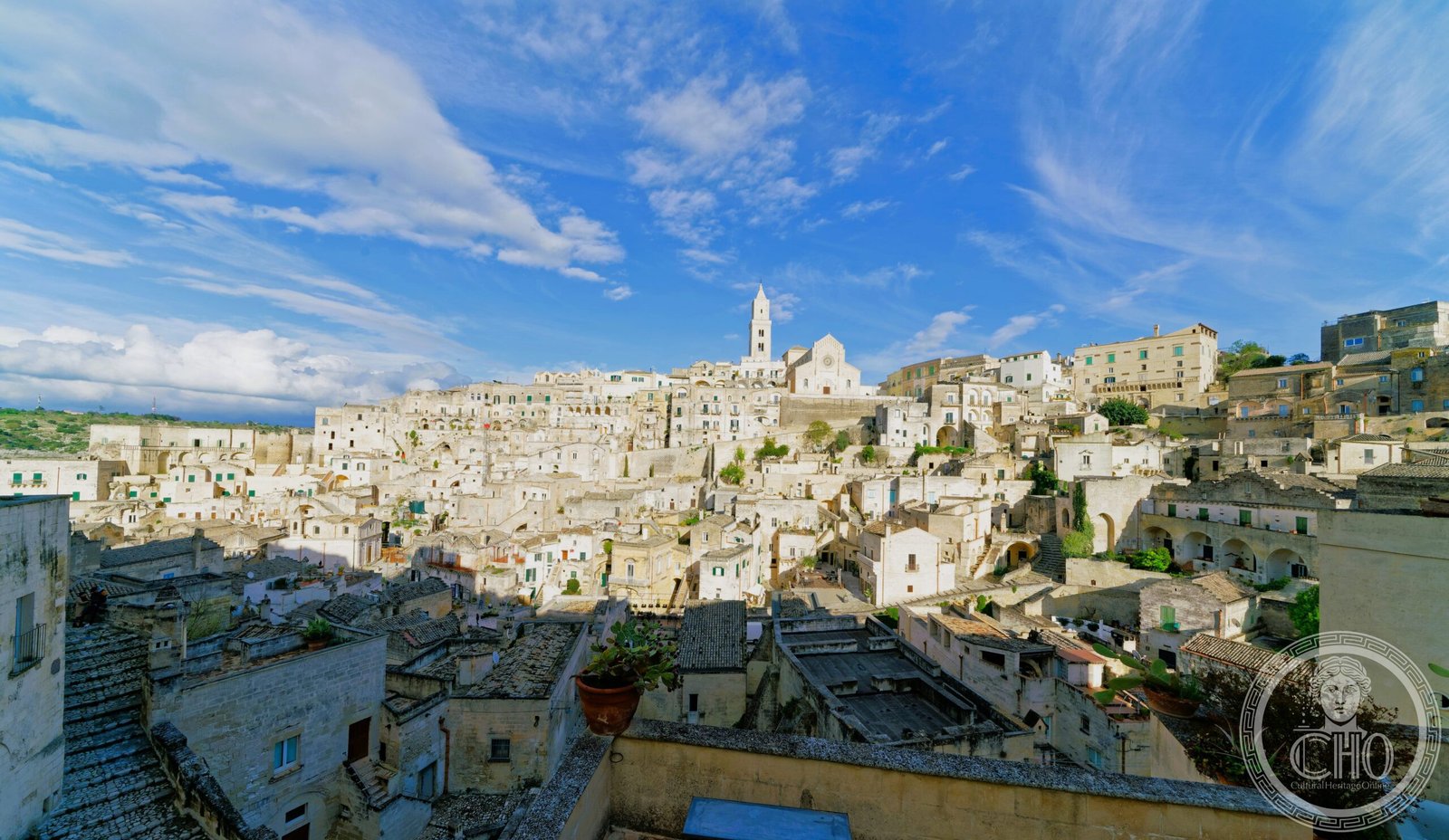
Rock complex of Madonna delle Virtù and San Nicola dei Greci
Two rupestrian churches carved from limestone rock, housing Byzantine and Latin frescoes and serving as spiritual centres for monastic communities fleeing religious persecution across the medieval Mediterranean.
At a glance
This complex comprises two interconnected rock churches in Matera’s ancient Sassi district. The Madonna delle Virtù, built around 1000 with an adjoining monastery, exemplifies “negative” architecture—entirely excavated from stone. Above it stands San Nicola dei Greci, dating to the 10th century and among Matera’s oldest crypts. Both now function as exhibition spaces for contemporary art.
History
The Madonna delle Virtù was founded around the year 1000 alongside a monastery housing nuns from Accon. San Nicola dei Greci, built in the 10th century, represents one of the city’s most ancient monastic foundations. Both churches reflect a broader medieval pattern: small communities of monks and lay believers, displaced from Cappadocia, Armenia, Syria and Asia Minor, sought refuge in these carved sanctuaries when worship became impossible in their homelands. The complex bears witness to Benedictine, Lombard and Byzantine monastic presence. A significant structural modification to Madonna delle Virtù occurred in 1934 during construction of the Sassi road network, which required rearrangement of a side aisle.
What you see
The Madonna delle Virtù displays three naves separated by columns, each terminating in an apse beneath a domed vault inscribed with a cross. The humpbacked ceiling is decorated with bas-relief arches. The central apse contains an eighteenth-century fresco cycle of considerable artistic quality depicting the Crucifixion flanked by the Madonna and San Giovanni.
San Nicola dei Greci comprises two naves with corresponding apses. Its defining feature is an extensive pictorial programme: the apsidal basin holds a fourteenth-century fresco of the Crucifixion with the Madonna and San Giovanni Battista; the left aisle contains a thirteenth- to fourteenth-century triptych of saints. Substantial historical alterations complicate recovery of original architectural details.
Both churches blend Latin and Byzantine architectural and liturgical conventions, reflecting their cosmopolitan patronage and cultural exchange across the medieval eastern Mediterranean.
Cultural significance
These rupestrian churches document the resilience and mobility of medieval religious communities across three continents. They enriched Matera with oriental artistic traditions through Byzantine fresco cycles, while their architectural hybridity—Greek forms with Latin liturgical spaces—testifies to centuries of cultural synthesis. Rock churches like these served contemplative and devotional functions beyond decoration, their frescoes and sculptures guiding prayer and spiritual reflection. Today they preserve evidence of Benedictine, Byzantine and Lombard monastic life and the perseverance of displaced Eastern Christians in the Latin West.
Key facts
- Address: Via Madonna delle Virtù, 75100 Matera
- Coordinates: 40.668399962792876, 16.611247658729553
- Telephone: 0835 319825
- Website: http://www.caveheritage.it
- Madonna delle Virtù founded: c. 1000
- San Nicola dei Greci founded: c. 10th century
Practical information
Both churches operate as exhibition venues for contemporary art installations. Current opening hours and exhibition schedules are available through the official website. Visitors should contact the site directly or check online before planning a visit to confirm access and any special arrangements.
Getting there
The complex lies within Matera’s Sassi district, the historic quarter carved into the limestone plateau. Public transport connections and parking information are available through Matera’s municipal tourism office. The site’s location within the UNESCO-listed Sassi allows for exploration of numerous neighbouring rock churches and historical sites.
Sources & resources
Find it on the map
See this place and what’s around it →Historical events at this place (1)
📷 Diventa un fotografo di Cultural Heritage Online
Condividi le tue foto dei luoghi: restano pubblicate con la tua firma come autore. Più vengono viste, più ti fai conoscere — e presto un concorso premierà le foto più apprezzate.
Accedi o registrati gratis per aggiungere una foto