

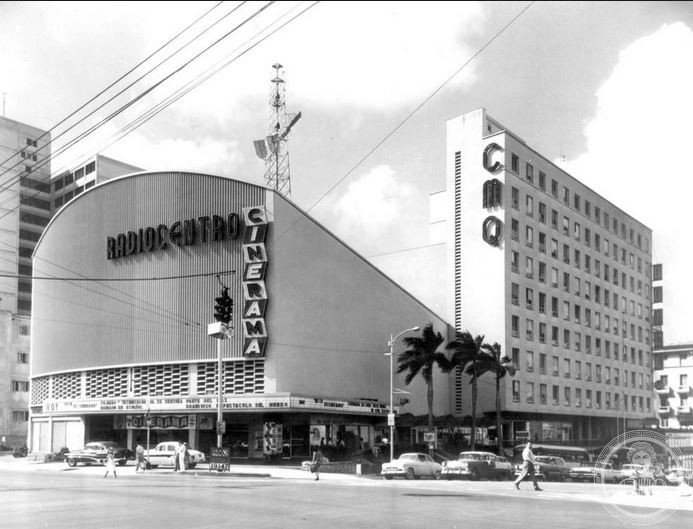
The Radiocentro CMQ Building, completed in 1947 in the Vedado neighbourhood of Havana, Cuba, stands as a landmark of mid-twentieth-century modernist architecture in Latin America. Designed by architects Martín Domínguez Esteban, Miguel Gastón, and Emilio del Junco, it was hailed as the first mixed-use building in Cuba, combining a cinema, commercial spaces, offices, and broadcast studios within a single ten-storey steel-frame complex. Loosely inspired by Rockefeller Center in New York, the structure addressed the challenging topography of La Rampa with a composition of independent modular boxes. It housed the legendary CMQ Radio and served as a recording hub for RCA Victor in Cuba, featuring artists such as Celia Cruz and Beny Moré. Today the building operates as the headquarters of the Cuban Institute of Radio and Television and continues to welcome visitors as the Yara Cinema.
At a glance
- Type
- Mixed-use modernist complex — cinema, offices, broadcast studios
- Period
- Completed 1947; theater inaugurated 23 December 1947
- Style
- Modernist with Art Déco influences
- Location
- 363 Calle L (at La Rampa), El Vedado, Havana, Cuba
- Coordinates
- 23.1400° N, 82.3833° W
- Architect(s)
- Martín Domínguez Esteban, Miguel Gastón, Emilio del Junco
Overview
Rising ten storeys above the bustling intersection of Calle L and La Rampa in Vedado, the Radiocentro CMQ Building was a transformative presence in Havana urban life from the moment it opened. Totalling over 21,800 square metres of floor area, it united a 1,700-seat Cinerama cinema, ground-floor retail and banking, restaurant spaces, and upper-level rental offices with the broadcast facilities of CMQ, one of Cuba’s most powerful radio networks. The complex was engineered by Purdy and Henderson and has stood for nearly eight decades as a reference point for modern Cuban architecture, influencing projects including the Hotel Habana Libre and the FOCSA Building nearby.
History
Construction of the Radiocentro CMQ Building began in the mid-1940s, driven by the ambitions of broadcasting entrepreneurs Goar and Abel Mestre, who sought a prestige headquarters for their CMQ radio empire. The theater wing opened on 23 December 1947, quickly becoming a cultural venue for Havana society. From 1948 to 1959, Studio Number 2 served as the principal RCA Victor recording studio in Cuba, capturing performances by artists including Celia Cruz and Beny Moré. The complex gained international attention in 1949 when Walter Gropius visited and cited it as a model of collaborative architecture. On 13 March 1957, during the failed assassination attempt against President Batista, student leader José Antonio Echeverría seized Radio Reloj within the building and broadcast a three-minute anti-Batista address before being killed in his escape. After the 1959 Revolution the building was nationalised and repurposed as headquarters for the Cuban Institute of Radio and Television.
Architecture & Design
The Radiocentro CMQ Building was conceived as Cuba’s first genuinely mixed-use urban complex, loosely modelled on Raymond Hood’s Rockefeller Center in New York. Domínguez Esteban, Gastón, and del Junco resolved the site’s steep La Rampa gradient by arranging independent modular boxes at different levels, creating a dynamic streetscape. The steel frame and concrete structure reaches 35 metres (115 feet) in height across ten stories, with a ground area of over 6,250 square metres. The cinema was originally configured for Cinerama, employing three projectors and a curved 25-foot-radius screen with capacity for 1,700 spectators. Glazed commercial frontages at street level encouraged pedestrian flow past exhibitions, cafeterias, and banking halls. The restrained, horizontal banding of the facade exemplifies the shift from ornate Art Déco towards the cleaner Modernist vocabulary then gaining ground across Latin America.
Cultural significance
Few buildings in Havana concentrate as many layers of twentieth-century Cuban culture as the Radiocentro CMQ Building. It was the birthplace of La Tremenda Corte, a radio comedy that broadcast over 360 episodes between 1947 and 1961 and achieved continent-wide fame. In July 1967 the complex hosted El Salón de Mayo, an international exhibition that brought Paris’s Salon de Mai movement to the Americas, with contributions from Pablo Picasso, Joan Miró, and Wifredo Lam; their artworks were reproduced as 180 integral colour granite mosaics still embedded in the surrounding Calle L and Calle 23 pavements. The building’s role in the 1957 anti-Batista broadcast cemented its place in Cuban revolutionary memory. Today the Yara Cinema — its successor — remains one of Havana’s most frequented cultural institutions.
Visiting today
The Yara Cinema, housed in the original theater wing, operates regular film screenings and is among the most accessible cultural venues in Havana for international visitors. The building’s ground-floor commercial spaces along La Rampa remain active. The exterior granite mosaics created for El Salón de Mayo can be observed freely along the adjacent pavements of Calle L and Calle 23. The ICRT offices occupy the upper floors and are not open to the public. Visitors are advised to check local listings for current Yara Cinema programme, as schedules change frequently.
Getting there
The Radiocentro CMQ Building sits at the corner of Calle L and La Rampa (Calle 23) in El Vedado, one of Havana’s most walkable districts. It is approximately 2.5 kilometres from the historic centre of Havana Vieja and is reachable on foot along the Malecón or by taxi. Several Havana Bus Tour (HabanaCity) routes serve the Vedado area, with stops near Coppelia Park a short walk away. Private taxis and classic car taxis are readily available throughout the city.
Sources & resources
Find it on the map
See this place and what’s around it →Record researched and written by Luigi De Marchi for Cultural Heritage Online, 2026.
📷 Become a Cultural Heritage Online photographer
Share your photos of places: they stay published under your name as the author. The more they're seen, the more you get noticed — and soon a contest will reward the most appreciated photos.
Log in or sign up free to add a photoIs this page about you?
This page is read by travellers and heritage enthusiasts who find it on Google. Tell us how you are connected to this place and we will take it from there.