
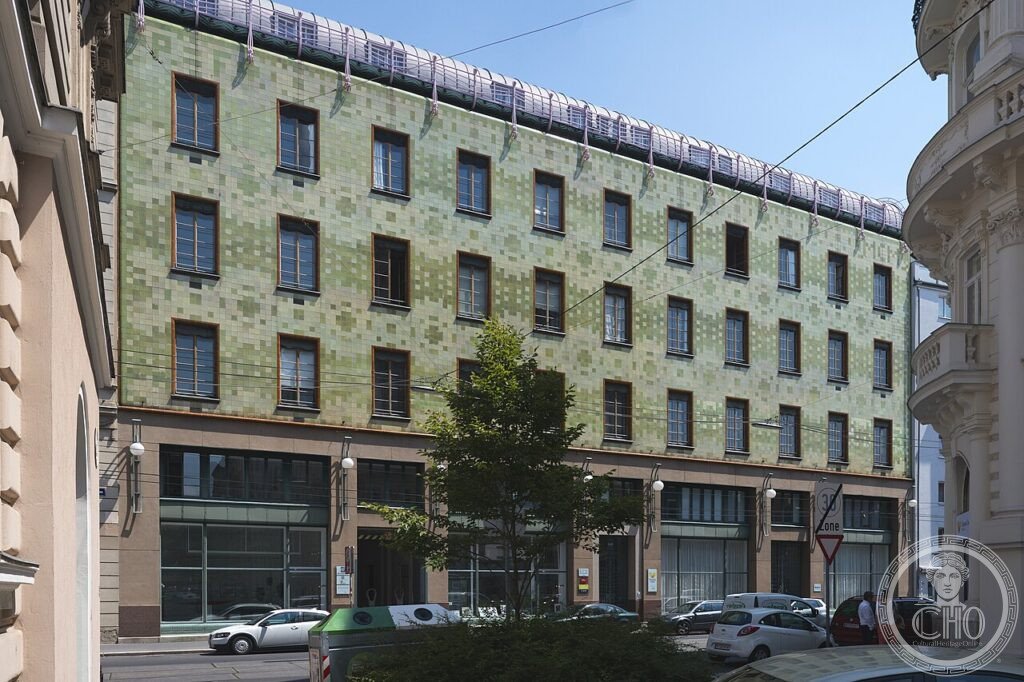

A facade of plain glazed tiles, laid in a uniform grid with no ornament: in the Vienna of 1900 that was enough to cause a scandal — and to make the young Max Fabiani’s name.
At a glance
At Ungargasse 59–61 in the third district stands the headquarters Max Fabiani built between 1897 and 1901 for Portois & Fix, the furniture makers and interior decorators of the Austro-Hungarian elite. Its street front dispensed with the sculpted ornament every commercial palace was expected to wear and offered instead a taut skin of uniform glazed tiles — a move so radical that contemporaries treated it as a provocation. Today the building reads as one of the earliest statements of Viennese proto-modernism, a bridge between the Secession and the sobriety to come.
Key facts
- Built: 1897–1901
- Architect: Max Fabiani
- Client: Portois & Fix, furniture makers and interior decorators (founded 1881 by Anton Fix and August Portois)
- Facade: Uniform glazed tiles laid without ornament — a contemporary scandal
- Address: Ungargasse 59–61, Vienna 3
- GPS: 48.1976, 16.3874 — View on Google Maps
History
Portois & Fix furnished the Ringstraße era: from 1881 the partnership of the Viennese upholsterer Anton Fix and the French-born furniture maker August Portois equipped apartments, palaces and hotels for the imperial court, the aristocracy and the industrial rich, with branches from London to Bombay and, at its height, some 700 employees. The firm collaborated with the leading designers of the Wiener Moderne — executing work for Otto Wagner, Koloman Moser and Josef Hoffmann, and later for the Wiener Werkstätte — so when it commissioned its own headquarters, it went to the avant-garde. Fabiani’s building served as company seat through the firm’s golden years; the company itself faded after the empire’s collapse, but the building has remained one of the textbook exhibits of early modern Vienna.
What you see
The facade’s force lies in its refusal. Glazed tiles in muted green-brown tones cover the upper storeys in an even grid, every tile identical, the pattern generated by the material itself rather than applied to it — ornament replaced by surface. Big workshop windows open the lower floors; discreet Secession touches survive in the metalwork and the attic zone, reminders of the moment of transition. It is a building better understood after visiting Wagner’s Majolikahaus: there the ceramic skin blooms into painted roses; here, three years on, the flowers are gone and the tile grid itself is the statement. The step from one to the other is the story of Viennese architecture between 1899 and 1910.
Practical information
- The building is in commercial use — viewed from Ungargasse
- The tiled facade needs oblique light to show its relief; mid-morning works best on this orientation
- Landstraße is a short detour from the centre — pair it with the Belvedere or the Hundertwasserhaus circuit
Getting there
Ungargasse runs parallel to Landstraßer Hauptstraße in the third district. From the U3/U4 interchange at Landstraße (Wien Mitte), walk south ten minutes; trams on Ungargasse itself stop within two blocks of nos. 59–61.
Nearby
- Artaria-Haus — Fabiani’s marble-clad companion piece on Kohlmarkt
- Majolikahaus — Wagner’s flowering ceramic facade, the term of comparison
- Österreichische Postsparkasse — Wagner’s late masterpiece of clad construction
- Belvedere Palace — the baroque garden palace complex, 15 minutes west
Sources
- German Wikipedia: “Portois & Fix” — company history, 1897–1901 construction, tile facade and scandal
- Wien Geschichte Wiki: “Max Fabiani” — architect biography and works list
- Wikidata Q1590426 — coordinates
Find it on the map
See this place and what’s around it →Record researched and written by Luigi De Marchi for Cultural Heritage Online, 2026.
📷 Become a Cultural Heritage Online photographer
Share your photos of places: they stay published under your name as the author. The more they're seen, the more you get noticed — and soon a contest will reward the most appreciated photos.
Log in or sign up free to add a photoIs this page about you?
This page is read by travellers and heritage enthusiasts who find it on Google. Tell us how you are connected to this place and we will take it from there.