
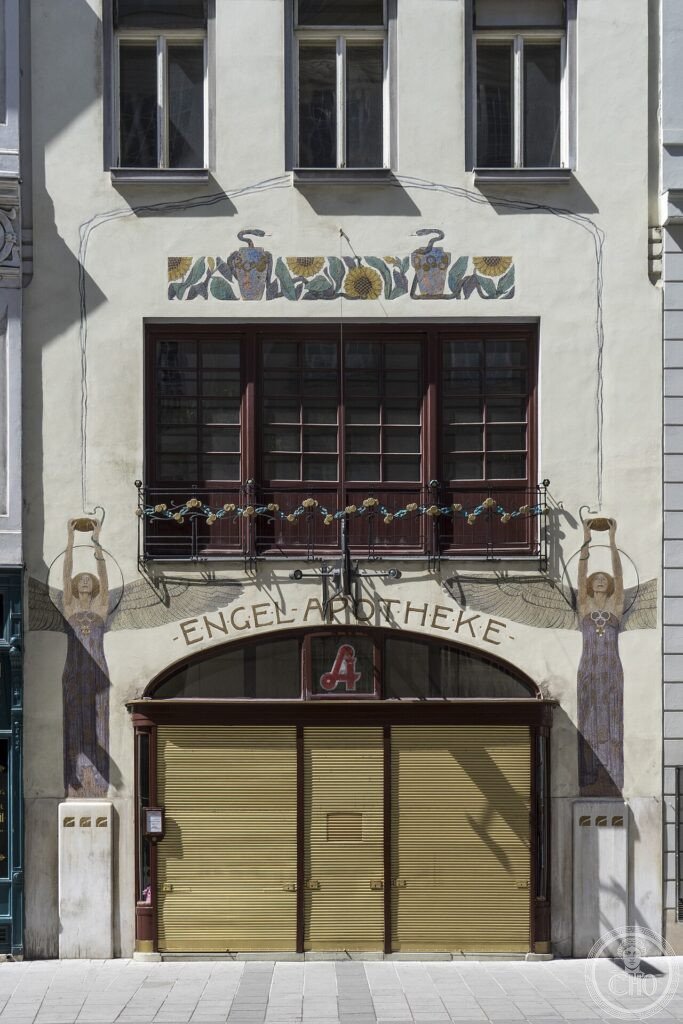

Two golden angels raise their cups over a narrow doorway off the Graben — a pharmacy’s medieval shop sign reborn as one of the most beloved Jugendstil facades in Vienna.
At a glance
The pharmacy “Zum weißen Engel” — At the White Angel — is one of Vienna’s oldest, probably founded around 1440 and documented at the latest by 1568. When its narrow premises at Bognergasse 9 were rebuilt in 1901–1902, the architects Oskar Laske and Viktor Fiala — Laske a pupil of Otto Wagner, later celebrated as a painter — gave the Secession one of its most charming small monuments: a slender facade whose portal is flanked by two mosaic angels in gold, the ancient shop sign translated into Jugendstil. The city’s heritage records single it out as one of the rare cases where a pharmacy sign inspired a whole artistic decoration.
Key facts
- Rebuilt: 1901–1902
- Architects: Oskar Laske and Viktor Fiala
- Pharmacy institution: Probably founded c. 1440; documented at the latest 1568
- Signature feature: Twin golden angel mosaics flanking the portal, designed by Laske
- Style: Viennese Secession (Jugendstil), figurative register
- Address: Bognergasse 9, Vienna 1
- GPS: 48.210269, 16.36788 — View on Google Maps
History
Vienna’s pharmacies carried medieval house signs the way inns did, and the white angel of Bognergasse had marked a dispensary for over four centuries when the property was rebuilt at the height of the Secession. Oskar Laske, twenty-seven and fresh from Wagner’s school, designed the new house with Viktor Fiala on the cramped Bognergasse parcel and made the angel the theme: two elongated figures in glittering gold mosaic, wings folded, raising cups — the attribute of healing. Laske would soon abandon building for painting, becoming one of Austria’s most original painters of city life; the Engel-Apotheke remains his architectural calling card. The facade has been restored and stands under protection; the ground-floor premises have continued in commercial use, with the mosaics as the street’s fixed point.
What you see
The building is narrow — a single bay pinched between neighbours — and Laske used the constraint. The upper facade rises in quiet Secession geometry with glazing bars and subtle mouldings; all the intensity concentrates at street level, where the two angel mosaics fill the spandrels beside and above the entrance arch. The figures are drawn with the elongated elegance of the Klimt generation, their gold grounds answering the shop lettering; between them, the arch frames the portal like an altar niche. It is a two-minute monument — but few facades in the city repay those two minutes so richly, and the golden surfaces respond to every change of light.
Practical information
- The facade is viewed from Bognergasse at any time; the mosaics are at eye level and photograph easily
- Gold ground means glare in direct sun — overcast light or late afternoon works best
- Thirty seconds from the Graben: combine with the Kohlmarkt and Hoher Markt Secession circuit
Getting there
Bognergasse branches off the Graben near its western end. From Stephansplatz (U1/U3), walk the length of the Graben and turn right just before Kohlmarkt; the angels appear on the left after fifty metres.
Nearby
- Artaria-Haus — Fabiani’s marble-skinned building on Kohlmarkt, two minutes away
- Anker Clock — Franz Matsch’s musical bridge-clock at Hoher Markt, five minutes north
- Zacherlhaus — Plečnik’s granite office palace on Brandstätte
- Peterskirche — the baroque dome across the Graben
Sources
- Wien Geschichte Wiki: “Zum weißen Engel (Apotheke)” — foundation dates, 1901–02 rebuild, Laske & Fiala, mosaic and sign tradition
- jugendstilwien.at — facade description and context
- Wikidata Q620532 — coordinates
Find it on the map
See this place and what’s around it →Record researched and written by Luigi De Marchi for Cultural Heritage Online, 2026.
📷 Become a Cultural Heritage Online photographer
Share your photos of places: they stay published under your name as the author. The more they're seen, the more you get noticed — and soon a contest will reward the most appreciated photos.
Log in or sign up free to add a photoIs this page about you?
This page is read by travellers and heritage enthusiasts who find it on Google. Tell us how you are connected to this place and we will take it from there.