
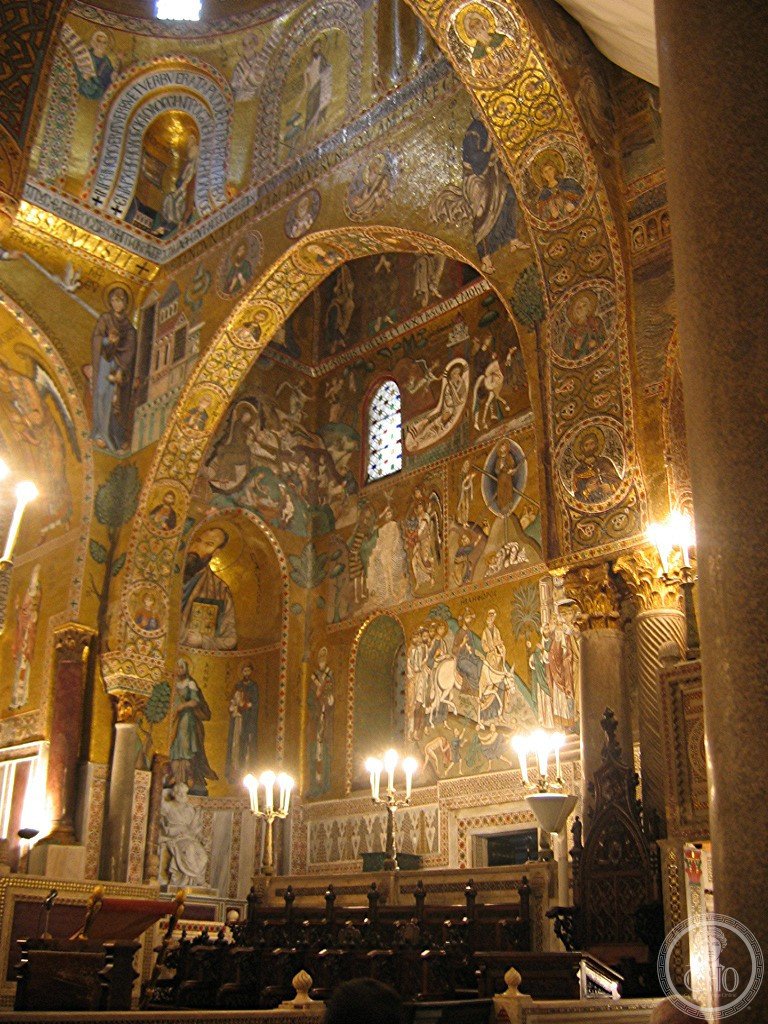
Palermo Arabo-Normanna
Palermo Arabo-Normanna (UNESCO 2015, rif. 1487) è la più completa espressione architettonica della fusione tra cultura islamica, bizantina e normanna del XII secolo CE — 9 monumenti a Palermo (Cappella Palatina 1132 CE, La Martorana 1143 CE, San Cataldo 1161 CE) più le cattedrali di Cefalù (1131 CE) e Monreale (1174 CE): il tutto costruito da Ruggero II e dai suoi successori in meno di 60 anni.
At a glance
Palermo arabo-normanna Sicilia (the most precisely Palermo arabo-normanna zone Palermo Sicilia Italy 38.1157 N 13.3615 E UNESCO WHS 2015 reference 1487 Arab-Norman Palermo and the Cathedral Churches of Cefalù and Monreale: the site (9 monuments in Palermo + Cathedral of Cefalù + Cathedral of Monreale: the group inscribed as a single UNESCO site because of the stylistic unity of the “Sicilian Norman” art and architecture of the 12th century CE; the Norman Kingdom of Sicily (the “Regnum Siciliae”: 1130–1194 CE): the most culturally diverse kingdom of medieval Europe: the Normans (Roger I arrived in Sicily 1061 CE; the conquest was completed 1072 CE) governed a population of: (1) Muslim Arabs (who had ruled Sicily 827–1072 CE): the Arab population in 1072 CE was approximately 200,000 (the majority in western Sicily; the Muslims maintained their mosques, their qadis (judges), their schools, and their Arabic language until 1220 CE when Frederick II expelled the remaining Muslims to Lucera, Puglia); (2) Byzantine Greeks (who had ruled Sicily until 827 CE; the Greek population of 1072 CE: approximately 150,000, mainly in eastern Sicily; the Greek language was the administrative language of the courts and churches until 1130 CE); (3) Lombard and Norman settlers: approximately 50,000 by 1100 CE; the cultural synthesis (the key fact of the Norman Kingdom: the Norman rulers were Northern French by origin (the De Hauteville family from Coutances, Normandy) who chose to govern in 3 languages simultaneously (Arabic for the Muslim population, Greek for the Byzantine population, Latin for the Church): this trilingual governance created the unique artistic hybrid visible in the 9 UNESCO monuments).
Key facts
- La Cappella Palatina: perché il soffitto a stalattiti mussulmane sopra la navata cristiana con mosaici bizantini è il monumento più emblematico della sintesi arabo-normanna: the Cappella Palatina (the Palatine Chapel of Palermo (Palazzo dei Normanni; Piazza del Parlamento 1; €15 with Palazzo dei Normanni; open Mon–Sat 8:15–17:40, Sun 8:15–13:00): built 1132–1140 CE by Roger II (the dedication: January 28, 1132 CE, the feast of Saint Peter; Roger II was present with 3 bishops and an Arab court official who wrote the description in Arabic); the architectural synthesis (the Cappella Palatina is a 3-nave basilica in the Latin style (length 33 m; nave width 13 m; apse height 12 m) with: (1) a Byzantine mosaic program (the mosaics: completed 1143 CE; the technique: Byzantine gold-ground mosaic (the background: 24-carat gold-leaf on glass (the “tesserae auratae”: each gold tessera = a piece of glass 8–15 mm × 8–15 mm with a 0.1 mm gold leaf sandwiched between 2 layers of glass; the gold-glass technique: invented in 3rd century BCE Egypt; perfected in 4th century CE Constantinople); the scenes: the 4 Evangelists (nave pendentives); the Christ Pantocrator in the apse (3.8 m diameter); the Life of Saints Peter and Paul (south nave) + the Life of Christ (north nave) + the Life of Roger II (the royal mantle in the south nave)); (2) a Fatimid muqarnas ceiling (the stalactite ceiling of the central nave: the muqarnas (Arabic: stalactite ceiling): the most important element of the Cappella Palatina; the muqarnas ceiling dimensions: 36 m length × 7 m width; the number of individual stalactite “cells”: 1,512 cells; the painted program of the muqarnas ceiling: each of the 1,512 cells is painted with figures from Arabic poetry and court life: musicians, dancers, acrobats, drinkers, hunters, animals); (3) a Norman Romanesque structure (the Corinthian columns of the nave: 18 marble columns in verde antico (Greek Laconian ophicalcite) and cipollino marble (Greek Euboean cipollino); each column: a spolium from a pre-Norman building in Sicily))
- GPS (Cappella Palatina, Palazzo dei Normanni, Palermo): 38.1157° N, 13.3615° E
History
Da Ruggero II 1130 CE al UNESCO 2015 (the most precisely Palermo arabo-normanna zone history: the Norman conquest (Roger I d’Hauteville (c.1031–1101 CE) began the Norman conquest of Sicily in 1061 CE; the conquest was completed with the fall of the Arab emirate of Palermo in 1072 CE; Palermo population in 1072 CE: approximately 450,000 (the second-largest city in the Mediterranean after Constantinople; larger than Rome, Venice, Paris)); Roger II (Ruggero II (1095–1154 CE): the son of Roger I; King of Sicily from 1130 CE (the first king: Roger I was only a “Count of Sicily”; Roger II was crowned king by Pope Anaclet II in the Cattedrale di Palermo on Christmas Day 1130 CE); the builder (Roger II built 4 of the 9 UNESCO monuments in Palermo: the Cappella Palatina (1132 CE); the Church of San Giovanni degli Eremiti (1136 CE); the Cathedral of Cefalù (1131 CE); the Church of La Martorana (1143 CE, endowed by his admiral George of Antioch)); the policy (Roger II’s famous tolerance policy: the Arab historian Ibn Jubayr (traveled Sicily 1184 CE, 30 years after Roger II’s death) described the Norman court: “The king can speak Arabic, and most of his pages and courtiers are Muslims”; “The king’s cook is a Muslim, his physician is a Muslim, his astrologer is a Muslim, and his seamstresses (who sew the royal robes) are Muslim women who work in a separate wing of the palace”); the end of the Norman Kingdom (1194 CE: Henry VI (Holy Roman Emperor) married Constance, the daughter of Roger II; on Henry VI’s death in 1197 CE their son Frederick II (1194–1250 CE) became king of Sicily: the Sicilian Norman dynasty was replaced by the Swabian Hohenstaufen dynasty); the UNESCO inscription (2015 CE: reference 1487).
What you see
La Cappella Palatina, La Martorana, San Cataldo, la Cattedrale, il mercato del Capo (the most precisely Palermo arabo-normanna zone visit (2 days): Day 1 — the Quattro Canti + Cappella Palatina circuit: the Cappella Palatina (Palazzo dei Normanni: €15; 8:15–17:40 Mon–Sat; the visit lasts 45–90 minutes: the best light for the mosaics: 10:00–13:00 when the morning sun enters from the east windows); the Balcony of Palazzo dei Normanni (the view of Palermo from the 12th century CE Norman palace balcony: the oldest continuously used parliament in the world (the Parliament of Sicily has met in the Palazzo dei Normanni continuously since 1130 CE)); Day 1 afternoon — La Martorana + San Cataldo (Piazza Bellini: the 2 most contrasting Norman churches in Palermo: (1) La Martorana (Santa Maria dell’Ammiraglio: built 1143 CE by George of Antioch (Roger II’s admiral of Greek origin); the Byzantine apse mosaics: the oldest mosaics in Palermo (1143 CE); the mosaic of George of Antioch prostrate at the feet of the Virgin: the only contemporary portrait of a non-royal Norman individual); (2) San Cataldo (1161 CE; William I “the Bad”; the 3 red Arab domes in a row + the blank interior (the mosaics and furnishings were stripped in the 18th century CE: only the geometric floor remains; but the floor = a 12th century CE Opus sectile (cut stone mosaic) in verde antico + porphyry + marble)); Day 2 — Monreale (the Cathedral of Monreale: 8 km from Palermo; bus 389 from Piazza Indipendenza (30 min; €1.40); €5 cathedral + €5 cloister; the gold mosaic program: 6,340 m² of gold-ground mosaics (the largest mosaic cycle in the world after the Hagia Sophia (the 8,000 m² of Constantinople vs the 6,340 m² of Monreale)); the cloister (the 228 paired marble columns with interlace capitals: no 2 columns have the same pattern)).
Practical information
- Come visitare la Cappella Palatina senza fila e come raggiungere Monreale da Palermo in meno di un’ora: il trasporto (Palermo Centrale → Palermo centro: bus 101/102/103 (15 min; €1.40) o a piedi 20 min lungo Via Roma; la Cappella Palatina (prenotazione obbligatoria in luglio-agosto: prenotare su coopculture.it o direttamente su fondazionefedericoII.org; il biglietto combinato Cappella Palatina + Palazzo dei Normanni: €15 (include la Sala dei Venti normanna (XI sec. CE) e la Sala di Ruggero (XII sec. CE: i mosaici a caccia (leoni, pavoni, palme, centauri stilizzati)))); Monreale (bus 389 da Piazza Indipendenza: 30 min; €1.40; frequenza: ogni 30 min dalle 7:30 alle 20:30; la cattedrale apre 8:00–12:30 e 14:30–17:00 dom/festivi 8:00–12:30; il chiostro €5 separato; la combinata cattedrale + chiostro: €8))
Getting there
Palermo Falcone e Borsellino (il Falcone): shuttle Prestia e Comande (45 min, €6.30) o treno Trinacria Express (50 min, €5.90). GPS Cappella Palatina: 38.1157/13.3615. €15 biglietto palazzo+cappella.
Nearby
- Cattedrale di Monreale (UNESCO 2015 rif. 1487 — 6.340 m² mosaici oro) — 8 km (bus 389 da Piazza Indipendenza; 30 min; €1.40; il chiostro con 228 colonne intrecciabili + la cattedrale con il più grande ciclo di mosaici del mondo dopo la Hagia Sophia)
- Valle dei Templi Agrigento (UNESCO 1997 rif. 831 — 7 templi dorici VI-V sec BCE) — 120 km (Trenitalia Palermo–Agrigento 2h; €12; il Tempio della Concordia 440 BCE; il Tempio di Giunone; il Tempio di Eracle)
Gallery
Sources
- Wikipedia, Arab-Norman Palermo; Cappella Palatina; Roger II of Sicily; La Martorana, accessed June 2026
- UNESCO, Arab-Norman Palermo and the Cathedral Churches of Cefalù and Monreale, WHS reference 1487, inscribed 2015
- Ibn Jubayr, Rihlat Ibn Jubayr (Ibn Jubayr’s Travels). 1184 CE (the primary Arab eyewitness account of Norman Palermo)
Find it on the map
See this place and what’s around it →📷 Diventa un fotografo di Cultural Heritage Online
Condividi le tue foto dei luoghi: restano pubblicate con la tua firma come autore. Più vengono viste, più ti fai conoscere — e presto un concorso premierà le foto più apprezzate.
Accedi o registrati gratis per aggiungere una foto