
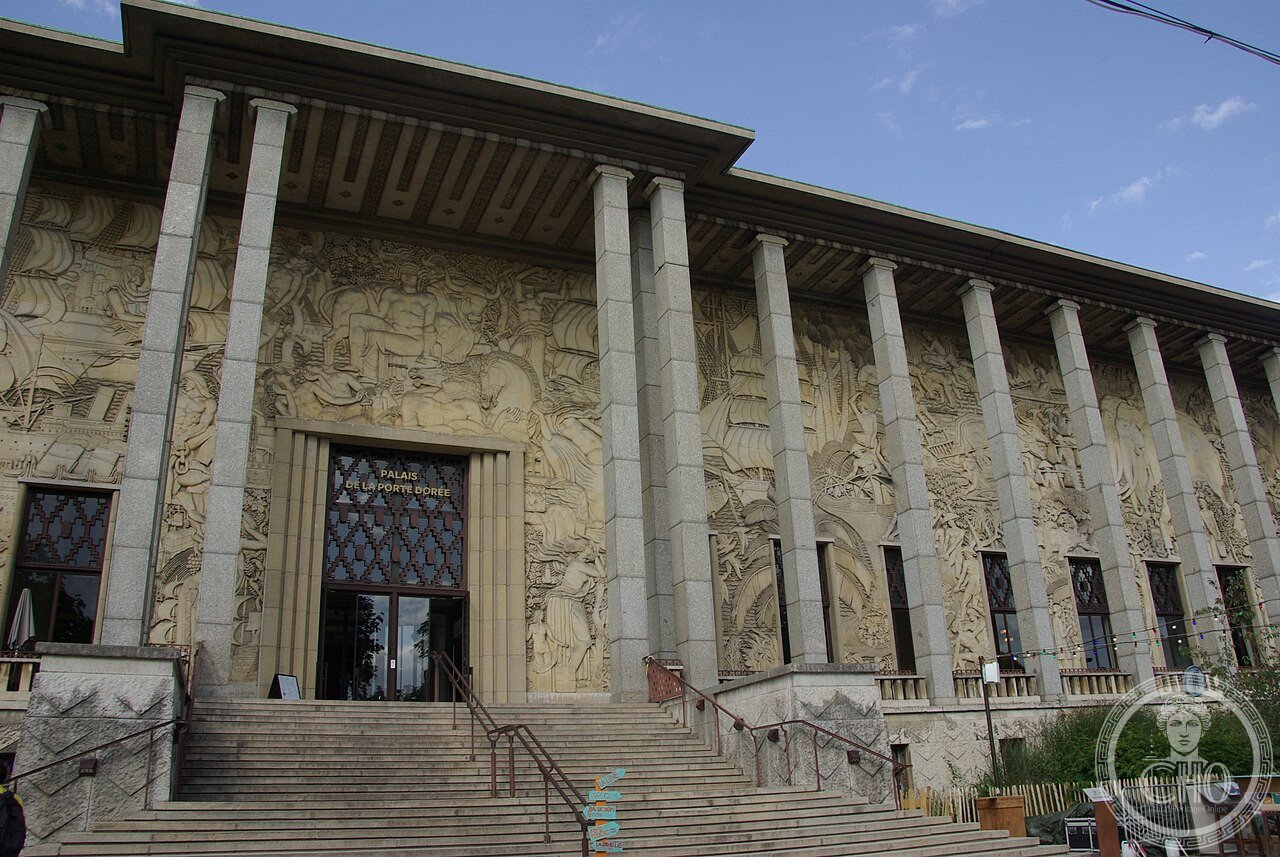
Standing at the eastern edge of the Bois de Vincennes, the Palais de la Porte Dorée is one of the most accomplished Art Deco public buildings in Europe — and one of the most ideologically contested. Built in 1931 as the centrepiece of the Paris Colonial Exposition, it was conceived to glorify France’s overseas empire at its territorial peak. Architects Albert Laprade and Léon Jaussely, together with sculptor Alfred Janniot, created a building whose entire exterior is wrapped in 1,200 square metres of bas-relief depicting ships, oceans, and the fauna of distant territories — a decorative programme as sophisticated as it is, by today’s standards, troubling. Inside, monumental frescoes continued the colonial narrative across vast ceremonial halls. After decades of reinvention, the palace now houses the Musée national de l’histoire de l’immigration, giving its colonial imagery a new and critical frame, while its basement holds one of Paris’s finest tropical aquariums, home to some 5,000 animals.
At a glance
- Type
- Museum / cultural institution
- Period
- Built 1931 for the Paris Colonial Exposition
- Style
- Art Deco
- Location
- 293 Avenue Daumesnil, 12th arrondissement, Paris, France
- Coordinates
- 48.84° N, 2.41° E
- Architect(s)
- Albert Laprade, Léon Jaussely, Léon Bazin
Overview
The Palais de la Porte Dorée occupies a singular place in French cultural memory. Commissioned for the 1931 International Colonial Exposition, the building was designed to be both a triumphal statement and a practical exhibition hall. Its 16,000-square-metre floor plan, wrapped in Alfred Janniot’s extraordinary bas-relief frieze, made it the defining monument of an event that drew eight million visitors. After the Exposition closed, the building passed through several institutional identities — Museum of Overseas France, Museum of African and Oceanic Arts — before its current life as the national museum dedicated to the history of immigration into France, a reframing that speaks directly to the building’s complex colonial origins.
History
The 1931 Colonial Exposition was the culmination of France’s imperial self-presentation; the Palais de la Porte Dorée was its permanent legacy. Designed by Laprade and Jaussely in only two years, the building opened in April 1931 and attracted enormous crowds. After the Exposition, it was renamed the Museum of Overseas France (1935), then the Museum of African and Oceanic Arts (1960). In 2003, its ethnological collections were transferred to the new Musée du Quai Branly, leaving the building empty. The Cité nationale de l’histoire de l’immigration opened here in 2007 (becoming a fully-fledged national museum in 2012), making it the first major French museum dedicated to the history of immigration — a pointed choice of venue given the building’s history of representing colonial subjects.
Architecture & Design
The Palais de la Porte Dorée is a supreme example of French Art Deco applied to civic architecture. The facade’s most remarkable feature is Alfred Janniot’s bas-relief frieze, which covers virtually every surface of the exterior in a continuous sculptural programme depicting French colonial territories: ships, tropical animals, local flora and human figures arranged in dynamic Art Deco compositions. The building’s plan is symmetrical and monumental, with a grand ceremonial entrance leading to a central hall ringed by frescoed salons. The interior woodwork, metalwork and lighting fixtures are intact period pieces of exceptional quality. In the basement, the original tropical aquarium — one of the oldest in France — has been restored and expanded, its Art Deco tanks now housing a globally significant collection of aquatic life.
Cultural significance
The Palais de la Porte Dorée is simultaneously a masterwork of Art Deco design and a monument to an era France has spent decades reckoning with. Its transformation into a museum of immigration is widely seen as one of the most intellectually honest repurposings of a colonial-era building anywhere in Europe: the structure’s ideological DNA is not hidden but placed explicitly under scrutiny, making every visit a form of critical engagement with history. The building is listed as a Monument historique and has been proposed for UNESCO recognition as part of a broader Art Deco heritage grouping.
Visiting today
The Musée national de l’histoire de l’immigration and the Aquarium tropical share the same entrance at 293 Avenue Daumesnil. The museum is open Tuesday to Friday and on weekends; closed Mondays. The aquarium is open on the same days with slightly extended hours. Combined tickets are available. The building’s exterior is always freely visible and worth a long walk around to appreciate the full extent of Janniot’s bas-relief. The surrounding Bois de Vincennes is an ideal complement to any visit.
Getting there
Metro Line 8 stops at Porte Dorée, immediately adjacent to the building’s entrance. Tram line T3a also stops at Porte Dorée, providing connections from southern Paris and Saint-Denis. By bus, lines 46 and 201 serve the area. From central Paris (Châtelet), Metro Line 8 takes approximately 20 minutes.
Sources & resources
Find it on the map
See this place and what’s around it →Record researched and written by Luigi De Marchi for Cultural Heritage Online, 2026.
📷 Become a Cultural Heritage Online photographer
Share your photos of places: they stay published under your name as the author. The more they're seen, the more you get noticed — and soon a contest will reward the most appreciated photos.
Log in or sign up free to add a photoIs this page about you?
This page is read by travellers and heritage enthusiasts who find it on Google. Tell us how you are connected to this place and we will take it from there.