
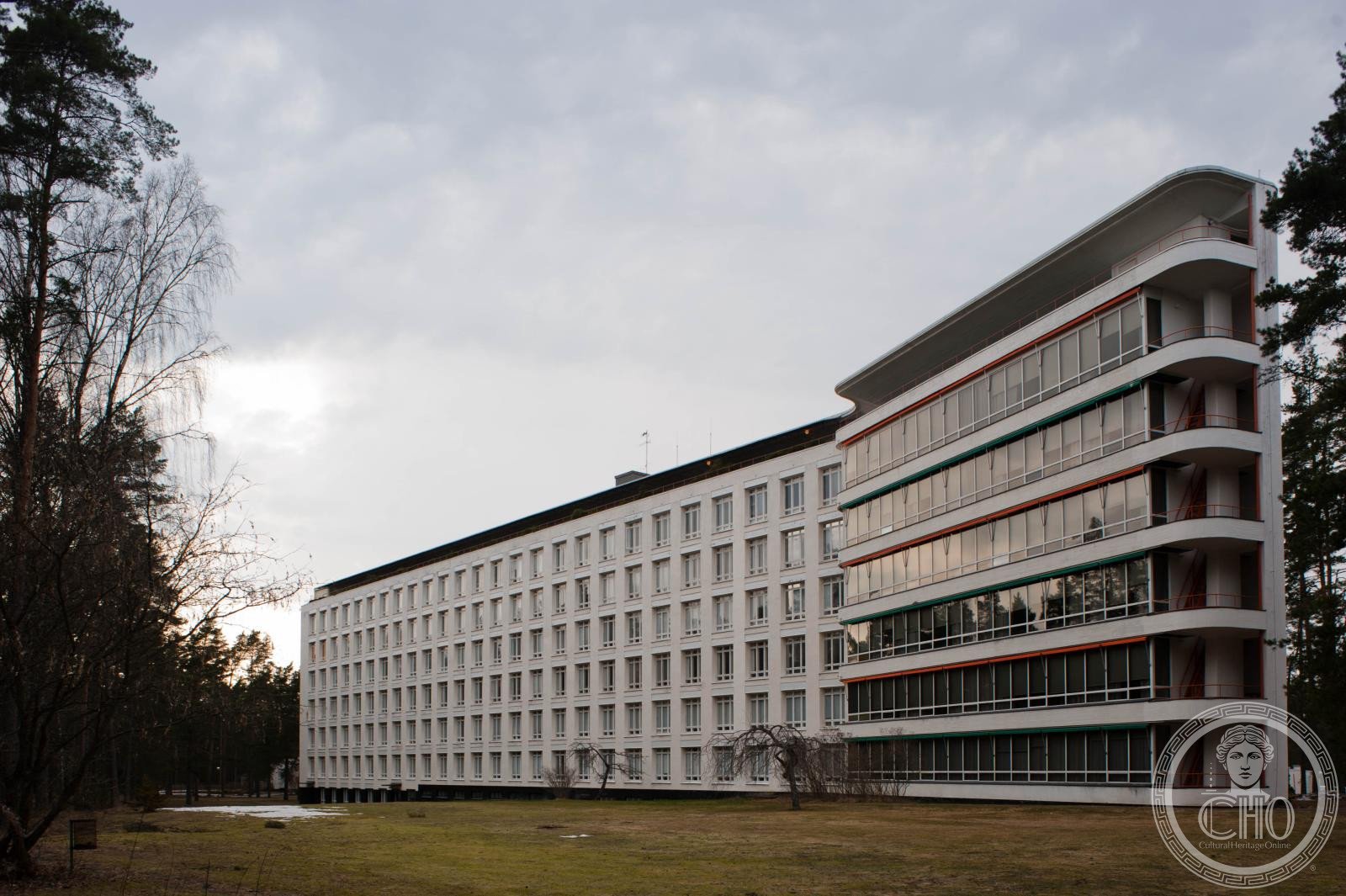
Paimio Sanatorium, completed in 1933, is the building that established Alvar Aalto as an architect of international significance. Commissioned to combat the tuberculosis epidemic that ravaged Finland in the early twentieth century, the sanatorium was conceived not merely as a functional hospital but as a therapeutic instrument: every architectural decision, from window angles and ceiling colours to noise-absorbing details and sun terrace orientation, was calibrated to aid recovery. Aalto won the design competition in 1929, and over the following four years produced a complex that synthesised the formal language of European Functionalism with a sensibility attuned to light, nature, and human wellbeing. The result was a building that looked forward to Aalto’s mature humanist modernism and influenced the design of healthcare facilities worldwide. Nominated for UNESCO World Heritage status, Paimio Sanatorium remains one of the most visited works of modern Finnish architecture.
At a glance
- Type
- Sanatorium / Rehabilitation Centre
- Period
- 1929–1933
- Style
- Nordic Functionalism
- Location
- Paimio, Southwest Finland
- Coordinates
- 60.465° N, 22.735° E
- Architect(s)
- Alvar Aalto
Overview
Paimio Sanatorium is a landmark of twentieth-century architecture located amid forested terrain in Southwest Finland. Designed by Alvar Aalto following his 1929 competition win, it was completed in 1933 and served as a tuberculosis treatment facility for almost thirty years. The building is now owned by Turku University Hospital and functions as a private rehabilitation centre for children. Its nomination for UNESCO World Heritage status reflects international recognition of its architectural and historical significance. Alongside the Paimio Chair, designed by Aalto specifically for convalescing patients, the building embodies the idea that design can be genuinely therapeutic.
History
In the late 1920s, tuberculosis was one of Finland’s most pressing public health crises. A consortium of southwestern Finnish municipalities organised an architectural competition in 1929, and Aalto, then a relatively young architect based in Turku, submitted the winning scheme. Construction proceeded between 1929 and 1933, with Aalto closely involved in every phase. The building received immediate critical acclaim from European modernist circles, bringing Aalto to international attention and leading to invitations to exhibit his work in London and elsewhere. By the early 1960s, advances in antibiotic treatment rendered dedicated tuberculosis sanatoriums obsolete, and Paimio transitioned to general hospital use before its current role as a children’s rehabilitation centre.
Architecture & Design
The sanatorium is composed of several interconnected wings arranged to maximise sunlight exposure for patients. Patient rooms face south-east, with windows angled to admit morning sun directly to bedridden occupants without glare. Ceilings in patient rooms were painted in muted, restful tones rather than clinical white, and heating elements were positioned to warm the air without creating uncomfortable draughts. Aalto designed the Paimio Chair, its curved plywood form shaped to ease breathing, for the building’s common rooms. External sun terraces allowed patients outdoor air therapy. The result is an architecture of care: modernist in form, profoundly humanist in intention.
Cultural significance
Paimio Sanatorium is the pivotal work in Aalto’s early career, marking his transition from regional Nordic classicism to a Functionalism inflected by environmental and human concerns. It prefigures the mature work including Viipuri Library, Villa Mairea, and Finlandia Hall. Its influence on healthcare design was immediate and global: the building demonstrated that a hospital could be designed as an instrument of healing, not merely a container for medical procedures. Its UNESCO nomination places it alongside other defining works of modern architecture.
Visiting today
Paimio Sanatorium is a working rehabilitation centre and access is restricted. Guided architectural tours are offered on selected dates, typically in summer, and must be booked in advance through the Alvar Aalto Foundation or the managing organisation. The surrounding forested grounds and exterior can be appreciated on arrival. Visitors with a serious interest in Aalto’s work should combine a visit with trips to Turku, where other Aalto-designed buildings are accessible.
Getting there
Paimio is located approximately 30 kilometres east of Turku. The sanatorium is best reached by car or taxi from Turku city centre. Local bus connections from Turku are available but infrequent, with a journey time of approximately 45 minutes. Turku is served by domestic and some international flights, and by train from Helsinki in approximately two hours.
Sources & resources
Find it on the map
See this place and what’s around it →Record researched and written by Luigi De Marchi for Cultural Heritage Online, 2026.
📷 Become a Cultural Heritage Online photographer
Share your photos of places: they stay published under your name as the author. The more they're seen, the more you get noticed — and soon a contest will reward the most appreciated photos.
Log in or sign up free to add a photoIs this page about you?
This page is read by travellers and heritage enthusiasts who find it on Google. Tell us how you are connected to this place and we will take it from there.