
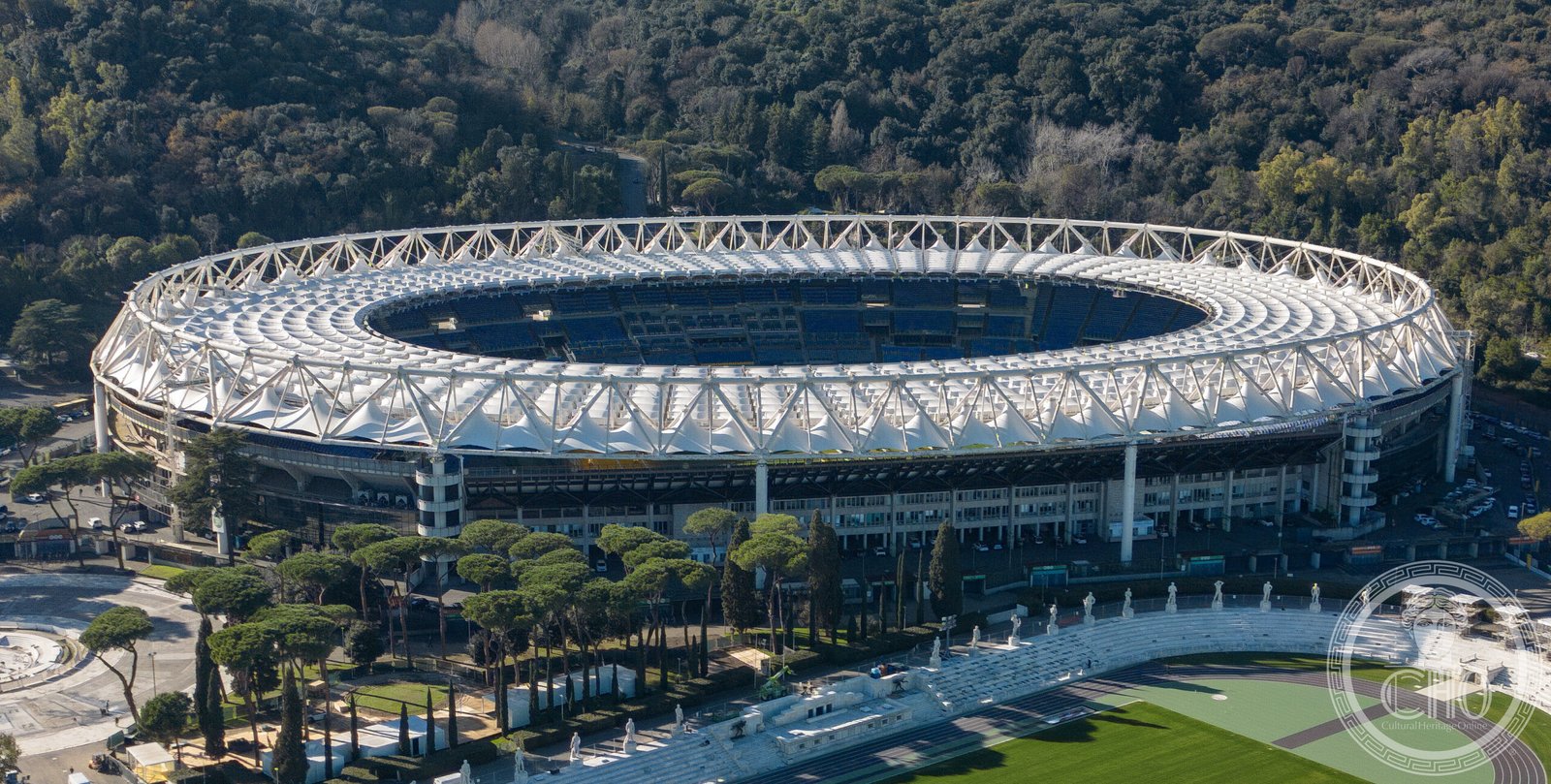
Stadio Olimpico
The Stadio Olimpico is Rome’s principal multi-purpose sports venue, seating over 70,000 spectators and ranking as the largest stadium in Rome and second-largest in Italy. Built in the Valle Flaminia quarter of the Foro Italico complex, it hosted the 1960 Summer Olympics athletics programme, two FIFA World Cup finals (1990), and multiple UEFA Champions League finals. Today it is the home ground of both Serie A clubs AS Roma and SS Lazio.
At a glance
- Type
- Multi-purpose stadium
- Period
- Original structure 1928–1932; rebuilt and enlarged 1950–1953; renovated 1987–1990
- Style
- Rationalist with post-war modernist upgrades; roof canopy added 1990
- Location
- Viale dei Gladiatori 2, 00135 Rome, Italy
- Coordinates
- 41.9339° N, 12.4547° E
- Capacity
- 70,634 (seated)
- Owner
- Sport e Salute (Italian government agency)
Overview
The Stadio Olimpico is colloquially known as l’Olimpico and stands within the Foro Italico sports complex on the northern bank of the Tiber. Owned by Sport e Salute and operated by the Italian National Olympic Committee (CONI), it is the symbolic heart of Italian sport. Its horseshoe-shaped bowl, wrapped in a distinctive tensile roof completed for the 1990 World Cup, can be seen from the Via Olimpica and the surrounding hills of Rome.
Beyond football, the stadium hosts the annual Coppa Italia final and international athletics meets, and it briefly served as a Formula 1 test venue. The Italian national football team also plays home matches here on occasion, and the ground hosted the 1977, 1984 and 2009 UEFA Champions League finals.
History
Planning for a large stadium at the Foro Mussolini (now Foro Italico) began in the late 1920s under the Fascist regime’s drive to use monumental architecture as political spectacle. Construction on the main oval began around 1928 and was substantially complete by 1932, though the facility was repeatedly enlarged before its official designation as the Stadio dei Centomila (“Stadium of the Hundred Thousand”) in 1953.
When Rome was awarded the 1960 Summer Olympics, a major renovation programme raised the capacity above 100,000. The stadium hosted the Olympic athletics events, and Abebe Bikila of Ethiopia won the marathon on a moonlit course running past ancient Roman monuments outside the venue. A second major renovation in 1987–1990 reduced capacity to around 73,000 in exchange for a continuous roof canopy and modern seating ahead of the FIFA World Cup, during which West Germany defeated Argentina in the final held here on 8 July 1990.
What you see
The current stadium presents an elliptical bowl of tiered seating in three main rings — Tevere, Monte Mario and Distinti — shaded by a continuous white Teflon-coated tensile fabric roof supported on external steel masts. The playing surface is a hybrid natural-grass pitch. The exterior preserves elements of the Rationalist Foro Italico setting, with marble-clad pathways, obelisks and monumental statuary along the approaches.
Inside, large video screens flank both ends of the pitch, and the lower tiers bring spectators close to the action. The surrounding Foro Italico complex includes the Stadio dei Marmi — an athletic track ringed by 60 marble athlete statues — offering an architectural promenade for visitors outside match days.
Cultural significance
As one of only a handful of venues to have staged both an Olympic Games and a FIFA World Cup final, the Stadio Olimpico occupies a singular place in world sports history. The 1960 marathon, run through the Arch of Constantine by torchlight, became one of the defining images of the post-war Olympic movement. The stadium also embodies the complex legacy of Fascist-era urban planning, sitting within a complex commissioned as propaganda and later repurposed as democratic public infrastructure.
Practical information
- Address
- Viale dei Gladiatori 2, 00135 Rome (Foro Italico)
- Tours
- Stadium tours available on non-match days; check official website for schedule and booking
- Tickets
- Match tickets sold through AS Roma and SS Lazio official channels
- Website
- Check official website for current information
Getting there
From central Rome, take Tram 2 to Piazza Mancini, then walk approximately 15 minutes through the Foro Italico. Bus lines 32 and 280 also stop near the stadium. By car, exit the GRA at Via Flaminia and follow signs for Foro Italico; limited parking is available on event days. The nearest Metro station is Ottaviano (Line A), roughly 3 km away, with connecting buses.
Sources & resources
Find it on the map
See this place and what’s around it →📷 Diventa un fotografo di Cultural Heritage Online
Condividi le tue foto dei luoghi: restano pubblicate con la tua firma come autore. Più vengono viste, più ti fai conoscere — e presto un concorso premierà le foto più apprezzate.
Accedi o registrati gratis per aggiungere una foto