
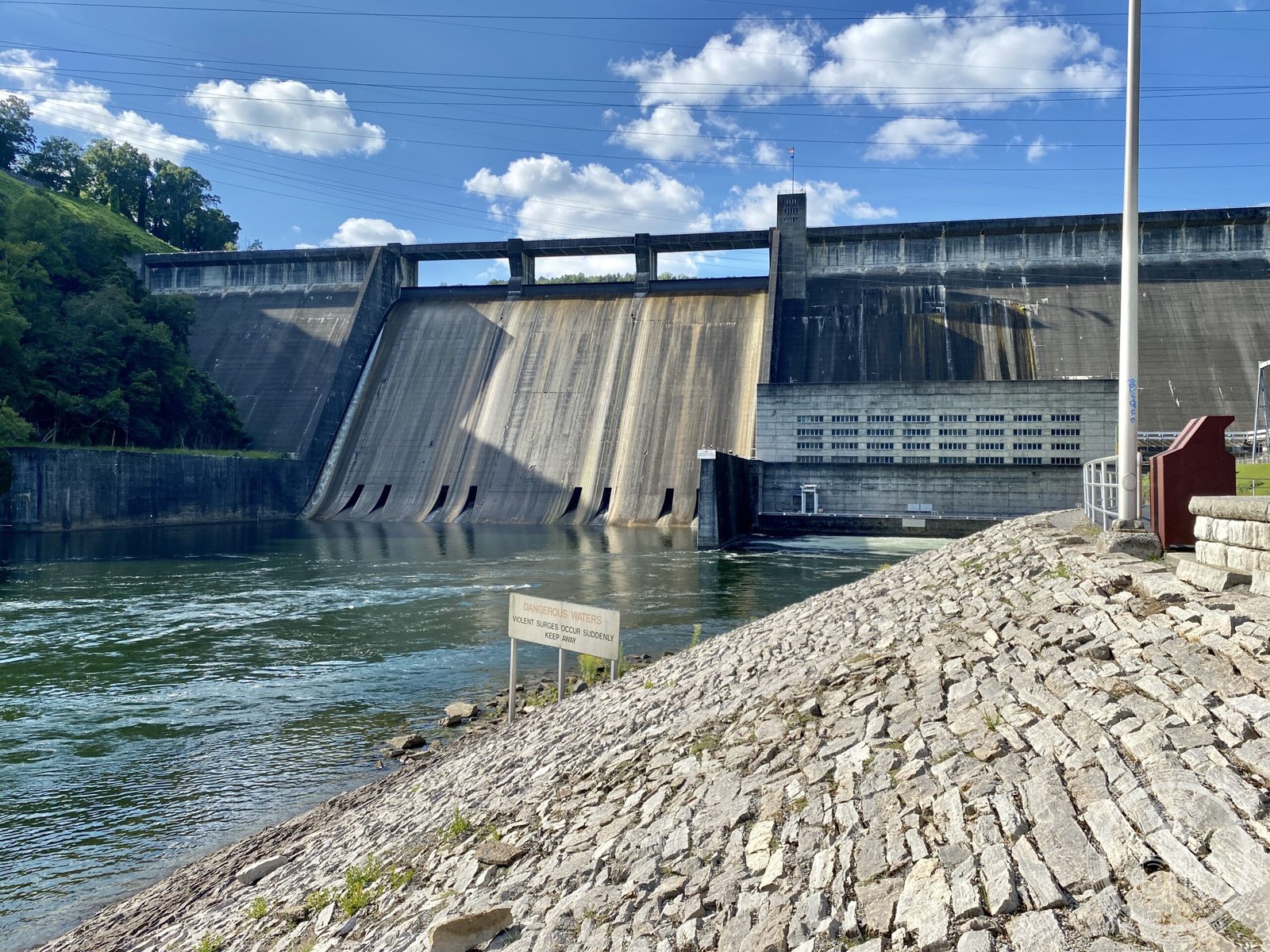
The first dam completed by the Tennessee Valley Authority, Norris Dam on the Clinch River in northern Tennessee set the architectural standard for the New Deal’s most ambitious infrastructure programme — a 265-foot concrete gravity dam whose companion powerhouse was designed in the WPA Moderne idiom by TVA chief architect Roland Wank, bringing refined Art Deco detailing to a structure whose primary purpose was the electrification of rural Appalachia.
At a glance
Norris Dam on the Clinch River in Union County, Tennessee, was completed in 1936 as the Tennessee Valley Authority’s inaugural project. The dam was named for Nebraska Senator George Norris, the principal legislative champion of the TVA Act of 1933, which established the federal agency to develop the Tennessee River watershed through flood control, hydroelectric power generation, and rural electrification. TVA chief architect Roland Wank developed a distinctive WPA Moderne architectural vocabulary for the dam structures — clean concrete forms, geometric ornamental details, and the refined integration of engineering and design that gave the TVA dams their character as objects of civic pride rather than merely industrial infrastructure. The Norris Dam complex was designated a National Historic Landmark in 1973.
Key facts
- Location: Clinch River, Union County (border with Campbell County), Tennessee
- Completed: 1936 (construction began 1933)
- Type: Concrete gravity dam
- Height: 265 feet (81 m)
- Length: 1,860 feet (567 m)
- Architecture: WPA Moderne; Roland Wank, TVA Chief Architect
- Named for: Senator George Norris of Nebraska
- Status: National Historic Landmark (1973); still in operation for TVA power generation
History
The Tennessee Valley Authority was created by Congress in May 1933 as part of Franklin Roosevelt’s New Deal, with a mandate to address the chronic poverty and economic underdevelopment of the Tennessee River basin through coordinated flood control, power generation, and agricultural and industrial development. The valley’s population, largely rural and dependent on subsistence farming, had no access to electrical power and was subject to devastating floods; both problems were to be addressed through a system of dams that would tame the river while generating electricity for distribution through rural cooperatives.
Norris Dam was the first structure in this system, begun in October 1933 and completed in March 1936. The construction camp that housed the dam workers grew into the town of Norris, Tennessee — a planned community designed by the TVA’s architects and planners as a model of progressive housing and community organisation. The dam created Norris Lake, the reservoir that bears the senator’s name, covering approximately 34,000 acres of the Clinch and Powell river valleys — an area requiring the relocation of thousands of families from their ancestral land.
Roland Wank joined TVA in 1933 as its chief architect, bringing European Modernist training and the conviction that public infrastructure could and should be designed with aesthetic care. His approach to the dam structures — treating the concrete surfaces as opportunities for refined geometric design rather than leaving them as purely functional engineering products — established the aesthetic that would characterize all the major TVA dams. The powerhouse at Norris was the first full expression of this approach, and the Wank style became a recognized contribution to American public architecture of the New Deal period.
What you see
The dam is best viewed from the overlook on the downstream side, where the full scale of the 265-foot concrete face is visible in relation to the powerhouse at its base and the Clinch River below. The WPA Moderne architectural character is most evident in the powerhouse building, where the geometric ornamental programme of Roland Wank’s design articulates the concrete surfaces with a restrained precision that avoids both the ornateness of traditional civic architecture and the purely utilitarian blankness of industrial construction. The bas-relief panels and clean geometric details of the powerhouse show how the TVA architects used Art Deco-derived forms to give the New Deal’s engineering works a civic dignity appropriate to their purpose.
The dam crest walkway and the surrounding TVA reservation provide multiple viewpoints of the structure at different scales. The visitor centre at the dam explains both the engineering and the human history of the Norris project, including the story of the displaced families whose communities lie beneath Norris Lake.
Practical information
- Access: The TVA Norris Dam reservation and overlook areas are open to the public. The powerhouse interior requires arrangement through TVA.
- Visitor centre: Norris Dam State Park, adjacent to the dam, provides interpretive exhibits and recreation access to Norris Lake.
- Best time: Spring and early summer offer the fullest reservoir and clearest views. Fall foliage creates dramatic colour in the surrounding valley.
- Time needed: 1-2 hours for the dam overlook, visitor centre, and the Norris town historic district.
Getting there
Norris Dam is located on the Clinch River approximately 25 miles north of Knoxville, Tennessee. From Knoxville, take I-75 north to Exit 122 (TN-61 / Norris Freeway), then northwest on US-441 to the dam. The nearest commercial airport is McGhee Tyson Airport (TYS) in Knoxville, approximately 30 miles southeast. The Norris historic district, a planned New Deal town, is approximately two miles from the dam on US-441.
Nearby
- Museum of Appalachia (1969) — John Rice Irwin’s remarkable assemblage of Appalachian material culture and vernacular architecture, relocated historic log buildings and farm structures, approximately three miles east in Norris on US-441 — an essential complement to the TVA story, documenting the culture that the dams and reservoirs altered.
- Norris Historic District — The planned New Deal town designed by TVA architects in 1933-1934 as a model community for dam workers; now a residential area with its original wood-frame houses and community buildings intact, listed on the National Register of Historic Places.
- Knoxville, Tennessee — The city at the confluence of the French Broad and Holston Rivers (forming the Tennessee), the regional capital and university city with significant TVA history; 25 miles southeast.
- Great Smoky Mountains National Park — The most visited national park in the United States, whose eastern entrance is approximately 50 miles southeast of Norris Dam via US-441 through Knoxville.
Sources
- National Historic Landmark nomination: Norris Dam, Tennessee Valley Authority.
- McDonald, Michael J., and John Muldowny. TVA and the Dispossessed. University of Tennessee Press, 1982.
- Talbert, Roy. FDR’s Utopian: Arthur Morgan of the TVA. University Press of Mississippi, 1987.
- North, S.N.D. Roland Wank and the Architecture of the Tennessee Valley Authority. Architecture History Foundation.
- Wikipedia, “Norris Dam,” https://en.wikipedia.org/wiki/Norris_Dam.
Find it on the map
See this place and what’s around it →📷 Become a Cultural Heritage Online photographer
Share your photos of places: they stay published under your name as the author. The more they're seen, the more you get noticed — and soon a contest will reward the most appreciated photos.
Log in or sign up free to add a photoIs this page about you?
This page is read by travellers and heritage enthusiasts who find it on Google. Tell us how you are connected to this place and we will take it from there.