
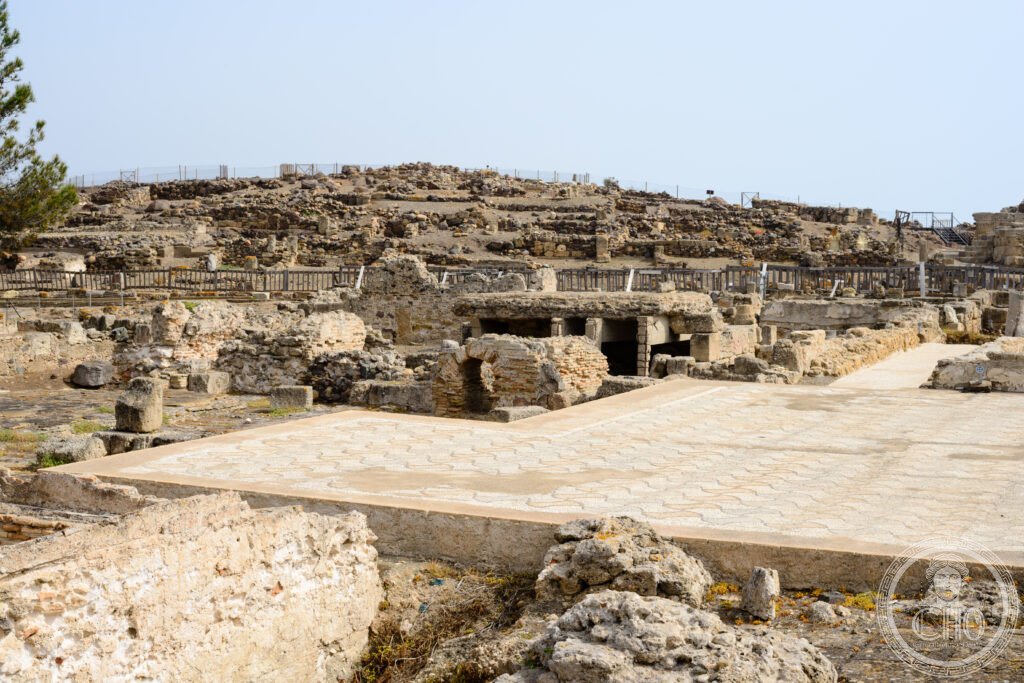
The oldest Phoenician city in Sardinia — and possibly in the western Mediterranean — occupies a narrow headland 30 kilometres south of Cagliari, with the sea on three sides and the ruins of a Punic-Roman city stretching from the isthmus to the cape: temples, baths, a theatre, mosaics, and the stele with the oldest known inscription in Sardinia (ninth century BCE), which contains the earliest known occurrence of the name “Sardinia” (Shrdn) in any ancient source.
At a glance
Nora is an archaeological site on the Capo di Pula, a headland on the south coast of Sardinia, 30 kilometres south-west of Cagliari. It is believed to be the oldest Phoenician foundation in Sardinia and one of the oldest Phoenician colonies in the western Mediterranean, with continuous occupation from approximately the ninth or eighth century BCE to at least the fifth century CE. The site is partially submerged — the ancient town extended further into the sea than the current headland, and portions of the Punic city are now visible underwater — and partially on land, where the Roman overlay (forum, theatre, baths, houses, streets, mosaics) is the most visible element.
Key facts
- Foundation: IX–VIII century BCE (Phoenician); the name “Nora” is probably Semitic, related to the Hebrew “nur” (fire, light); Nora was likely a trading station on the sea route from Tyre to Tartessos (south Spain) and the Atlantic tin route
- Stele di Nora: IX century BCE (estimated); Phoenician inscription in Phoenician script; contains the name “Shrdn” (Sardinia) — the earliest known occurrence of the name in any surviving text; found in 1773; now in the Museo Nazionale di Cagliari
- Punic city: V–III century BCE; the city had a tophet, a sacred enclosure of Tanit (the chief Punic goddess), a necropolis, and substantial urban fabric; the Punic street grid underlies the Roman one
- Roman city: from 238 BCE; Nora became a Roman municipium; the visible remains are mostly Roman (I–III century CE): the theatre (c. I century CE, one of the best-preserved in Sardinia), the Forum Baths (I century CE, mosaic pavements), the Castellum (late antique defensive tower on the cape), and the basilica
- Submerged city: approximately 1.5–2 m of subsidence since the Punic period; Punic building foundations and amphora fragments visible underwater to the west of the headland
- GPS: 38.9892, 8.4741 — Google Maps
History
The Stele di Nora — a limestone block approximately 1 metre high, inscribed in Phoenician script in nine lines, found in 1773 near the headland — is the most important single monument of the site. It is dated on paleographic grounds to approximately the ninth century BCE, which would make the Phoenician inscription at Nora contemporary with or slightly earlier than the earliest Phoenician inscriptions from the Lebanese homeland. The text reads (in translation): “In the land of Tarshish [possibly Tartessos in Spain, or a generic term for the distant west]… Milkaton son of Shubna, general of [a Phoenician king or god]… He built [a monument to] the god [Pumay?]… in Sardinia.” The word “Shrdn” in line 7 is the earliest known written form of the name of the island.
The Roman city at Nora was built largely on top of the Punic one, using the same street grid and many of the same building plots. The most intensively occupied period was the first to third centuries CE, when Nora was a prosperous provincial town with a theatre, three bath complexes, a forum, and multiple paved streets. The mosaic floors visible today in the Forum Baths (geometric and figure mosaics of the first and second centuries CE) are among the most intact Roman mosaics in Sardinia.
What you see
The archaeological area of Nora is entered at the north end of the isthmus and extends south to the tip of the cape (approximately 1 km on foot along the main track). The most conspicuous monument is the Roman Theatre (on the west side of the cape, I century CE, partially restored in the 1950s–60s and used for summer performances): a traditional Roman theatre with cavea cut into the hillside, seating approximately 1,000 spectators, facing west toward the sea. The Forum Baths (on the east side, I century CE) have the best preserved mosaic floors: geometric patterns in black and white, with figurative panels (fish, sea creatures, a theatrical mask).
Beyond the theatre, on the southern tip of the headland, the Castellum (late antique tower, IV–V century CE) and the remains of a Christian basilica mark the last phase of occupation. From this point, looking north back along the headland, the extent of the site is visible as a flat stretch of ruins between the sea on either side — a landscape unique in Sardinia for its combination of archaeological density and maritime setting.
Gallery
Practical information
- Archaeological area: Open daily 9:00–19:00 (summer) / 9:00–17:00 (winter). Admission ~€5. Combined ticket with Museo Civico di Pula ~€8.
- Museo Civico di Pula: In the centre of Pula, 3 km from the site; houses the most important portable finds from Nora (the Stele di Nora is a cast — the original is in Cagliari; but the museum has Punic figurines, Roman glass, mosaics, bronze objects, and a good didactic exhibition on the site). Open daily 9:00–20:00 (summer). Admission ~€4.
- Season: Best visited April–June and September–October; July–August is very hot (the headland is exposed) and access roads can be congested. Sunset visits are particularly beautiful — the theatre looks west over the sea.
Getting there
Capo di Pula, Pula (CA), Sardegna. By car from Cagliari: 30 km, 35 min (SS195 south to Pula, then SS195 toward Santa Margherita di Pula, follow signs “Nora” / “Area Archeologica”). No public transport to the site. From Cagliari Elmas airport: 30 km, 35 min by car. Parking at the site: free, large; no summer congestion on the road (unlike the beaches nearby which fill in August).
Nearby
- Cagliari — 30 km north; the capital of Sardinia; the Museo Nazionale Cagliari (Cittadella dei Musei) houses the original Stele di Nora, the finest Punic bronzes from Sardinia (bronzetti nuragici), and Roman mosaics; the Castello district (Pisan medieval quarter, XIII century); the Roman amphitheatre (II century CE, still used for summer events)
- Chia — 25 km south-west; one of the most beautiful beach areas in Sardinia (Spiaggia di Su Giudeu, Spiaggia di Chia, Spiaggia di Su Portu); the Punic-Roman ruins of the ancient city of Bithia (III century BCE – III century CE) are visible on the headland above the beach; Saracen tower (Torre di Chia, XVI century)
- Pula — 3 km north of the site; a small Sardinian town with a pleasant main piazza; good base for visiting Nora and the Chia coast
Sources
- Wikipedia EN: Nora, Sardinia
- Wikipedia EN: Nora stone
- Bonetto, Jacopo; Ghiotto, Andrea; Novello, Monica (eds.): Nora. Il foro romano, Padova, 2009
- Museo Civico di Pula: museonora.it
Find it on the map
See this place and what’s around it →📷 Become a Cultural Heritage Online photographer
Share your photos of places: they stay published under your name as the author. The more they're seen, the more you get noticed — and soon a contest will reward the most appreciated photos.
Log in or sign up free to add a photo