
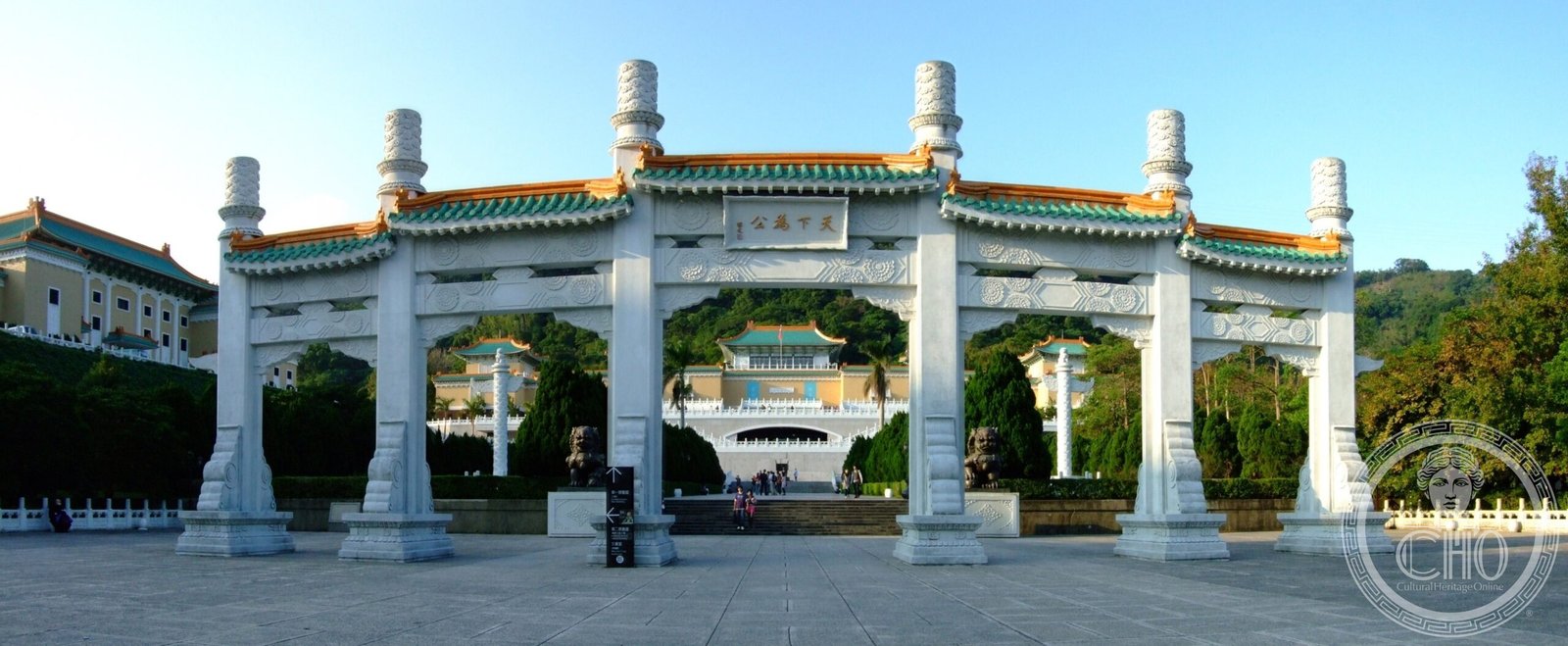
National Palace Museum
The National Palace Museum in Taipei is one of the world’s greatest repositories of Chinese art and imperial artefacts, holding a permanent collection of nearly 700,000 objects spanning 8,000 years of Chinese civilisation. The museum houses treasures from the Chinese imperial court including jade carvings, bronzes, calligraphy, paintings, ceramics, and rare books assembled by the Song, Yuan, Ming, and Qing dynasties.
At a glance
- Type
- National art and history museum
- Period
- Collection history from the imperial court; current Taipei building opened 1965
- Style
- Traditional Chinese palace architecture (Chinese Renaissance Revival)
- Location
- Shilin District, Taipei, Taiwan (Republic of China)
- Coordinates
- 25.1022° N, 121.5485° E
Overview
The National Palace Museum holds what is widely regarded as the world’s finest collection of Chinese art, built from the imperial collections of the Chinese emperors over many dynasties. When the Kuomintang government retreated to Taiwan in 1949 following the Chinese Civil War, approximately 600,000 artefacts were transported from the Palace Museum in Beijing, forming the core of the Taipei collection. The museum rotates its displays, as only a fraction of the enormous collection can be exhibited at any one time.
History
The collections trace their origin to the Song dynasty imperial court (10th–13th century) and expanded dramatically through the Ming and Qing periods as emperors commissioned and collected paintings, ceramics, bronze vessels, and calligraphic masterworks. After the fall of the Qing dynasty in 1912, the collection was managed in the Forbidden City in Beijing. Between 1933 and 1948 the most important objects were evacuated — first south to avoid Japanese invasion, then to Taiwan. The current purpose-built museum in Taipei’s Shilin District opened in 1965 in a building designed in traditional Chinese palace style.
What you see
The permanent collection is displayed across three main floors of the main building, organised by category: bronzes, jade, lacquerware, enamelware, ceramics, painting and calligraphy, and rare books. Among the most celebrated individual objects are the Jadeite Cabbage — a piece of pale green jade carved to resemble a Chinese cabbage with grasshoppers — and the Meat-shaped Stone, a layered piece of jasper that uncannily resembles a braised pork belly. Rotating exhibitions ensure that different parts of the vast collection appear on a regular cycle.
Cultural significance
The National Palace Museum represents the largest concentration of Chinese imperial artefacts outside mainland China, making it central to debates over cultural heritage, national identity, and the political history of the Chinese-speaking world. For art historians, it is an indispensable resource for the study of East Asian painting, calligraphy, jade carving, and ceramic traditions spanning nearly a millennium of imperial patronage.
Practical information
- Address
- 221 Zhi’shan Road, Section 2, Shilin District, Taipei 11143, Taiwan
- Opening hours
- Tuesday–Sunday 09:00–17:00; closed Mondays. Special evening hours on selected dates — check official website.
- Tickets
- Paid admission; concessions available; audio guides in multiple languages for hire
Getting there
Take the Taipei Metro (MRT) Red Line to Shilin station, then board bus Red 30 or 255 to the museum stop (approx. 15 minutes). Taxis from central Taipei take 20–30 minutes depending on traffic. The museum provides a free shuttle bus service from Shilin station on weekends.
Sources & resources
- Wikipedia — National Palace Museum
- Official website — National Palace Museum Taipei
- Cultural Heritage Online — explore more world heritage sites
Find it on the map
See this place and what’s around it →📷 Diventa un fotografo di Cultural Heritage Online
Condividi le tue foto dei luoghi: restano pubblicate con la tua firma come autore. Più vengono viste, più ti fai conoscere — e presto un concorso premierà le foto più apprezzate.
Accedi o registrati gratis per aggiungere una foto