
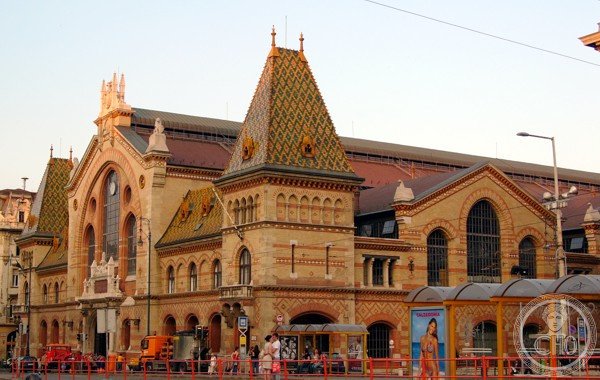
Nagy Vásárcsarnok — Central Market Hall, Budapest
The Nagy Vásárcsarnok (Great Market Hall or Central Market Hall) is the largest and oldest indoor market in Budapest, Hungary, opened on 15 February 1897. Conceived by Károly Kamermayer, the city’s first mayor, as the centrepiece of a coordinated plan to modernise Budapest’s food supply infrastructure, the market hall was designed by architect Samu Pecz in a Hungarian Gothic Revival style with Zsolnay ceramic tiles on its iron-framed structure. Restored after severe damage in World War II and again in the 1990s, it remains an active food market and a celebrated heritage building visited by hundreds of thousands of tourists each year.
At a glance
- Type
- Indoor market hall; heritage architecture
- Period
- Constructed 1894–1897; restored 1990s
- Style
- Hungarian Gothic Revival with exposed cast-iron structure
- Location
- Vámház körút 1-3, Budapest IX district, Hungary (southern end of Váci utca)
- Coordinates
- 47.4871° N, 19.0563° E
Overview
The Great Market Hall stands at the southern terminus of Váci utca, Budapest’s main pedestrian shopping street, at the foot of the Liberty Bridge over the Danube. Its vast interior — approximately 150 metres long — operates on three levels: the ground floor for fresh produce, meat, and dairy; the first-floor galleries for Hungarian crafts, embroidery, paprika, and tourist goods; and a lower basement level for pickled goods and a small food court. The building is simultaneously a functioning neighbourhood market and one of Budapest’s most architecturally distinctive public spaces.
History
Mayor Kamermayer proposed a network of covered market halls to replace Budapest’s chaotic open-air markets in the 1890s, as part of the broader urban modernisation accompanying the 1896 Millennial celebrations of Hungary’s founding. Architect Samu Pecz designed the central hall using the latest iron-frame construction techniques wrapped in a historicist brick and ceramic exterior that would harmonise with Budapest’s emerging architectural identity. The market opened in 1897 and quickly became the city’s primary wholesale and retail food centre. Heavily damaged during the Siege of Budapest in 1944–45, it was partially repaired under communism but fell into disrepair; a comprehensive restoration between 1991 and 1994 using EU funds returned the building to its original appearance, including the Zsolnay tile roof.
What you see
The exterior presents a dramatic facade of red brick and polychrome Zsolnay ceramic tiles on the pitched roof, with twin towers at the main entrance echoing the Gothic Revival vocabulary used at Matthias Church. Inside, the soaring cast-iron nave with glazed clerestory windows floods the central hall with natural light, revealing rows of fresh vegetable stalls, butchers, fishmongers, and flower sellers on the ground level. The upper gallery walkways display a concentration of Hungarian lace, embroidered tablecloths, paprika strings, pálinka, and other traditional crafts and foodstuffs that make the hall a popular destination for visitors seeking authentic Hungarian products in a heritage setting.
Cultural significance
The Nagy Vásárcsarnok is a landmark of late-nineteenth-century urban planning, representing the ambition of the newly unified Budapest (formed 1873) to provide itself with civic infrastructure on a European metropolitan scale. Its architecture — Hungarian Gothic Revival applied to an industrial iron structure — exemplifies the creative tension of the Austro-Hungarian Dual Monarchy period, when Hungarian architects sought to express a national style through modern construction technology. The building’s continued function as a working food market, rather than conversion to a purely tourist or commercial use, preserves the authentic character that underlies its heritage value.
Practical information
- Address
- Vámház körút 1-3, Budapest 1093, Hungary
- Opening hours
- Monday 06:00–17:00; Tuesday–Friday 06:00–18:00; Saturday 06:00–15:00; closed Sunday
- Admission
- Free entry
- Best time to visit
- Weekday mornings for the authentic market atmosphere; avoid peak weekend afternoons in high season
Getting there
The market hall is directly adjacent to the Fővám tér Metro station (M4 line, green line). Tram lines 2 and 47/49 stop at Fővám tér on the Danube embankment, one minute on foot from the main entrance. From the city centre (Deák tér), a pleasant 15-minute walk south along Váci utca leads directly to the market’s main facade.
Sources & resources
- Wikipedia — Great Market Hall: en.wikipedia.org/wiki/Great_Market_Hall
- Cultural Heritage Online: culturalheritageonline.com
Find it on the map
See this place and what’s around it →📷 Diventa un fotografo di Cultural Heritage Online
Condividi le tue foto dei luoghi: restano pubblicate con la tua firma come autore. Più vengono viste, più ti fai conoscere — e presto un concorso premierà le foto più apprezzate.
Accedi o registrati gratis per aggiungere una foto