
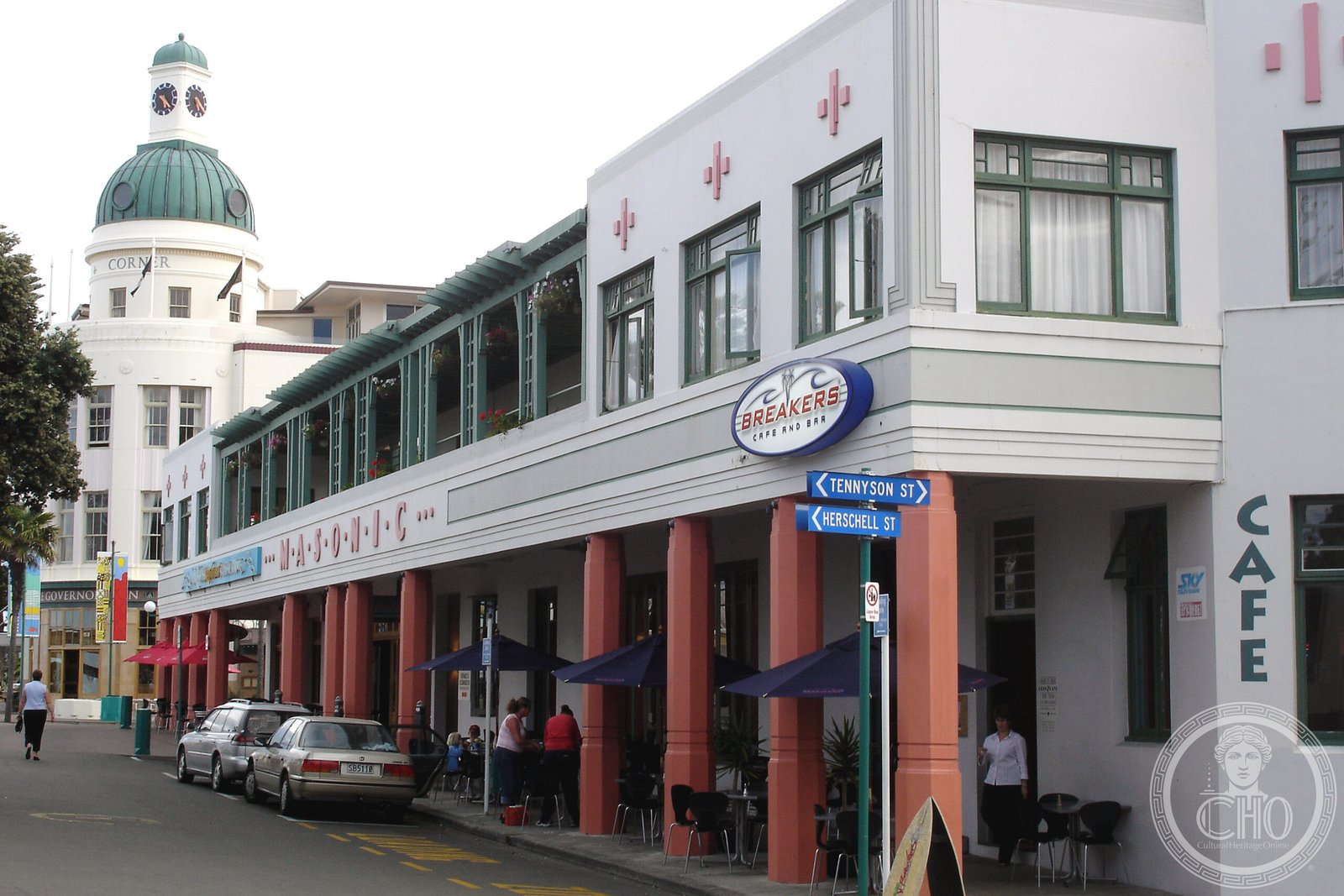
On 3 February 1931, a magnitude-7.8 earthquake levelled the centre of Napier and killed 256 people, leaving the city a field of rubble. What followed was one of the most remarkable episodes of urban reconstruction in history: within two years, the entire central business district had been rebuilt in the Art Deco and Spanish Mission Revival styles then sweeping the world, producing a cohesive architectural ensemble matched nowhere else on earth. Napier and Miami Beach are now recognised as the two best-preserved Art Deco cities on the planet, but where Miami’s district grew incrementally over decades, Napier’s rose from disaster in a single sustained act of collective will. The earthquake also lifted approximately 4,000 hectares of harbour seabed above sea level, physically enlarging the city. Today the rebuilt CBD — its parapets decorated with sunbursts, zigzags, stylised flora, and Maori motifs — draws visitors from around the world, celebrated each February during the Tremains Art Deco Weekend, which attracts over 40,000 people annually.
At a glance
- Type
- Historic urban district / architectural ensemble
- Period
- Reconstructed 1931–1933 following earthquake of 3 February 1931
- Style
- Art Deco / Spanish Mission Revival
- Location
- Central Business District, Napier, Hawke’s Bay, New Zealand
- Coordinates
- 39.4928° S, 176.9178° E
- Architect(s)
- Louis Hay, Atkin & Mitchell (Wellington), and local practitioners
Overview
The Napier Art Deco Historic Area encompasses the central business district as rebuilt following the 1931 Hawke’s Bay earthquake. The ensemble is distinguished by its uniformity — nearly every commercial building in the CBD dates from a single two-year reconstruction period — and by the quality and variety of its decorative detailing, which ranges from Streamline Moderne to Zigzag Art Deco to Spanish Mission Revival with Moorish accents. Key surviving buildings include the Halsbury Chambers (Louis Hay, 1932), the National Tobacco Company building (1933), the Daily Telegraph building, and the Sound Shell (1935). New Zealand’s government has listed the precinct as a Category I Historic Heritage Area, the highest level of protection available.
History
Napier was a prosperous wool and meat export port when the earthquake struck at 10:47 am on 3 February 1931. The tremor, centred near Wairoa, destroyed virtually every masonry building in the city centre; fires burned for two days through the rubble. The government-led reconstruction was immediate and systematic: new building codes were introduced, streets were widened, and uniform building heights were mandated. Architects responded with designs in the fashionable Art Deco idiom filtering through from New York, London, and Los Angeles. By 1933 the CBD was essentially complete, a purpose-built Art Deco city unlike any other on earth. Heritage recognition came slowly: serious conservation advocacy began in the 1980s, the annual Deco festival launched in 1993, and UNESCO nomination was pursued from 2007, though World Heritage status was not awarded in 2011.
Architecture & Design
Two styles predominate. The Zigzag Art Deco mode, drawn from New York skyscraper ornament, is characterised by geometric relief panels, sunburst motifs, stepped parapets, and polychrome faience tile. The Spanish Mission Revival mode, popular in California and adapted for Hawke’s Bay’s Mediterranean-like climate, features white-rendered facades, red-tiled cornices, arched openings, and wrought-iron details. A handful of buildings combine the two registers. The Halsbury Chambers by Louis Hay is generally regarded as the masterpiece of the ensemble, its limestone facade demonstrating the highest level of Deco craftsmanship in the country. Maori motifs — koru spirals, kowhaiwhai patterns — appear occasionally as ornamental elements, giving the district a distinctly New Zealand character.
Cultural significance
Napier’s Art Deco district is unique because it preserves a complete urban environment frozen at a single moment in architectural history, untouched by the clearances and redevelopments that erased equivalent precincts in other cities. It is a living document of how the Art Deco movement was received and adapted in the colonial Pacific — absorbing North American, British, and European influences while developing local inflections rooted in Maori visual culture and the subtropical landscape. The district is also a testament to the resilience of a community that refused to rebuild in the past and instead embraced the architectural language of the future.
Visiting today
The Art Deco Trust operates a visitor centre on Tennyson Street in central Napier, offering self-guided walking maps, guided tours, and an extensive programme of events centred on the annual Tremains Art Deco Weekend in February. Most of the significant buildings are visible from the street; interiors of the Napier Municipal Theatre and the Public Library are accessible during opening hours. Vintage car parades, swing dances, and fashion shows during the festival make it one of the most atmospheric heritage events in the southern hemisphere. The Hawke’s Bay Museum and Art Gallery provides historical context.
Getting there
Napier is served by Hawke’s Bay Airport, with direct flights from Auckland, Wellington, and Christchurch on Air New Zealand. By road, State Highway 2 connects Napier to Hastings (20 km) and continues north to Wairoa and south toward Wellington. InterCity coaches serve Napier from major North Island cities. Within the city, the Art Deco CBD is compact and best explored on foot; the visitor centre on Tennyson Street is the logical starting point. Bicycles can be hired at several outlets for a wider circuit of the district.
Sources & resources
Find it on the map
See this place and what’s around it →Record researched and written by Luigi De Marchi for Cultural Heritage Online, 2026.
📷 Become a Cultural Heritage Online photographer
Share your photos of places: they stay published under your name as the author. The more they're seen, the more you get noticed — and soon a contest will reward the most appreciated photos.
Log in or sign up free to add a photo