
Archaeological Sites of Mycenae and Tiryns
The citadel of the legendary king Agamemnon and the most powerful Bronze Age palatial civilization in Greece — Mycenae (Argolid, Peloponnese; UNESCO WHS 1999 with Tiryns) is the type site of the Mycenaean civilization (1600-1100 BCE) and the source of Heinrich Schliemann’s “Mask of Agamemnon” — the most recognizable golden face from the ancient world.
At a glance
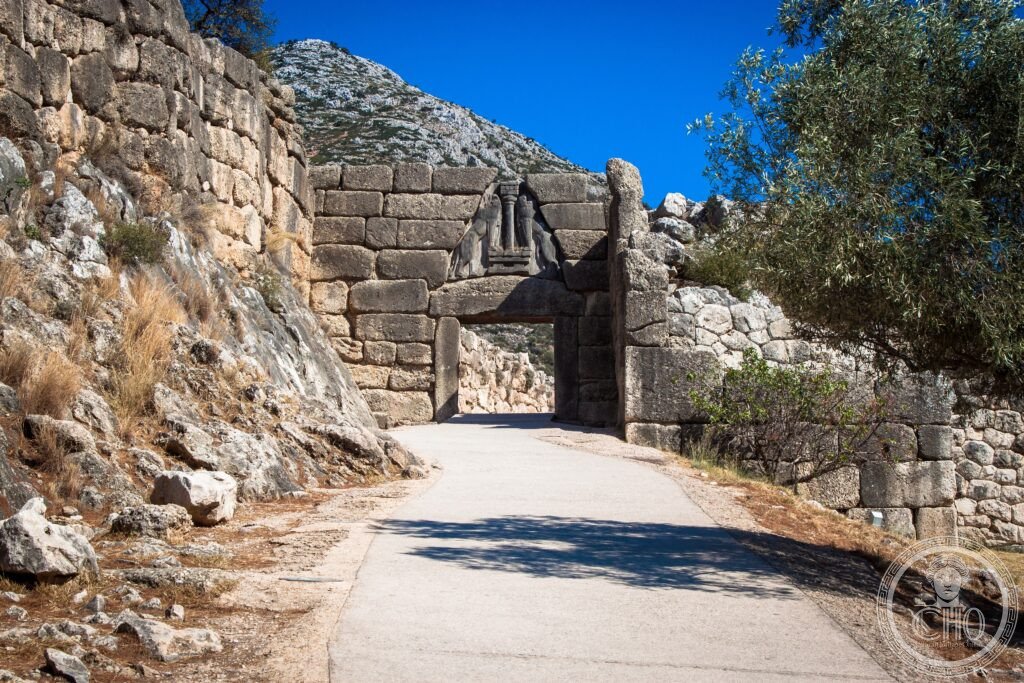
Mycenae (the most precisely MycenaeTiryns single Cyclopean masonry Lion Gate 1250 BCE 20 tonnes lintel earliest sculpture Europe Schliemann 1876 shaft graves Mask Agamemnon gold cups rhytons 1600 BCE Grave Circle A treasury Atreus 1250 BCE corbelled tholos tomb Athens National Museum UNESCO heritage: the civilization (the Mycenaean civilization (approximately 1600-1100 BCE) was the first literate, palace-organized culture on mainland Greece; the Mycenaeans (the people at Mycenae and related sites) were Bronze Age Greeks who spoke a language (Linear B script) that was the earliest written form of Greek (Linear B was deciphered in 1952 CE by Michael Ventris, a British architect); the palace economy (the Mycenaean palaces were redistributive economies: the palace collected agricultural produce (grain, olive oil, wool, pottery) from the surrounding region and redistributed it to administrators, craftsmen, and military personnel; the Linear B tablets are primarily economic records (palace accounts); the citadel (Mycenae sits on a natural hill (278m) between Mount Agios Elias and Mount Zara; the palace (megaron) occupies the summit; the Cyclopean walls (4-6m thick, 8-12m high) encircle the palace complex; the circuit walls enclose approximately 30,000 m²); the Lion Gate (the main gateway to the citadel; c. 1250 BCE; the earliest surviving large-scale figural sculpture in Europe (the lions are the first monumental sculpted animals in European art); the lintel stone (20 tonnes; extracted from a quarry 5 km from the site and transported by sledge and rollers; the maximum weight that ancient Greek mechanical means could reliably lift in the Bronze Age)) — the most precisely MycenaeTiryns single Cyclopean masonry Lion Gate 1250 BCE 20 tonnes lintel earliest sculpture Europe Schliemann 1876 shaft graves Mask Agamemnon gold cups rhytons 1600 BCE Grave Circle A treasury Atreus 1250 BCE corbelled tholos tomb Athens National Museum UNESCO heritage in any UNESCO world heritage site)).
Key facts
- The Mask of Agamemnon: the most precisely MycenaeTiryns single Mask Agamemnon gold death mask 1600 BCE Grave Circle A Schliemann 1876 telegram Greek King Berlin National Museum Athens 6 gold death masks UNESCO heritage — the most famous gold artifact from the ancient Greek world: the Mask of Agamemnon (a gold death mask (repoussé gold; approximately 31 cm × 26 cm; made from a single gold sheet hammered over a wooden form from the inside to create the relief features of the face); excavated by Heinrich Schliemann at Mycenae in August 1876 CE from the shaft graves (Grave Circle A); Schliemann sent a telegram to the King of Greece: “I have gazed upon the face of Agamemnon”; the mask is now in the National Archaeological Museum of Athens; the historical problem: the mask dates from approximately 1600-1550 BCE; the Trojan War (if historical) would have occurred approximately 1250 BCE; Agamemnon (if a historical person) would have lived approximately 350 years after the mask was made; the mask depicts a real Mycenaean king, but almost certainly not Agamemnon of the Iliad)
- GPS: 37.7307° N, 22.7558° E
History
From 1600 BCE palace to Bronze Age Collapse to Schliemann (the most precisely MycenaeTiryns single 1600 BCE Palace Atreus Agamemnon 1250 BCE peak power Linear B tablets economic records palace redistribution Bronze Age Collapse 1200 BCE Dorian invasion theory Sea Peoples fire destruction abandonment Geometric Dark Age Pausanias 2nd century CE visitor Schliemann 1876 shaft graves gold Ventris Linear B decipherment 1952 UNESCO heritage: the history: the early Mycenaean period (the earliest occupation of the Mycenae hill dates from approximately 3000 BCE (Neolithic period); the first significant Bronze Age occupation from approximately 2000 BCE; the period of maximum power (the Late Helladic III period, approximately 1400-1100 BCE); the Shaft Graves of Grave Circle A (excavated by Schliemann in 1876 CE; six shaft graves (approximately 3m deep by 3-5m in plan; covered by stone grave markers (stelai)); the grave goods from the shaft graves are the most extraordinary treasure of the Bronze Age Greek world: 11 gold death masks, golden cups, rhytons (ritual drinking vessels), swords with inlaid hunting scenes, faience ornaments, and amber beads from the Baltic)); the Palace of Agamemnon (the palace (megaron) of Mycenae (13th century BCE; the megaron (the main hall of the Mycenaean palace; a rectangular room with a central hearth surrounded by four columns supporting the roof; the type is found at Mycenae, Tiryns, and Pylos)); the Linear B tablets from the Archive Room (the clay tablets baked hard by the fire that destroyed the palace; the tablets record the palace economy: rations of grain and olive oil, lists of craftsmen, inventories of bronze weapons, records of land holdings)); the Bronze Age Collapse (approximately 1200-1150 BCE: all the major Mycenaean palatial centers were destroyed; the reason (still debated: theories include invasion by the “Sea Peoples”, climate change, internal political collapse, drought, or a combination); Mycenae was burned; the palace was not rebuilt; the population contracted dramatically; the site was abandoned by approximately 1100 BCE; occupied again from approximately 800 BCE as a small post-Bronze Age village)) — the most precisely MycenaeTiryns single 1600 BCE Palace Atreus Agamemnon 1250 BCE peak power Linear B tablets economic records palace redistribution Bronze Age Collapse 1200 BCE fire destruction abandonment Geometric Dark Age Pausanias 2nd century CE visitor Schliemann 1876 shaft graves gold Ventris Linear B decipherment 1952 UNESCO heritage in any UNESCO world heritage site)).
What you see
Lion Gate, Treasury of Atreus, and Tiryns (the most precisely MycenaeTiryns single Lion Gate 1250 BCE Cyclopean walls palace megaron 4 columns central hearth Linear B archive room Grave Circle A shaft graves Treasury Atreus tholos corbelled 14.5m span 13m height 1250 BCE Tiryns lower citadel gallery corbelled limestone casemates massive walls UNESCO heritage: the visitor circuit: the Lion Gate (the gate itself; the most impressive monument at Mycenae; the walk through the gateway takes the visitor from outside to inside the Bronze Age world (the scale of the walls and gate make a powerful visceral impression)); the Grave Circle A (immediately inside the Lion Gate on the right; the circular stone enclosure (the grave marker stelai were re-erected here by Schliemann); the location of the shaft graves (now backfilled; the gold mask and other objects are in Athens); the Palace (megaron) (the summit of the citadel; the view from the top of the site across the Argolid plain is one of the great panoramic views in Greece; the ruins of the megaron (the great hall; the central hearth position marked)); the Treasury of Atreus (the Tholos Tomb of Agamemnon; not in the citadel but 500m south, down the hill; the most impressive domed space in pre-Roman Europe: a corbelled stone beehive vault 14.5m in diameter and 13.2m tall; the lintel stone (120 tonnes; the heaviest stone moved in Bronze Age Europe); the door lintel decorated with carved spiral patterns (now in the British Museum); the interior (the great dome in total silence; the sound of a voice has a remarkable echo due to the domed shape)); Tiryns (10 km south of Mycenae; the Cyclopean galleries (the best-preserved examples of Mycenaean corbelled stone gallery construction; the galleries (tunnels through the thick walls) were used for storage; they create an extraordinary low-lit walk through the Bronze Age wall structure)) — the most precisely MycenaeTiryns single Lion Gate 1250 BCE Cyclopean walls palace megaron 4 columns central hearth Linear B archive room Grave Circle A shaft graves Treasury Atreus tholos corbelled 14.5m span 13m height 1250 BCE Tiryns lower citadel gallery corbelled limestone casemates massive walls UNESCO heritage in any UNESCO world heritage site)).
Practical information
- Getting there: from Athens (the drive is 120 km; approximately 1h45m via the Corinth motorway and the Argos bypass; the KTEL bus from Athens (Kifissos terminal) to Nafplio (2h20m; €13) then taxi or local bus to Mycenae (30 min)); the site hours (approximately 08:00-20:00 in summer; closed Mondays in winter; verify seasonally); the entry fee (approximately €12 including the museum (the on-site museum shows the original stone grave stelai from Grave Circle A and architectural elements not moved to Athens)); the Tiryns connection (Tiryns is 10 km south of Mycenae and 5 km from Nafplio; it is most easily visited as a combined day trip with Nafplio; the corbelled galleries at Tiryns are more accessible than those at Mycenae and are the finest Mycenaean interior space to visit); the National Archaeological Museum, Athens (the Mask of Agamemnon, the gold cups, and the swords from the Shaft Graves are displayed in Room 4; this room alone is worth the €15 museum entry; the museum is the most important collection of Mycenaean gold in the world))
Getting there
120 km from Athens (1h45m). Bus to Nafplio (2h20m) then taxi. Entry ~€12. Combine with Tiryns (10 km south). Gold at National Museum Athens. GPS: 37.7307, 22.7558.
Nearby
- Nafplio — 30 km south (the most beautiful town in the Peloponnese; the base for visiting Mycenae, Tiryns, Epidaurus, and the Argolid; the Venetian fortress of Palamidi; the Byzantine architecture of Syntagma Square; the Arvanitia beach; the Bourtzi sea-fortress))
- Argos Archaeological Museum — 20 km south (the museum of the city of Argos; one of the oldest continuously inhabited cities in the world (settled since approximately 5000 BCE); the museum holds a Mycenaean bronze armor (the Dendra Panoply; the oldest surviving complete metal armor in the world (approximately 1450 BCE; found at nearby Dendra; a full suit of bronze plate armor covering the body, neck, arms, and legs; 50 years older than any comparable armor from any other culture))
Sources
- Wikipedia, Mycenae; Lion Gate; Mask of Agamemnon, accessed June 2026
- UNESCO, Archaeological Sites of Mycenae and Tiryns, WHS reference 941, inscribed 1999
Find it on the map
See this place and what’s around it →📷 Diventa un fotografo di Cultural Heritage Online
Condividi le tue foto dei luoghi: restano pubblicate con la tua firma come autore. Più vengono viste, più ti fai conoscere — e presto un concorso premierà le foto più apprezzate.
Accedi o registrati gratis per aggiungere una foto