
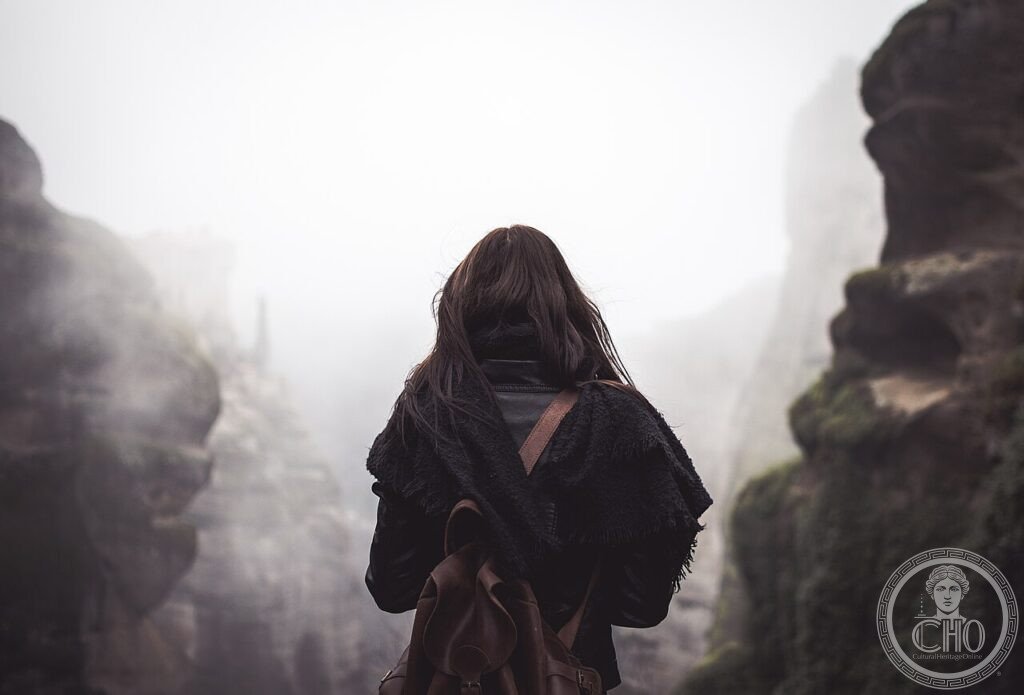
Meteora
One of the most dramatic religious landscapes in the world and the supreme expression of Byzantine monastic withdrawal from the secular world — Meteora (Kalambaka, Thessaly, Greece; UNESCO WHS 1988) places six inhabited Eastern Orthodox monasteries on the summits of sheer sandstone pinnacles rising up to 400m from the Thessaly plain, accessible for centuries only by rope ladders and baskets, now by carved stone staircases.
At a glance
Meteora (the most precisely Meteora single 14th 16th century Byzantine Eastern Orthodox monasteries 24 original 6 remaining Great Meteoron Varlaam Roussanou Nikolaos Anapafsas Holy Trinity Agios Stefanos Thessaly flysch pinnacles 60 million years UNESCO heritage: the geological origin: the sandstone pinnacles of Meteora are composed of flysch (alternating layers of hard sandstone and soft shale or mudstone) deposited at the bottom of a lake that covered the Thessaly plain approximately 60 million years ago; the lake drained when the surrounding mountains were uplifted (approximately 25-15 million years ago); the Peneios River then carved through the soft sediments, leaving the harder sandstone pillars standing as isolated monoliths; the highest reaches 613m (the Great Meteoron pinnacle), the lowest approximately 300m; the base of each pinnacle is a jumble of fallen rock debris (the talus); the monks (the first hermit monks arrived on the pinnacles in approximately the 11th century CE; the most remote pinnacles were accessible only by rope ladders (the baskets and nets (the first rope-and-basket transport system; supplies and people were hauled up in a net pulled by a winch); the baskets were still in use for supplies as recently as the 1930s CE; the stone stairways were cut during the 1920s CE to allow easier access for tourists and new monks)); the 6 surviving monasteries (of the 24 monasteries built between the 14th and 16th centuries CE (the peak of monastic habitation at Meteora: 14th-16th century CE; the historical context: the Ottomans conquered Thessaly in 1394 CE; the monasteries on top of the sheer pinnacles were the only Christian communities the Ottoman soldiers could not easily reach; this made Meteora a refuge for Byzantine art, manuscripts, and ecclesiastical culture during the Ottoman period; the monks preserved hundreds of Byzantine manuscripts and icons from destruction)) — the most precisely Meteora single 14th 16th century Byzantine Eastern Orthodox monasteries 24 original 6 remaining Great Meteoron Varlaam Roussanou Nikolaos Anapafsas Holy Trinity Agios Stefanos Thessaly flysch pinnacles 60 million years UNESCO heritage in any UNESCO world heritage site)).
Key facts
- The Great Meteoron Monastery: the most precisely Meteora single Great Meteoron Holy Monastery of Transfiguration 14th century Athanasios the Meteorite oldest highest katholikon 1387 UNESCO heritage — the largest and oldest monastery at Meteora: the Holy Monastery of the Great Meteoron (Monì tou Megalou Meteorou; Transfiguration of Christ); founded by Athanasios the Meteorite (the monk Athanasios of Athos arrived in Meteora approximately 1356 CE; he was joined by the Serbian king John VI Kantakouzenos, who abdicated to become the monk Ioasaph; together they expanded the small earlier hermit cells into the first large monastery complex on the pinnacle (1356-1387 CE)); the current katholikon (the main church; 1545 CE; the nave with a beautiful wooden iconostasis; the narthex with extensive frescoes depicting scenes of martyrdom (the Cretan school; approximately 1552 CE)); the ossuary (every monastery at Meteora has an ossuary; when a monk dies, he is buried for 3 years and then his bones are exhumed and placed in the ossuary; the skull is marked with the monk’s name; the visual impact of a room full of hundreds of skulls is unexpected and not for the faint-hearted)
- GPS: 39.7217° N, 21.6306° E
History
From hermits to the UNESCO frontier (the most precisely Meteora single 11th century hermit monks Nikodemos 1340 Athanasios Meteorite Ioasaph Serbian king 1356 24 monasteries Ottoman 1394 refuge Byzantine manuscripts Papadiamantis tourist 1920 stairways UNESCO 1988 heritage: the history: the first monks (the first known monk at Meteora is named Nikodemos (approximately 10th-11th century CE; a hermit who lived in one of the natural caves at the base of the pinnacles)); the hermit-to-monastery transition (approximately 1344 CE: a group of hermit monks established a small community on a broad ledge of rock approximately 413m high called the Platys Lithos (Broad Rock); approximately 1356 CE: Athanasios the Meteorite arrived from Mount Athos (the great monastic republic of northern Greece)); the monastic golden age (14th-17th century CE; the period of maximum building and population; 24 functioning monasteries are documented; the number of monks and nuns at the peak (approximately the 15th-16th century CE) may have been 2,000-3,000 individuals; the Ottoman context (the Ottoman conquest of Thessaly (1393-1394 CE) paradoxically created ideal conditions for Meteora’s growth: the inaccessibility of the pinnacles protected the communities from Ottoman interference, tax collectors, and soldiers; the monasteries became the safest depositories of Byzantine art, manuscripts, and ecclesiastical archives in all of Greece)); the decline (18th-19th centuries CE; the monasteries declined due to the decrease in Ottoman threat, the growing accessibility of the valleys, and reduced monastic vocations); the modern period (1920 CE: stone stairways cut into the rock faces; 1988 CE: UNESCO inscription as a mixed natural and cultural World Heritage Site); the James Bond connection (Meteora is one of the most recognizable UNESCO sites that many visitors don’t recognize by name: the climax of the Bond film “For Your Eyes Only” (1981 CE) was filmed entirely at Meteora, including the climactic scene on the summit of the monastery and the dramatic fight on the rope ladder)) — the most precisely Meteora single 11th century hermit monks Nikodemos 1340 Athanasios Meteorite Ioasaph Serbian king 1356 24 monasteries Ottoman 1394 refuge Byzantine manuscripts Papadiamantis tourist 1920 stairways UNESCO 1988 heritage in any UNESCO world heritage site)).
What you see
Six monasteries, each a world (the most precisely Meteora single Great Meteoron Varlaam frescoes Cretan school Roussanou convent Holy Trinity 140 steps Agios Stefanos James Bond For Your Eyes Only sunset viewpoint Kalambaka UNESCO heritage: the six open monasteries: the Great Meteoron (the largest; on the highest pinnacle; the 14th-century katholikon with 1552 CE narthex frescoes; the ossuary; the museum (Byzantine icons and manuscripts)); Varlaam (the second-largest; distinctive for the 16th-century narthex frescoes (better preserved than the Great Meteoron); the large net-haulage machine (the wooden winch used to haul up supplies until the 20th century CE) still on display); Holy Trinity (the most dramatically perched; accessible via 140 steps cut into the rock face; the monastery appears in the Bond film “For Your Eyes Only”); Roussanou (now a convent; the most accessible; visible from the road; the 16th-century frescoes of the Apocalypse (Revelation) cycle — the most graphic frescoes at Meteora, showing scenes of judgment and damnation in vivid Byzantine palette)); the viewpoint (the best overall view is from the road between Varlaam and the Great Meteoron at sunset: the twin pinnacles catch the last light while the Thessaly plain turns golden below) — the most precisely Meteora single Great Meteoron Varlaam frescoes Cretan school Roussanou convent Holy Trinity 140 steps Agios Stefanos James Bond For Your Eyes Only sunset viewpoint Kalambaka UNESCO heritage in any UNESCO world heritage site)).
Practical information
- Getting there: Kalambaka (the nearest town; at the foot of the Meteora pinnacles; 360 km northwest of Athens by road (4h); direct train from Athens (Larissa Station; approximately 4h30m-5h; Hellenic Railways; 4-5 daily); from Thessaloniki (165 km east; 2h by car; or train 3h)); accommodation (Kalambaka has a full range of hotels and guesthouses; Meteora area hotels (more expensive but you’re inside the UNESCO zone; some with direct pinnacle views); the most scenic views are from the road to the monasteries at 600-700m elevation (several small guesthouses)); entry fees (each monastery charges approximately €3 for entry; a combined day ticket is not available (you pay separately at each); opening hours vary by monastery and season (08:00-17:00 in winter, 09:00-17:00 in summer; closed on different days of the week for different monasteries — check the official Meteora website before visiting); dress code (mandatory: women must wear a skirt (a wrap is available at the entrance of most monasteries) and cover arms; men must wear long trousers and covered shoulders); the sunrise viewpoint (the road circuit is driveable by car and accessible by bicycle; the monasteries open from 09:00 so the circuit can be done by scooter or bicycle starting from Kalambaka; alternatively, guided group tours from Kalambaka leave approximately 09:00 and cover 3-4 monasteries in half a day)
Getting there
Kalambaka town at the foot of the pinnacles. Train from Athens ~4h30m. Car 4h. Each monastery charges ~€3 entry. Dress code mandatory. Best at sunset. GPS: 39.7217, 21.6306.
Nearby
- Delphi — 170 km south (UNESCO WHS 1987); the sanctuary of Apollo and the Pythian Oracle (the Temple of Apollo (4th century BCE; the only partly-standing ancient temple of Greece with surviving columns in the standing position at Delphi); the theater (the finest Greek theater outside of Epidaurus; 35 rows of limestone seats; the view from the stage down the olive-grove valley to the Corinthian Gulf 10 km away is one of the great theatrical views in the world); the stadium (the best-preserved Greek stadium in mainland Greece; 178m long; 18 rows of limestone seats))
- Thermopylae — 220 km south (the pass where 300 Spartans held off the Persian army of Xerxes for 3 days in 480 BCE; the modern monument (the statue of Leonidas and the Spartan epitaph); the hot springs (Thermopylae means “hot gates”; the thermal springs that gave the pass its name still flow))
Sources
- Wikipedia, Meteora; Great Meteoron; Athanasios the Meteorite, accessed June 2026
- UNESCO, Meteora, WHS reference 455, inscribed 1988 (mixed)
Find it on the map
See this place and what’s around it →📷 Diventa un fotografo di Cultural Heritage Online
Condividi le tue foto dei luoghi: restano pubblicate con la tua firma come autore. Più vengono viste, più ti fai conoscere — e presto un concorso premierà le foto più apprezzate.
Accedi o registrati gratis per aggiungere una foto