
The oldest agricultural village yet discovered in Egypt and one of the oldest in Africa north of the Sahara — occupied from approximately 5000 to 4100 BC, a full millennium before the first pharaohs and home to what may be the oldest modelled human portrait in Africa.
At a glance
On the desert edge at the western margin of the Nile Delta in Lower Egypt, approximately 60 km northwest of Cairo, Merimde Beni-Salama preserves the stratified remains of the oldest agricultural village discovered in Egypt. The site was occupied from approximately 5000 to 4100 BC — a span of 900 years that predates the first pharaonic dynasties by a full millennium and the construction of the Giza pyramids by approximately 2,000 years. Its three cultural phases (Merimda I–III) document the emergence of settled farming and animal husbandry in the Nile Delta, and its burials include what is believed to be the oldest modelled human portrait head in Africa: a small terracotta face dated approximately 5000 BC.
Key facts
- Location: Western margin of the Nile Delta, approximately 60 km northwest of Cairo, Lower Egypt
- Period of occupation: c. 5000–4100 BC (Merimda I, II, and III cultural phases; approximately 900 years continuous occupation)
- Site area: Approximately 180,000 m² at maximum extent
- Stratigraphy: Approximately 2.1 metres of stratified deposit, among the deepest Neolithic sequences in Egypt
- Economy: Mixed emmer wheat and barley agriculture, cattle and pig husbandry, hunting, and Nile Delta fishing
- Notable find: Small terracotta portrait head, c. 5000 BC — believed to be the oldest modelled human portrait in Africa
- Excavation history: Hermann Junker (Austrian Archaeological Institute), five seasons 1928–1939; Egyptian Antiquities Organisation, 1970s–1980s
History
Merimde Beni-Salama was established around 5000 BC by a farming community that had adopted the agricultural package — emmer wheat, barley, cattle, pigs — that had spread westward from the Near East via the Fertile Crescent and Sinai into the Nile Valley. The site’s location on the desert edge of the western Delta, at the transition between the cultivable alluvial plain and the arid Libyan desert, gave it access to both agricultural land along the Delta channels and the hunting and fishing resources of the desert fringe and Delta marshes. The three cultural phases identified at Merimde represent a 900-year sequence of gradual development: the earliest phase (Merimda I) is characterised by small oval semi-subterranean reed huts and relatively simple material culture; the later phases show larger settlement extent, more elaborate storage facilities, and increasingly standardised pottery forms.
Hermann Junker of the Austrian Archaeological Institute conducted the foundational excavations in five seasons between 1928 and 1939, identifying the principal cultural phases and recovering the remarkable terracotta head that has become the site’s most famous object. Subsequent work by the Egyptian Antiquities Organisation in the 1970s and 1980s refined the chronology and extended the known settlement area. The site has not been the subject of major recent fieldwork and remains incompletely excavated; a substantial portion of the original deposit is believed to survive.
The people of Merimde predate Egyptian writing and formal art production by approximately 1,500 years, and their relationship to later predynastic cultures (Badarian, Naqada) and ultimately to pharaonic Egypt is debated. The site stands at the beginning of a cultural sequence that would eventually produce one of the world’s most spectacular civilisations — making it foundational to any understanding of Egyptian cultural origins, even though almost nothing is visible at the site today.
What you see
Unlike the great monuments of pharaonic Egypt, Merimde Beni-Salama has no standing structures. The Neolithic village consisted of oval semi-subterranean reed huts approximately 2–3 metres in diameter, storage pits lined with basketry, hearths, and a communal food-storage area — all of which have been reduced over six millennia to a low mound of compacted earth and debris. The site is a classic tell (occupation mound), identifiable in the flat Delta landscape by its slight elevation above the surrounding fields, but not visually dramatic in the way that masonry ruins are.
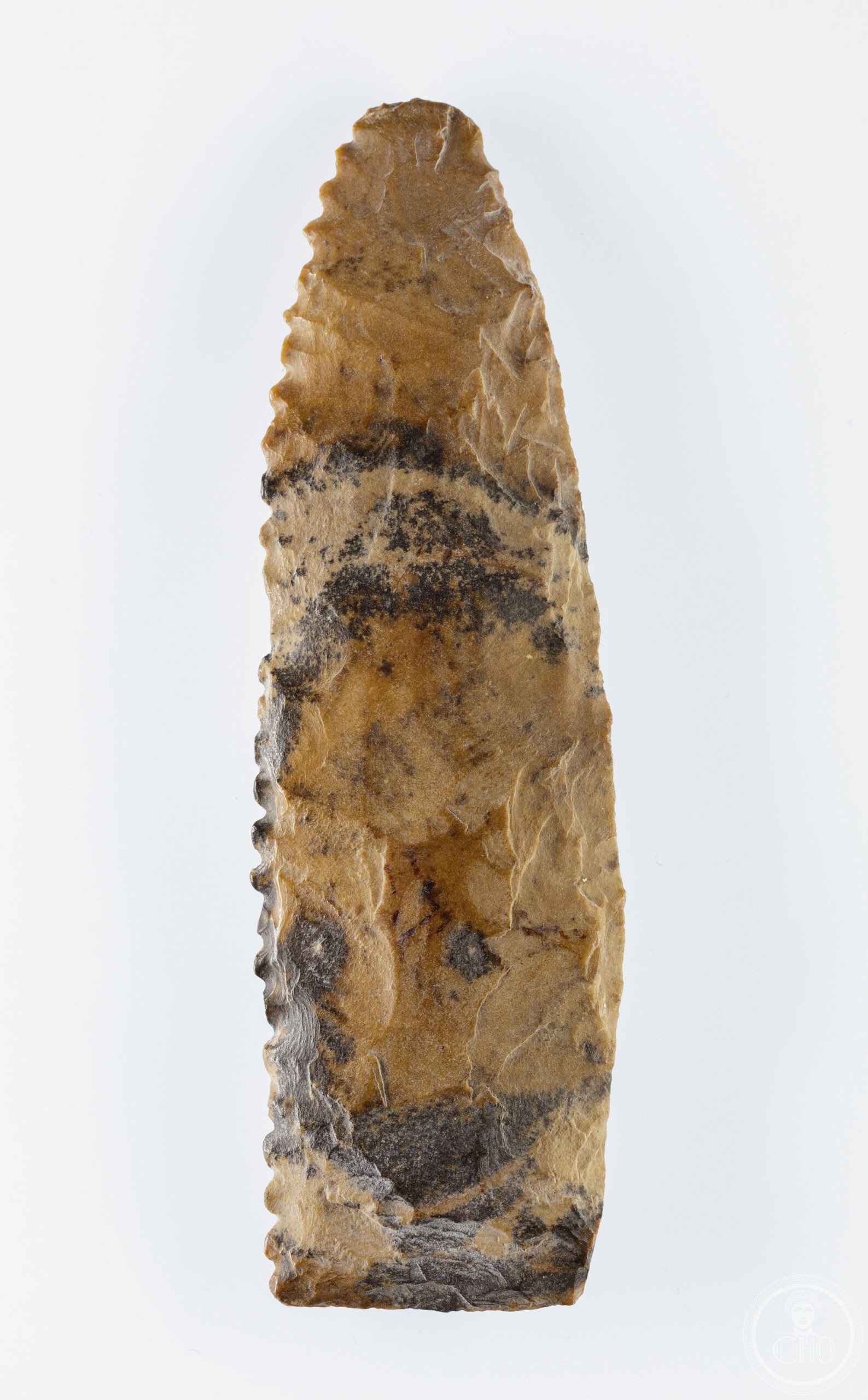
The material culture recovered from Merimde — pottery, flint tools including the bifacial sickle inserts now in international museum collections, bone and ivory objects, animal bones, and carbonised grain — is distributed among the Egyptian Museum in Cairo, the Kunsthistorisches Museum in Vienna (Junker’s collection), and the Metropolitan Museum of Art in New York. The terracotta portrait head is held in the Egyptian Museum, Cairo. For visitors interested in Merimde’s legacy, the Egyptian Museum’s predynastic galleries are the most rewarding destination.
Practical information
- Site access: The site is in a rural agricultural area northwest of Cairo; access is possible but requires a private vehicle and local navigation; no organised visitor infrastructure exists
- For the finds: The Egyptian Museum in Cairo (Tahrir Square) holds key Merimde material including the terracotta portrait head; open daily, admission approximately 200 EGP for foreign visitors
- Recommended approach: Combine with the Egyptian Museum visit in Cairo rather than travelling to the site itself, which offers little to see in situ
- Research access: For academic visits, contact the Ministry of Antiquities and Tourism, Cairo
Getting there
Merimde Beni-Salama is approximately 60 km northwest of Cairo in the western Delta, accessible by road via the agricultural villages north of the Nile Delta margin. The site is not formally open to tourists and has no visitor infrastructure. The nearest city is Cairo; the nearest international airport is Cairo International (CAI). For most visitors, the Egyptian Museum in Cairo (45 minutes from the city centre) is the practical destination for engagement with Merimde’s cultural legacy, as it holds the most significant finds from the site.
Nearby
- Egyptian Museum, Cairo — holds the Merimde terracotta portrait head and other predynastic material; essential companion visit
- Giza Plateau — approximately 70 km southeast, the pyramids and Great Sphinx built approximately 2,500 years after Merimde’s peak occupation
- Wadi Natrun monasteries — approximately 50 km south, ancient Coptic Christian monasteries in the desert between Cairo and Alexandria
- Alexandria — approximately 180 km northwest along the Delta coast, with the Greco-Roman Museum and Catacombs of Kom el-Shoqafa
Sources
- Junker, H. (1929–1940). Gîza I–XII / Vorläufiger Bericht über die Grabungen auf der neolithischen Siedlung Merimde-Benisalâme. Akademie der Wissenschaften, Vienna.
- Eiwanger, J. (1984). Merimde-Benisalâme I: Die Funde der Urschicht. Deutsches Archäologisches Institut, Cairo.
- Hassan, F. A. (1988). The Predynastic of Egypt. Journal of World Prehistory 2(2): 135–185.
- Midant-Reynes, B. (2000). The Prehistory of Egypt: From the First Egyptians to the First Pharaohs. Blackwell, Oxford.
- Wikipedia contributors. “Merimde Beni-Salama.” Wikipedia, The Free Encyclopedia. Accessed 2026.
Find it on the map
See this place and what’s around it →📷 Become a Cultural Heritage Online photographer
Share your photos of places: they stay published under your name as the author. The more they're seen, the more you get noticed — and soon a contest will reward the most appreciated photos.
Log in or sign up free to add a photo