

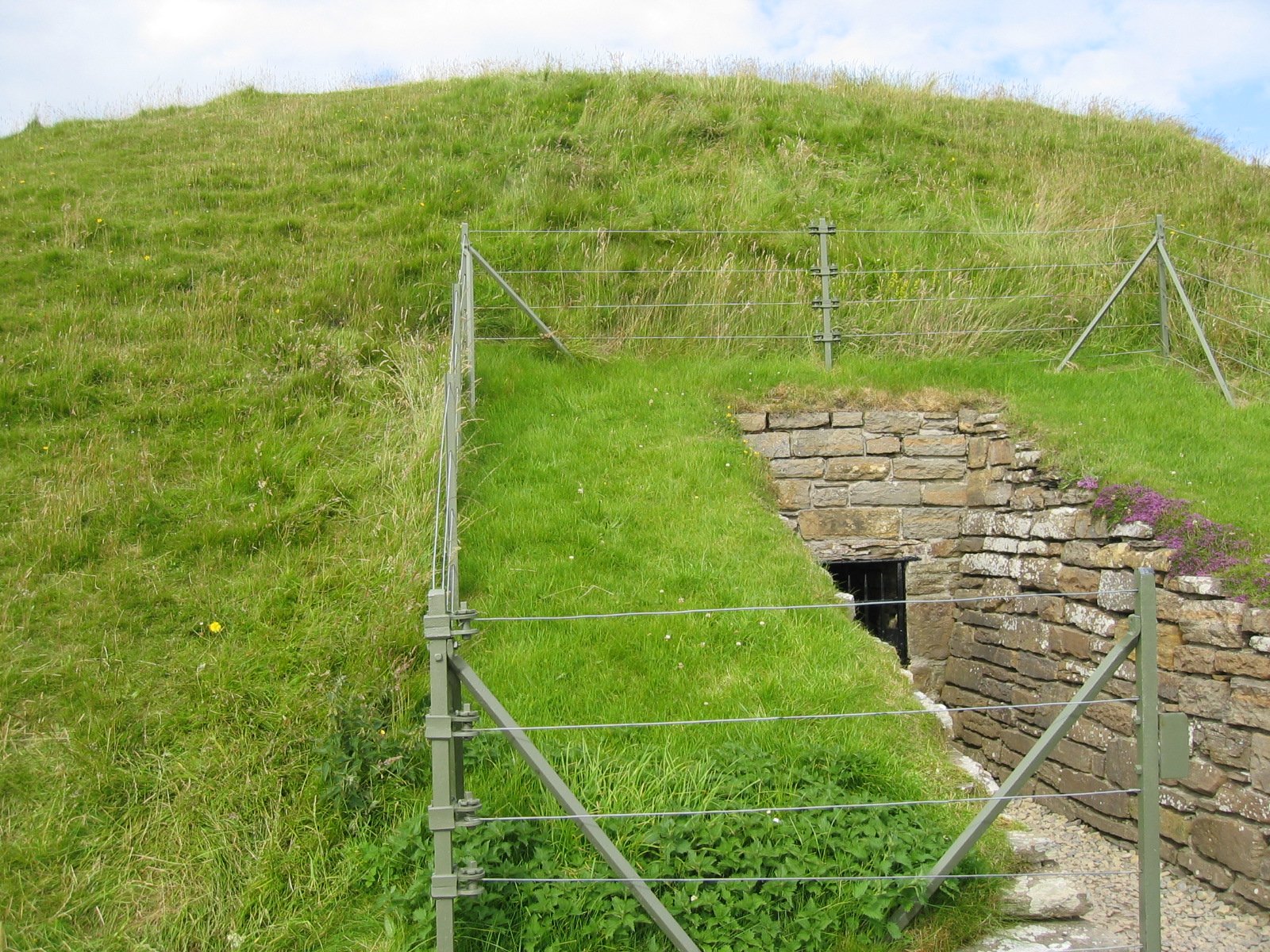
Built around 2800 BC on Orkney’s Mainland island, Maeshowe is contemporary with Stonehenge and older than the Pyramids — a passage tomb so precisely engineered that the setting sun illuminates its inner chamber on the winter solstice. Three thousand years after its builders died, Viking crusaders broke in during a blizzard and left the largest collection of runic graffiti in the world.
At a Glance
Maeshowe stands on a low artificial mound on the flat plain of the West Mainland of Orkney, four kilometres east of Stromness. It is part of the UNESCO World Heritage property “Heart of Neolithic Orkney” (1999), inscribed alongside the Standing Stones of Stenness, the Ring of Brodgar, and Skara Brae. The chamber is accessed by a low, 11-metre entrance passage aligned precisely with the setting sun at the winter solstice. Entry is by guided Historic Environment Scotland tour only — tickets sell out weeks in advance.
The Neolithic Engineering
Maeshowe was built c. 2800 BC by Neolithic farmers using tools of stone, bone, and antler. The central chamber measures roughly 4.5 metres square and stands 3.8 metres high. The walls are built of enormous flagstone slabs — some individual stones weigh up to three tonnes — fitted without mortar to right-angle corners that modern bricklayers struggle to replicate. The largest slabs measure up to three metres in length. Three side cells open off the main chamber, each originally sealed by a large stone that could be rolled into place. The entire structure is covered by a 7.3-metre-high earthen mound. The engineering precision, achieved without metal tools, remains one of the most remarkable feats of the Neolithic world.
The Winter Solstice Alignment
The most dramatic feature of Maeshowe is invisible for most of the year. The 11-metre entrance passage faces the setting sun at the winter solstice with geometric precision. For approximately three weeks around 21 December, the last light of the afternoon sun shines directly down the passage and illuminates the back wall of the central chamber in an intensifying beam of gold. On the solstice itself, the effect lasts for about 45 minutes before the sun drops below the horizon. On all other days of the year, the chamber is entirely dark. The alignment is so precise — one archaeological survey found it accurate to within half a degree — that it cannot have been accidental.
The Viking Intrusion: c. 1153 AD
For approximately 3,600 years, Maeshowe sat undisturbed. Then, in the winter of c. 1153 AD, a group of Norsemen — identified by the Orkneyinga Saga as part of the crusading party of Jarl Rognvald Kali Kolsson, bound for Jerusalem — were caught in a snowstorm and sheltered inside the tomb. Over the course of several days, they carved runic inscriptions into the walls of the chamber and passage. The Saga records that two men went mad during the storm; the cramped darkness of a 5,000-year-old tomb in a blizzard may have had something to do with it.
The Runic Graffiti
The result is 30 runic inscriptions: the largest single collection of Viking-age runic graffiti anywhere in the world, and one of the most extensive bodies of rune-carving outside Scandinavia. The inscriptions are vivid in their ordinariness. “Ingigerth is the most beautiful of all women” was carved next to a drawing of a drooling dog. “Hákon alone bore treasure out of this mound” (a claim that may or may not be true, and that was clearly contested by the other inscribers). “Many a proud woman has had to stoop to enter here.” “This was carved by the best rune-carver in the western ocean” — and nearby, a second carver offered a quietly sceptical response in runes. The inscriptions date by linguistic analysis to the 12th century and are entirely consistent with the Saga account. They are among the most humanizing objects in archaeology: the voices of medieval Norwegian crusaders sheltering from a blizzard in a Stone Age tomb, doing what people have done on walls since the beginning of time.
The Heart of Neolithic Orkney
Maeshowe is not an isolated monument. Within 5 km stand the Standing Stones of Stenness (c. 3100 BC, the earliest stone circle in Britain), the Ring of Brodgar (c. 2500 BC, 104 metres in diameter with 27 of its original stones still standing), and Skara Brae (c. 3180 BC, the best-preserved Neolithic village in Northern Europe, buried under sand until a storm exposed it in 1850). Together these form the Heart of Neolithic Orkney UNESCO World Heritage Site. Ongoing excavations at the nearby Ness of Brodgar — a massive Neolithic building complex discovered in 2003 — are still active and continue to reveal new aspects of the social world that built Maeshowe.
Practical Information
Maeshowe is managed by Historic Environment Scotland. Access is by pre-booked guided tour only; the entrance passage requires crouching, and the chamber accommodates small groups only. Tours depart from the Tormiston Mill visitor centre on the A965 road near Stenness. The winter solstice tours (distributed by ballot) are among the most sought-after heritage experiences in Britain. Combine with visits to the Standing Stones, Ring of Brodgar, and Skara Brae in a single day. Stromness (ferry port from mainland Scotland) is 6 km west; Kirkwall is 15 km east.
Sources & Resources
- Historic Environment Scotland — Maeshowe
- UNESCO World Heritage Centre — Heart of Neolithic Orkney
- Wikipedia: Maeshowe
- Michael Barnes, The Runic Inscriptions of Maeshowe, Orkney (Uppsala, 1994)
- Caroline Wickham-Jones, Orkney: A Historical Guide (Birlinn, 2015)
Find it on the map
See this place and what’s around it →📷 Become a Cultural Heritage Online photographer
Share your photos of places: they stay published under your name as the author. The more they're seen, the more you get noticed — and soon a contest will reward the most appreciated photos.
Log in or sign up free to add a photo