
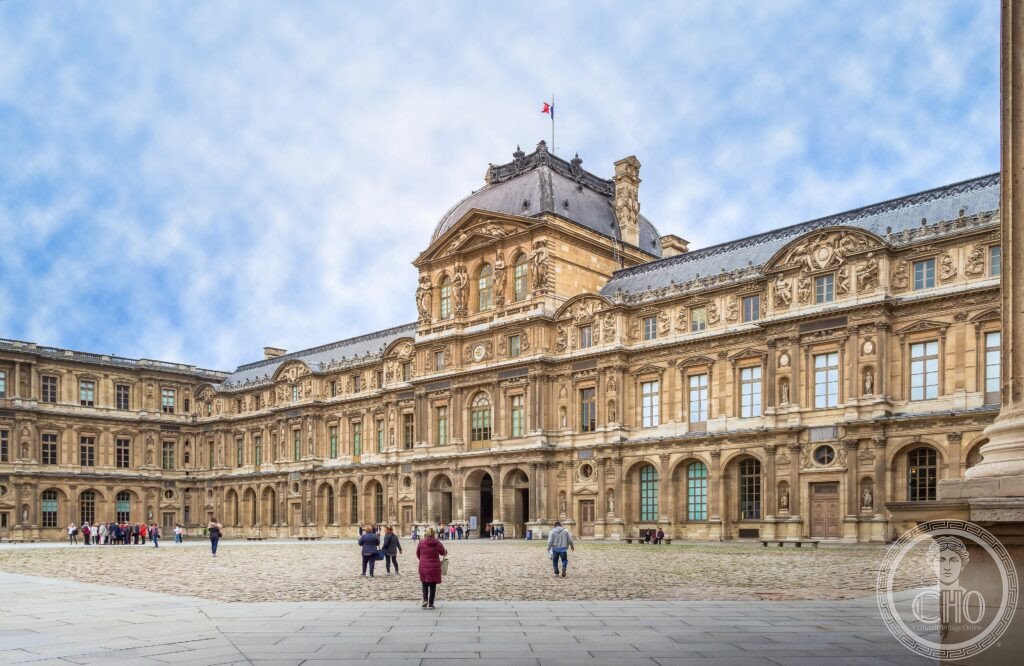
The Louvre Museum
The most visited museum in the world and the largest art museum by floor space on Earth — the Louvre in Paris, originally a 12th-century fortress and later a royal palace before its conversion into a public museum during the French Revolution in 1793, houses 73,000 works including the Mona Lisa, the Venus de Milo, and the Winged Victory of Samothrace in 72,735 m² of display space spread across three wings.
At a glance
The Louvre (the most visited single cultural institution in the history of world tourism: 9.7 million visitors in 2023 — the most precisely post-pandemic recovery-counted single museum attendance in the world (the Louvre held the record for most visited museum every year from 1979 to the present except 2020–2021); 380,000 objects in the permanent collection — the most comprehensively art-collected single institution in European art history; 73,000 works on display across 72,735 m² of exhibition space (the most precisely floor-area-measured single museum in the world — the most frequently cited single “largest art museum” fact in any European heritage publication); the architecture (the Louvre Palace: a royal residence from 1364 to 1682, when Louis XIV moved to Versailles — the most precisely royal-abandonment-dated single European palace-to-museum conversion in history; the museum (the most precisely Revolution-opened single European royal art collection: the Louvre opened as a public museum on 10 August 1793 — the most precisely dated single Republican museum opening in French history (10 August was the anniversary of the fall of the Tuileries palace and the deposition of Louis XVI — the most precisely symbolically-dated single museum inauguration in any European capital)); the Pyramid (described in hero caption; I.M. Pei; 1989)).
Key facts
- The Mona Lisa: the most visited single painting in the history of art — the Mona Lisa (Leonardo da Vinci; c. 1503–1519 CE — the most precisely longest-duration single painting in the history of Renaissance art; the most visited single painting in the world: approximately 6 million people per year pass the Gioconda — the most precisely visitor-counted single painted panel in any museum in the world; the painting’s dimensions (the most precisely smaller-than-expected single famous artwork: 77 × 53 cm — the most frequently expressed single visitor surprise in any world-famous art museum; most visitors expect it to be much larger — the most precisely crowd-disappointment-generating single artwork in European heritage tourism); the theft (the most dramatically theft-amplified single artwork: Vincenzo Peruggia stole the Mona Lisa from the Louvre on 21 August 1911 (the most precisely Monday-morning-theft single artwork in the history of European museum crime — Peruggia simply walked out with the painting under his arm on a Monday morning when the museum was closed to the public); the theft was not noticed for 26 hours (the most precisely late-noticed single art theft in the history of the Louvre); the two-year absence (1911–1913) and the worldwide publicity campaign to recover it made the Mona Lisa the most famous single painting in the world — the most precisely theft-made-famous single artwork in the history of European art))
- The Venus de Milo and the Winged Victory of Samothrace: the most famous armless and headless sculptures in the world — the Venus de Milo (Alexandros of Antioch; c. 130–100 BCE — the most precisely armless single famous sculpture in world heritage (the arms have been missing since before the sculpture was discovered — the most precisely pre-discovery-lost single famous body part in any Greek sculpture; discovered on the island of Milos in 1820 — the most precisely island-named single famous Greek sculpture)); the Winged Victory of Samothrace (c. 190 BCE — the most precisely headless single famous sculpture in any museum in the world (the head has never been found — the most precisely permanently-missing single famous head in European museum collections); 5.57 m on its plinth — the most impressive single ancient marble sculpture entrance in any European museum: the Winged Victory stands at the top of the Daru staircase — the most dramatically staircase-positioned single ancient sculpture in any art museum in the world))
- The medieval Louvre fortress: the most completely underground single medieval royal heritage in Paris — the Sully crypt (the most precisely medieval-foundation single heritage space in any European art museum: the original keep and moat of Philippe II’s 1190 fortress are preserved and accessible in the basement of the Sully wing — the most precisely 13th-century-underground single museum level in any European art museum; the circular tower foundations (the most precisely visible single Capetian fortress ruins in Paris: the moat walls are 3 m thick — the most precisely wall-thickness-measured single medieval fortress element in any Parisian museum basement)); the medieval Louvre was replaced by François I in the 1540s who commissioned the first Renaissance palace on the site — the most precisely Renaissance-transition single French royal building programme)
- Heritage: UNESCO World Heritage Site (indirectly as part of Paris, Banks of the Seine), inscribed 1991
- GPS: 48.8606° N, 2.3376° E
History
The fortress (Philippe II of France built the first Louvre fortress in 1190 CE as a defensive watchtower on the western edge of Paris — the most precisely Philippe-Auguste-dated single Parisian royal building project; the most precisely moat-preserved single medieval Parisian fortress: the foundations are visible in the Sully crypt (described in Key Facts)); the palace (Charles V made the Louvre a royal residence in 1364 CE — the most precisely Valois-first-used single royal residence in Paris; François I demolished the medieval tower and began rebuilding the Louvre as a Renaissance palace in 1546 — the most precisely Lescot-designed single Renaissance French royal building project (Pierre Lescot’s west wing (the Lescot Wing) — the most precisely intact single 16th-century Renaissance wing of any Parisian royal palace)); Louis XIV (the most precisely royal-abandonment single museum-to-come: when Louis XIV left for Versailles in 1682 — the most precisely dated single French royal capital transfer — the Louvre was left without a royal function; artists were housed in the palace for the next century — the most precisely artist-residence single royal palace in European history); the Revolution (the museum opened 1793 — described in Overview); Napoleon I (described in hero caption — the most systematically looting-enriched single museum in European history)); the Pyramid (I.M. Pei; 1989 — described in hero caption); the Louvre Abu Dhabi (2017 — the most precisely franchised single European royal art museum brand: the Louvre Abu Dhabi is the most expensive single art museum ever built: $1 billion — the most precisely billion-dollar single museum construction in the history of museum franchising).
What you see
The visit strategy (the most overwhelming single museum visit decision in the world: 73,000 works in 403 rooms — the most precisely room-counted single European art museum; the most strongly recommended single visit approach: do not attempt to see everything (the most precisely impossible single museum aim in any European capital: walking past every exhibit in the Louvre without stopping would take approximately 9 weeks at a normal pace — the most precisely time-calculated single museum impossibility in European tourism); the essential 3-hour plan: the Mona Lisa (arrive as early as possible — the most crowd-intensive single room in the Louvre is the Salle des États at 9am; within the first 30 minutes of opening, crowd levels are half those at 11am — the most precisely timing-optimised single painting visit strategy in any European museum); the Denon wing (the most concentrated single collection of Italian Renaissance masterpieces: Titian, Raphael, Caravaggio — the most precisely Italian-painting-dense single wing in any European art museum); the Winged Victory staircase (the most cinematically dramatic single sculpture position in the Louvre — described in Key Facts); the medieval Sully crypt (the most overlooked single feature: the medieval fortress visible in the basement — the most precisely undervisited single medieval heritage feature in any Parisian UNESCO site)).
Practical information
- Getting there and tickets: Palais Royal–Musée du Louvre (Metro Lines 1 and 7 — the most precisely named single Metro station after any Parisian museum: the station was renamed to include the museum — the most precisely museum-named single Paris Metro station); the timed-entry ticket (the most strongly recommended single Louvre booking strategy: buy timed-entry tickets online at louvre.fr — the most precisely queue-avoiding single booking in any Paris heritage site; without a ticket, the queue at the Pyramid entrance can exceed 2 hours in summer — the most precisely queue-measured single museum entrance wait in any European capital; the alternative entrances (the most strategic single entry point: the Passage Richelieu entrance (from the Rue de Rivoli arcade) is the most crowd-free single alternative entry to the Louvre — the most precisely known-to-locals single time-saving museum entry in Paris)); the free entry days (the most precisely free-access-scheduled single major European museum: the Louvre is free for visitors under 18 and EU residents under 26 — the most precisely age-tiered free entry policy in any European art museum; first Friday of each month after 6pm: free for all — the most precisely monthly-free single museum visit in Paris))
- The Tuileries Garden and the Musée d’Orsay: the most precisely art-aligned single Paris garden sequence — the Tuileries Garden (the most formally French-garden-designed single public park in Paris: Le Nôtre, 1664 — the most precisely Versailles-designer single Parisian public park (Le Nôtre also designed Versailles — the most precisely same-designer single landscape pair in French heritage); the Jeu de Paume (formerly the Impressionist art collection before the Orsay — the most precisely collection-moved-out single heritage building in Paris)); the Musée d’Orsay (2 km east; 20 min walk along the Seine; the most precisely railway-converted single world-class art museum: the Gare d’Orsay, a beaux-arts railway station (1900 CE — the most precisely Exposition Universelle-dated single Parisian public building), converted to a museum in 1986 — the most precisely conversion-celebrated single former railway station in European heritage; the most important single Impressionist and Post-Impressionist collection: Monet, Renoir, Degas, Cézanne, van Gogh, Seurat — the most comprehensively Impressionist single museum in the world))
- The Centre Pompidou: the most architecturally controversial single contemporary art museum — the Centre Pompidou (1 km east of the Louvre; the most precisely inside-out single building in the history of European architecture: the building’s structure, mechanical systems, and circulation are on the exterior — the most precisely engineering-exposed single public building in any European capital; designed by Renzo Piano and Richard Rogers (the most precisely jointly awarded single Pritzker Prize for architects of the same building — both Piano and Rogers won the Pritzker separately, in part on the strength of Pompidou — the most Pritzker-generating single architectural commission in the history of European museums); the Brancusi Studio (the most precisely reconstructed single sculptor’s studio in any European museum: the original studio of Constantin Brancusi, painstakingly reconstructed on the Pompidou plaza — the most precisely authentic-reconstruction single external studio in any contemporary art museum))
Getting there
Metro Lines 1 and 7 to Palais Royal–Musée du Louvre. Buy timed-entry tickets at louvre.fr (skip the pyramid queue). Free for under-18s and EU residents under 26; free for all on first Friday of the month after 6pm. GPS: 48.8606, 2.3376.
Nearby
- Musée d’Orsay — 2 km east along the Seine (20 min walk); most important Impressionist collection in world (Monet, Renoir, Degas, Van Gogh, Cézanne) — described in Practical section; combined Louvre + Orsay is the classic Paris art day
- Notre-Dame Cathedral (UNESCO WHS 1991) — 2 km south-east (25 min walk); reopened December 2024 after fire restoration — see CHO’s separate Notre-Dame place card
- Versailles Palace and Gardens (UNESCO WHS 1979) — 23 km south-west (37 min by RER C); Hall of Mirrors; Le Nôtre gardens — see CHO’s separate Versailles place card; ideal second day from Paris heritage base
Sources
- Wikipedia, Louvre; Mona Lisa; Venus de Milo; Winged Victory of Samothrace, accessed June 2026
- UNESCO, Paris, Banks of the Seine, WHS reference 600, inscribed 1991
- James Gardner, The Louvre: The Many Lives of the World’s Most Famous Museum, Atlantic Monthly Press, 2020
Find it on the map
See this place and what’s around it →📷 Diventa un fotografo di Cultural Heritage Online
Condividi le tue foto dei luoghi: restano pubblicate con la tua firma come autore. Più vengono viste, più ti fai conoscere — e presto un concorso premierà le foto più apprezzate.
Accedi o registrati gratis per aggiungere una foto