
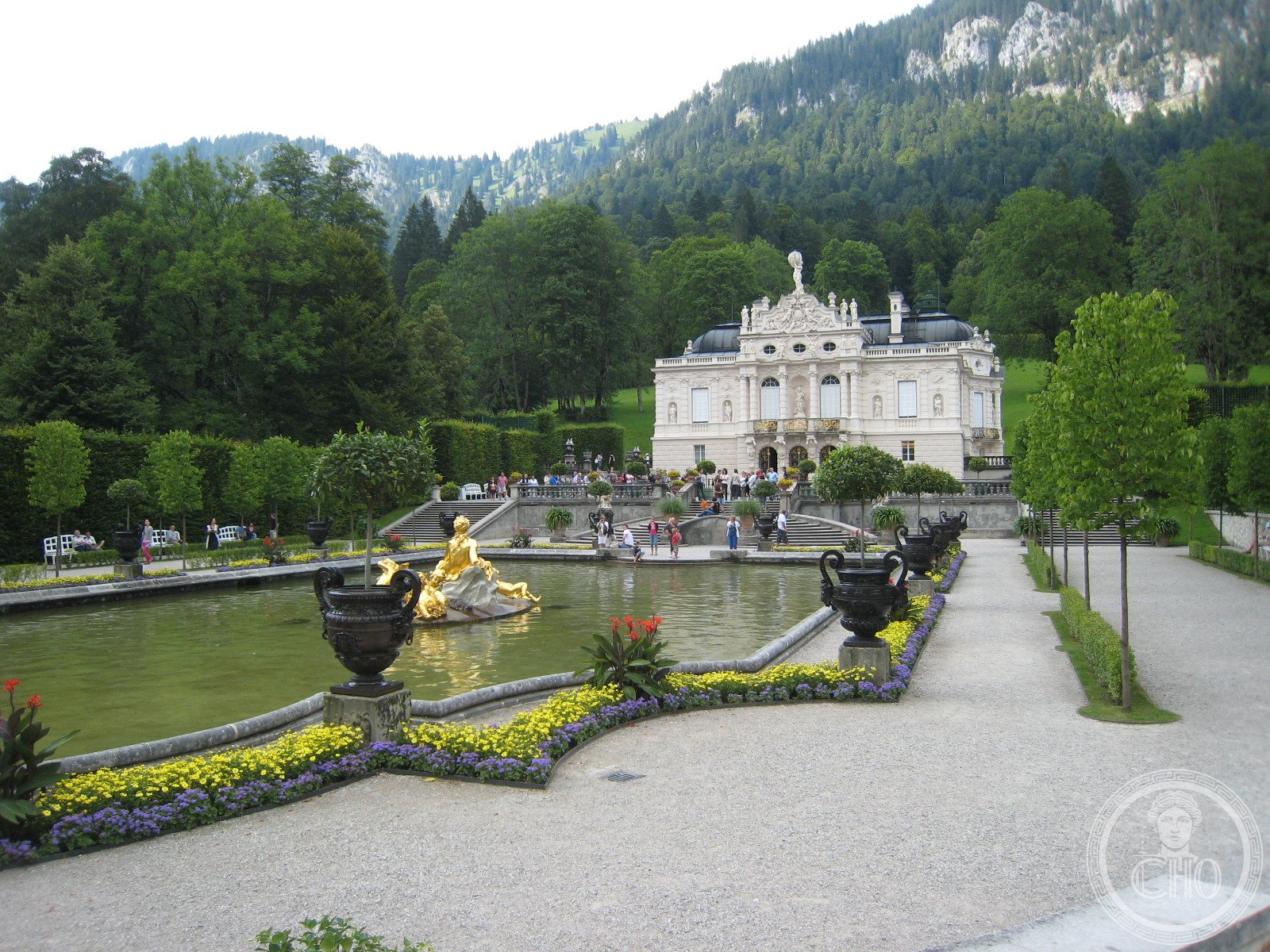
Linderhof Castle
Linderhof Palace (Schloss Linderhof) is a late-nineteenth-century royal palace in the Bavarian Alps, built by King Ludwig II of Bavaria between 1863 and 1886 as his most intimate private retreat. The smallest of the three palaces commissioned by Ludwig II, Linderhof is the only one he lived to see completed, and it remains one of the best-preserved expressions of his visionary — and fantastical — approach to royal architecture. Set within elaborately designed formal gardens in the Graswang Valley near Ettal, the palace and its grounds are among the most visited royal monuments in Germany.
At a glance
- Type
- Royal palace and gardens
- Period
- Construction 1863–1886; gardens laid out contemporaneously
- Style
- Rococo Revival; French Baroque garden design
- Location
- Linderhof 12, 82488 Ettal, Bavaria, Germany
- Coordinates
- 47.5716° N, 10.9586° E
- Current use
- State palace museum open to the public; administered by the Bavarian Palace Administration
Overview
Linderhof Palace is the jewel of the Graswang Valley, a richly decorated Rococo Revival building of modest scale that belies the extraordinary opulence of its interior, which Ludwig II designed almost entirely as a personal monument to the absolutist monarchy of Louis XIV of France. The palace stands at the centre of a formal French-style garden featuring cascading fountains, a Neptune fountain basin, and elaborately clipped hedges radiating outward from the building. Beyond the formal garden, the surrounding park contains a series of folly-like structures — including the Venus Grotto, an artificial stalactite cave inspired by Wagner's Tannhäuser — that transform the landscape into a stage set for Ludwig's romantic imagination.
History
Ludwig II initially used the site as a hunting lodge inherited from his father King Maximilian II, transforming a small timber building into a modest garden pavilion in the 1860s before deciding on a more ambitious palace project. Construction of the present palace began in 1863 and continued through successive expansions, with the main building substantially completed by 1878 and the final elements of the park finished by 1886, the year of Ludwig's mysterious death at Lake Starnberg. Unlike his grander projects — Neuschwanstein and Herrenchiemsee — Linderhof was conceived as a private refuge rather than a representative palace, which explains the intimacy of its scale and the extravagance of its private apartments. The palace passed to the Bavarian state after Ludwig's death and has been open to the public ever since.
What you see
The palace interior is a tour de force of Rococo Revival craftsmanship: the state bedroom — centred on a monumental blue-and-gold canopied bed — surpasses Versailles in decorative density within its modest dimensions, while the dining room features the famous "Tischlein-deck-dich" mechanical table that could be lowered to the kitchen below and raised fully set, allowing the king to dine alone without seeing servants. In the grounds, the Neptune Fountain shoots a jet of water 25 metres high, and the Venus Grotto — a man-made cave lit originally by an early electric system — recreates the first act of Wagner's Tannhäuser. The Moorish Kiosk and the Moroccan House, relocated follies from the 1867 and 1878 Paris World Exhibitions respectively, add an orientalist dimension to the park.
Cultural significance
Linderhof is inseparable from the cult of Ludwig II, the "Fairy-tale King" whose eccentric patronage of Wagner and obsessive building programme left Bavaria a legacy of romantic architecture that continues to attract millions of visitors annually. As the only palace Ludwig II completed and inhabited, it offers the most direct access to his personality of all his royal projects. The palace and grounds are protected as a monument of national significance and form part of the network of Bavarian Palace Administration royal residences that collectively constitute one of Europe's greatest ensembles of nineteenth-century royal architecture.
Practical information
- Address
- Linderhof 12, 82488 Ettal, Bavaria, Germany
- Opening hours
- April–October: daily 09:00–18:00; November–March: daily 10:00–16:00; closed 24 December and 1 January. Grotto and park buildings closed in winter — check www.schloss-linderhof.de for current schedules
- Admission
- Paid entry; combined tickets available for palace and park buildings; reduced rates for students, children under 18 free
Getting there
Linderhof Palace is located in the Graswang Valley, approximately 10 km west of Ettal and 26 km from Garmisch-Partenkirchen. By car, take the B23 federal road from Garmisch and follow signs to Linderhof; a large car park is available on site (fee applies). By public transport, regional buses run from Oberammergau (approximately 20 minutes), which is itself connected by rail from Munich via Murnau; the journey from Munich takes around two hours total. The nearby villages of Ettal and Oberammergau are worth combining into a day trip in this scenic Alpine valley.
Sources & resources
Find it on the map
See this place and what’s around it →📷 Diventa un fotografo di Cultural Heritage Online
Condividi le tue foto dei luoghi: restano pubblicate con la tua firma come autore. Più vengono viste, più ti fai conoscere — e presto un concorso premierà le foto più apprezzate.
Accedi o registrati gratis per aggiungere una foto