
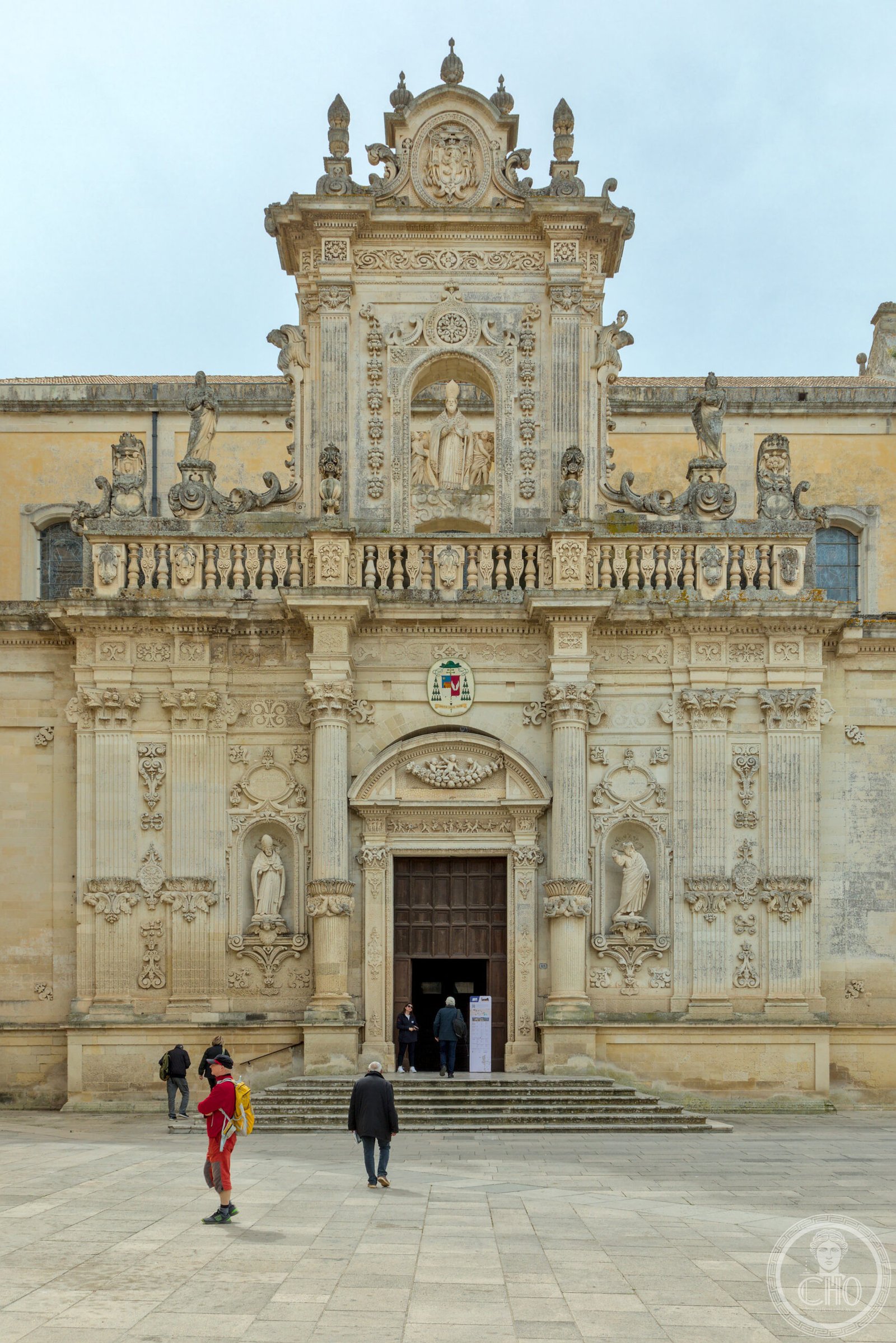
Lecce Cathedral — Santa Maria Assunta
Lecce Cathedral, dedicated to the Assumption of the Virgin Mary, is the principal church of the city of Lecce in Apulia and the seat of the Archbishop of Lecce. First documented in the 11th century and rebuilt in its current form between 1659 and 1670 by the architect Giuseppe Zimbalo — who also designed the adjacent campanile — it stands as one of the masterworks of Lecce Baroque, a distinctive regional style characterised by the exuberant decorative carving of golden local limestone known as pietra leccese.
At a glance
- Type
- Roman Catholic cathedral (Archdiocese of Lecce)
- Period
- Originally 11th century; rebuilt 1659–1670 by Giuseppe Zimbalo
- Style
- Lecce Baroque; pietra leccese limestone
- Location
- Piazza del Duomo, historic centre of Lecce, Apulia
- Coordinates
- 40.3517° N, 18.1670° E
Overview
Lecce Cathedral anchors the enclosed Piazza del Duomo — one of the finest Baroque piazzas in Italy — together with the Bishop’s Palace and the Seminary. The cathedral is the seat of the Archbishop of Lecce and the spiritual centre of one of the oldest Christian communities in Italy, with roots in the apostolic era according to local tradition. As part of the historic centre of Lecce, the cathedral and its piazza are visited by hundreds of thousands of tourists each year who come to experience the city’s extraordinary concentration of Baroque architecture.
History
A cathedral church has stood on this site since at least the 11th century, when Lecce was an important centre under Norman rule in southern Italy. The medieval structure was substantially altered and expanded over subsequent centuries before Bishop Luigi Pappacoda commissioned a complete reconstruction in 1659. The architect Giuseppe Zimbalo, the foremost master of Lecce Baroque, directed the works until 1670, creating the building substantially as it stands today. The slender campanile beside the cathedral, completed in 1682, is also attributed to Zimbalo and rises to 70 metres, making it a defining feature of the Lecce skyline.
What you see
The cathedral presents an unusual double facade: the main ceremonial entrance faces the piazza with a relatively restrained front, while a second, more elaborately decorated facade opens onto the side street. Inside, a three-nave Latin-cross plan unfolds beneath a richly painted ceiling; the chapels along the nave contain canvases by important Neapolitan and local Baroque painters. The adjacent campanile, visible from much of the city, tapers through multiple ornate registers of Zimbalo’s characteristic carved decoration — scrolls, grotesque masks, and floral festoons executed in the warm golden pietra leccese that gives the entire city its distinctive honey-coloured palette.
Cultural significance
Lecce Cathedral is the spiritual and architectural heart of Lecce, a city sometimes called the “Florence of the South” for the density and quality of its Baroque heritage. The building represents the peak of Giuseppe Zimbalo’s career and the fullest expression of Lecce Baroque as a regional school — one that used the exceptional workability of local pietra leccese to develop an ornamental vocabulary of extraordinary richness and originality. The cathedral and its piazza have been proposed multiple times as candidates for UNESCO World Heritage recognition alongside the wider Baroque city.
Practical information
- Address
- Piazza del Duomo 1, 73100 Lecce LE, Italy
- Hours
- Check official website for current opening times; entry to the cathedral is generally free
- Note
- The Piazza del Duomo is an enclosed piazza that opens off Via Vittorio Emanuele II through a single monumental archway
Getting there
Lecce is at the southern tip of Apulia on the Salento peninsula, approximately 40 km from Brindisi and 90 km from Taranto. The cathedral is in the historic centre, a 5-minute walk from Lecce railway station, which is served by Trenitalia Intercity and regional trains from Bari (2 hours) and Brindisi (30 minutes). Brindisi–Casale airport is the nearest regional airport, with connections to Italian and European cities. The historic ZTL centre is pedestrian-priority; parking is available at the perimeter.
Sources & resources
Find it on the map
See this place and what’s around it →📷 Diventa un fotografo di Cultural Heritage Online
Condividi le tue foto dei luoghi: restano pubblicate con la tua firma come autore. Più vengono viste, più ti fai conoscere — e presto un concorso premierà le foto più apprezzate.
Accedi o registrati gratis per aggiungere una foto