
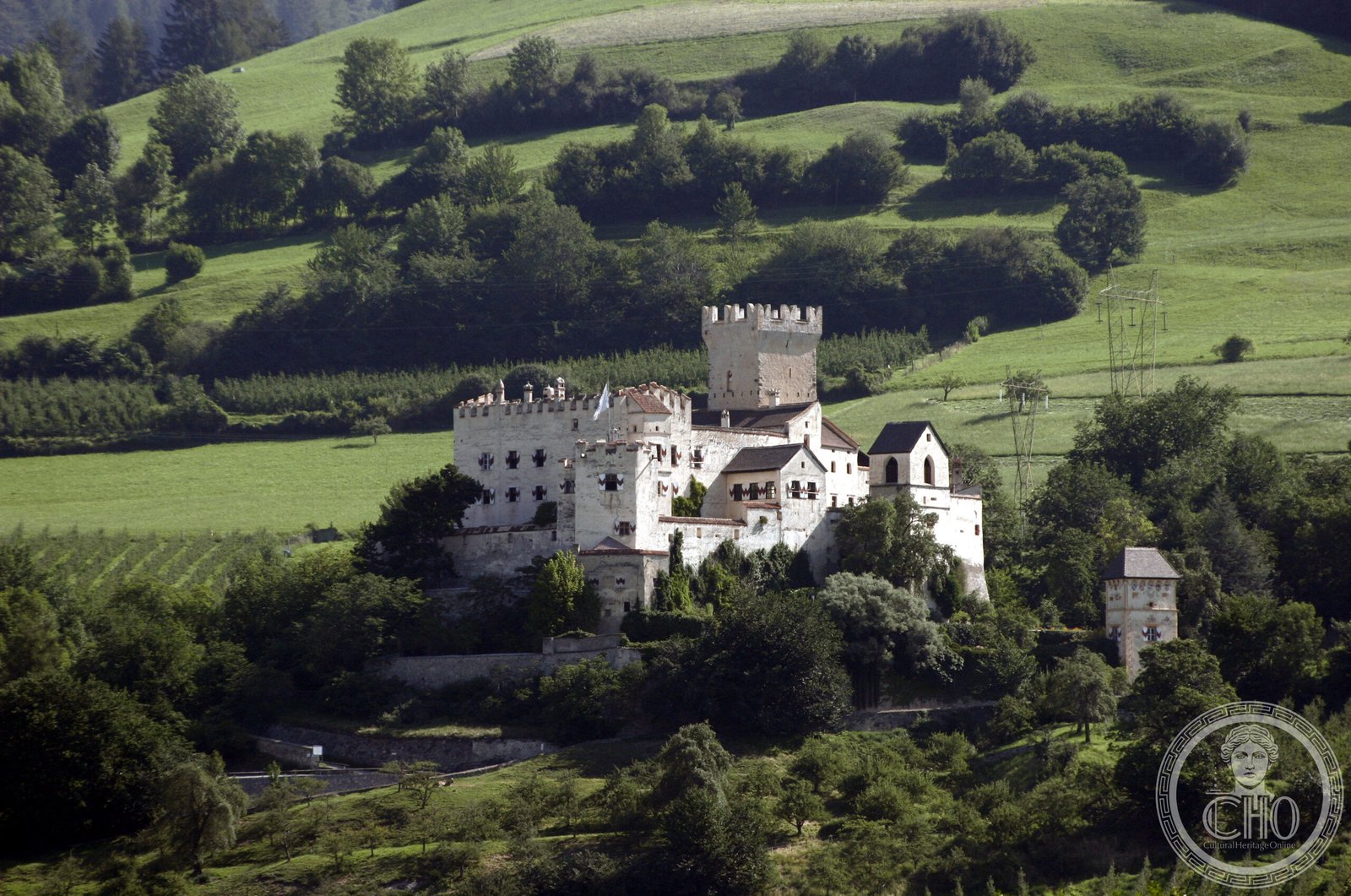
Castel Coira — Churburg
Castel Coira, known in German as Churburg, is a medieval castle above the village of Sluderno (Schluderns) in the Val Venosta (Vinschgau) of South Tyrol, northern Italy. Founded in 1253 by the Bishops of Chur, it was acquired in 1338 by the Counts of Matsch (Matscher) and has remained in the possession of the same noble family — now the Counts Trapp — for nearly seven centuries. Churburg is celebrated for housing the finest private collection of late-medieval armour in the world, assembled by the Matscher counts in the 14th and 15th centuries and preserved virtually intact.
At a glance
- Type
- Medieval castle and private armour museum
- Period
- Founded 1253 (Bishop of Chur); rebuilt and expanded 14th–17th century; continuously inhabited
- Style
- Alpine Gothic; later Renaissance and Baroque residential additions
- Location
- Churburg 1, 39020 Sluderno BZ · 46.6640° N, 10.5823° E
Overview
Churburg commands the Val Venosta from a rocky spur overlooking the Adige (Etsch) river, its compact mass of towers, curtain walls, and residential ranges visible from the valley floor below. The castle is privately owned and maintained by the Counts Trapp, descendants of the Matscher line, who continue to inhabit parts of the complex. Guided tours led by family members or trained staff are the only means of access, giving visits an intimate character unusual for a monument of this international significance. The armour collection draws specialists and enthusiasts from across Europe and North America.
History
The castle was founded in 1253 by the Prince-Bishop of Chur as an administrative centre for the bishopric’s Val Venosta holdings. The Counts of Matsch, one of the most powerful Alpine noble families, acquired Churburg in 1338 and undertook major reconstruction, adding the residential tower, the courtyard arcades, and — crucially — commissioning a series of complete armours from the leading workshops of Milan, Innsbruck, and Augsburg. The Matscher line died out in the male line in 1500; the castle passed through female descent to the Trapp family, ancestors of the Counts Trapp who own it today. Remarkably, neither the Napoleonic wars nor the two world wars stripped the armour collection, which survives with a completeness found nowhere else in private hands.
What you see
The tour moves through the castle’s historic rooms, including the Gothic hall with its painted timber ceiling, the chapel frescoed in the 14th and 15th centuries, and the armoury itself — a sequence of rooms displaying approximately eighty complete armours dating from around 1360 to 1570. Several pieces bear the marks of the great Milanese armourer families (Missaglia, Negroli) and represent the highest technical and artistic achievement of late-medieval plate armour production. The courtyard presents triple-storey Renaissance arcades added in the 16th century that soften the fortress’s originally purely defensive character. Views from the battlements extend across the broad Val Venosta and the peaks of the Ortler massif.
Cultural significance
Churburg is internationally recognised among armour scholars as the single most important repository of late-medieval military equipment in existence, surpassing even major museum collections in the completeness and provenance certainty of its pieces. Several armours in the collection are among the very few surviving examples attributable to specific Milanese masters by documentary evidence. The castle and its collection together constitute an irreplaceable document of Alpine noble culture, military technology, and the arms trade of the 14th–16th centuries.
Practical information
Churburg is open for guided tours from late March to early November, Tuesday to Sunday; closed Mondays and during winter. Tours begin at fixed times and must be followed as a group — independent exploration of the castle is not permitted. Advance booking is strongly recommended in July and August. The castle is reached on foot from the village of Sluderno (about 20 minutes uphill). Check the official Churburg website for current tour times, prices, and seasonal closures.
Getting there
Sluderno is on the Val Venosta railway line connecting Merano and Malles Venosta; Sluderno-Glorenza station is the nearest stop (about 2 km from the castle). By car, exit the Val Venosta road (SS38) at Sluderno and follow signs to Churburg; limited parking is available at the base of the access track. The Vinschgau cycling route passes through Sluderno for visitors combining the castle with the region’s renowned cycle tourism.
Sources & resources
Find it on the map
See this place and what’s around it →📷 Diventa un fotografo di Cultural Heritage Online
Condividi le tue foto dei luoghi: restano pubblicate con la tua firma come autore. Più vengono viste, più ti fai conoscere — e presto un concorso premierà le foto più apprezzate.
Accedi o registrati gratis per aggiungere una foto