
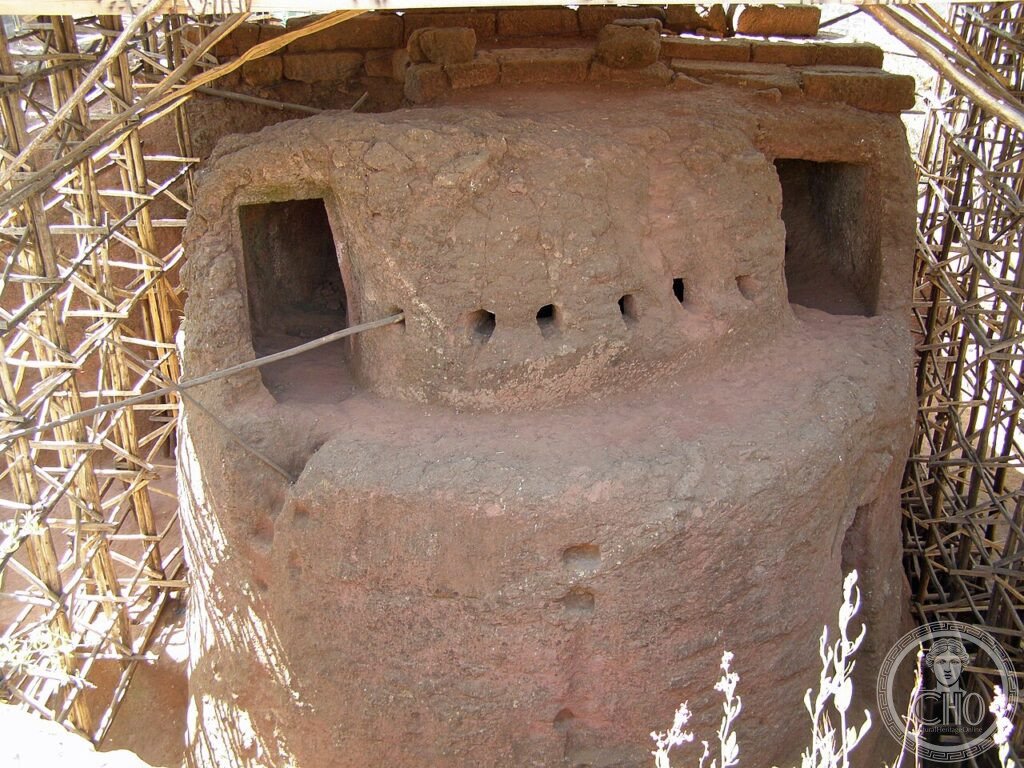
Rock-Hewn Churches of Lalibela
The most extraordinary sacred architecture in sub-Saharan Africa and one of the greatest feats of human engineering ever undertaken — the 11 rock-hewn churches of Lalibela (Amhara Region, northern Ethiopia; UNESCO WHS 1978) were carved from the living basalt rock by King Lalibela of the Zagwe Dynasty in the 12th-13th centuries CE to create a “New Jerusalem” in Africa.
At a glance
Lalibela (the most precisely Lalibela single 11 rock-hewn churches Bete Giyorgis Bete Medhane Alem 12th 13th century Zagwe Dynasty King Lalibela New Jerusalem Timkat Ethiopian Orthodox Christianity living church UNESCO heritage: the basic concept: unlike most ancient churches which are built upward from the ground, the Lalibela churches are carved downward into the basalt rock (the technique called rupestrian or rock-cut architecture); each church is carved from a single mass of rock by removing all the surrounding stone while leaving the church form intact; the churches range from simple caves to the magnificent free-standing monoliths (entirely detached from the parent rock on all four sides) of Bete Medhane Alem and Bete Giyorgis; the 11 churches (traditionally counted as two groups: the Northern Group (7 churches) and the Southern Group (3 churches), plus the isolated Bete Giyorgis (to the southwest); the groups are connected by subterranean passages and trenches; the churches are still in active daily use by the Ethiopian Orthodox Tewahedo Church (the church has been in continuous use since their carving; the priests maintain daily liturgical practice)); the pilgrims (Lalibela receives approximately 100,000+ Ethiopian Orthodox Christian pilgrims annually; the Ethiopian Christmas (Genna; January 7 CE, Ethiopian calendar) and Timkat (Ethiopian Epiphany; January 19 CE) draw the largest pilgrim gatherings; the sight of thousands of white-robed pilgrims crowding into the church trenches at dawn for Timkat is one of the most powerful religious spectacles anywhere in the world) — the most precisely Lalibela single 11 rock-hewn churches Bete Giyorgis Bete Medhane Alem 12th 13th century Zagwe Dynasty King Lalibela New Jerusalem Timkat Ethiopian Orthodox Christianity living church UNESCO heritage in any UNESCO world heritage site)).
Key facts
- Bete Giyorgis — St. George’s Church: the most precisely Lalibela single Bete Giyorgis Church St George 15m pit single basalt block cruciform roof King Lalibela thankyou victory Zagwe UNESCO heritage — the most photographed of the 11 churches and the most perfectly preserved: Bete Giyorgis (Ge’ez for “House of George”; dedicated to St. George the Patron Saint of Ethiopia); the structural form (excavated in a perfectly square pit 15m deep; the church itself is a perfect cube approximately 12m × 12m × 12m; entirely freestanding — detached from the surrounding rock on all four sides and below; the roof surface (the characteristic three nested cruciform designs carved in relief; the three crosses represent the Holy Trinity in Ethiopian theological tradition)); the founding legend (King Lalibela built Bete Giyorgis last; when he was finishing his new Jerusalem, St. George himself appeared in full armor and complained that none of the 10 churches was dedicated to him; King Lalibela apologized and immediately carved the most perfect church of all as an offering to St. George; the legend is dramatized annually at the Timkat festival when the priests carry the Tabot (replica of the Ark of the Covenant) out of each church in a candlelit procession)); the interior (a single room; the walls carved with blind arcading; the 13th century CE ceiling frescoes depicting Old Testament scenes; the current UNESCO temporary shelter roof protecting the frescoes from rain erosion)
- GPS: 12.0316° N, 39.0446° E
History
King Lalibela and the New Jerusalem (the most precisely Lalibela single King Lalibela Zagwe Dynasty 1181 1221 CE Roha New Jerusalem Jerusalem Muslims 1187 Saladin pilgrimage Ethiopia UNESCO heritage: the historical foundation: the Zagwe Dynasty (the dynasty that ruled the Ethiopian highlands from approximately 900 to 1270 CE; the kings of the Zagwe were Christian (Ethiopian Orthodox) and closely related to the Aksumite Christian tradition that preceded them; the dynasty’s most famous king was Lalibela (ruled approximately 1181-1221 CE; beatified by the Ethiopian Orthodox Church as St. Lalibela; also known under his earlier name Gebre Meskel (the regnal name Lalibela means “the bees recognize his sovereignty” in Ge’ez)); the motivation for building a New Jerusalem (the traditional account: King Lalibela was inspired to build his rock churches after the Muslim capture of Jerusalem by Saladin in 1187 CE made pilgrimage to the holy city impossible for Ethiopian Christians; Lalibela would create a new Jerusalem in Ethiopia so that Ethiopian Christians could fulfil their pilgrimage obligation without travelling to the Middle East; the town of Lalibela was renamed from its original name Roha to Lalibela in honor of the king after his death; the rivers around the town were renamed Jordan, and the hill outside the town was called Golgotha, directly mirroring the topography of Jerusalem) — the most precisely Lalibela single King Lalibela Zagwe Dynasty 1181 1221 CE Roha New Jerusalem Jerusalem Muslims 1187 Saladin pilgrimage Ethiopia UNESCO heritage in any UNESCO world heritage site)).
What you see
The full circuit of 11 churches (the most precisely Lalibela single Bete Medhane Alem largest rock-hewn church world Bete Maryam oldest Bete Amanuel royal Debre Sina Bete Abba Libanos UNESCO heritage: the 11 churches in brief: Northern Group: Bete Medhane Alem (“House of the Savior of the World”; the largest rock-hewn church in the world; approximately 33.5m × 23.5m × 11.5m; the facade of 28 columns arranged in a colonnade (6 detached columns, 22 engaged into the facade wall); the interior (3 aisles; 38 column pairs; the Aksumite-style ceiling); Bete Maryam (“House of Mary”; believed to be the oldest of the 11 churches; famous for its interior frescoes (among the oldest surviving Ethiopian paintings; the Madonna and Child; the Crucifixion; St. George and the Dragon)); Bete Amanuel (“House of Emmanuel”; the most architecturally refined; the elaborately carved exterior (the horizontal rows of blind windows, alternating projecting and recessed courses of ashlar — the exact pattern of the Aksumite royal palace tradition)); Bete Abba Libanos (the only semi-monolithic church — attached to the cliff face at the back); Southern Group: Bete Gabriel-Rufael (a twin church in two connected chambers; carved into the highest cliff face; accessed via a raised causeway); Bete Mercurios; Bete Amanuel (second church of this name in the Southern Group)); Bete Giyorgis (see Key facts) — the most precisely Lalibela single Bete Medhane Alem largest rock-hewn church world Bete Maryam oldest Bete Amanuel royal Debre Sina Bete Abba Libanos UNESCO heritage in any UNESCO world heritage site)).
Practical information
- Getting there: Lalibela Airport (LLI; daily flights from Addis Ababa (ADD; Ethiopian Airlines; 1h30m; the most convenient access); from Addis Ababa to Lalibela overland: approximately 650 km (2 days by bus; spectacular mountain road; not recommended without significant time); accommodation in Lalibela (the town has grown significantly around tourism; the Ben Abeba Restaurant (a Swiss-Ethiopian architectural landmark — a building shaped like a spiral bird; the best view in Lalibela; the menu Ethiopian and international)); the churches (entrance ticket ETB 1,500 (approximately USD 27; 2026 price; has increased significantly in recent years); the ticket covers all 11 churches; shoes must be removed at each church; a mandatory guide from the local Lalibela Guide Association is included in the ticket price; pilgrimage season (January Timkat; Ethiopian Christmas in January; the most atmospheric time to visit — also the most crowded and expensive; the off-season (March-August) is cooler and quieter))
Getting there
Lalibela Airport (LLI) from Addis Ababa (1h30m, Ethiopian Airlines). Entry ETB 1,500. Shoes removed in each church. January Timkat is peak pilgrimage season. GPS: 12.0316, 39.0446.
Nearby
- Aksum — 250 km northwest (UNESCO WHS 1980; see separate entry); the ancient obelisk city and the claimed home of the Ark of the Covenant; the pre-Christian Aksumite kingdom’s stelae field; the Mary of Zion Cathedral
- Simien Mountains National Park — 200 km northwest (UNESCO WHS 1978); the dramatic escarpment (the “roof of Africa” section; peaks to 4,550m); the Gelada baboon (Theropithecus gelada; the grass-eating monkey with the distinctive red chest patch; endemic to the Ethiopian highlands; the Simien is the best place in the world to observe them; groups of 500+ Gelada can be seen at the escarpment edge at dawn)
Sources
- Wikipedia, Lalibela; Bete Giyorgis; Zagwe Dynasty, accessed June 2026
- UNESCO, Rock-Hewn Churches, Lalibela, WHS reference 18, inscribed 1978
Find it on the map
See this place and what’s around it →📷 Diventa un fotografo di Cultural Heritage Online
Condividi le tue foto dei luoghi: restano pubblicate con la tua firma come autore. Più vengono viste, più ti fai conoscere — e presto un concorso premierà le foto più apprezzate.
Accedi o registrati gratis per aggiungere una foto