
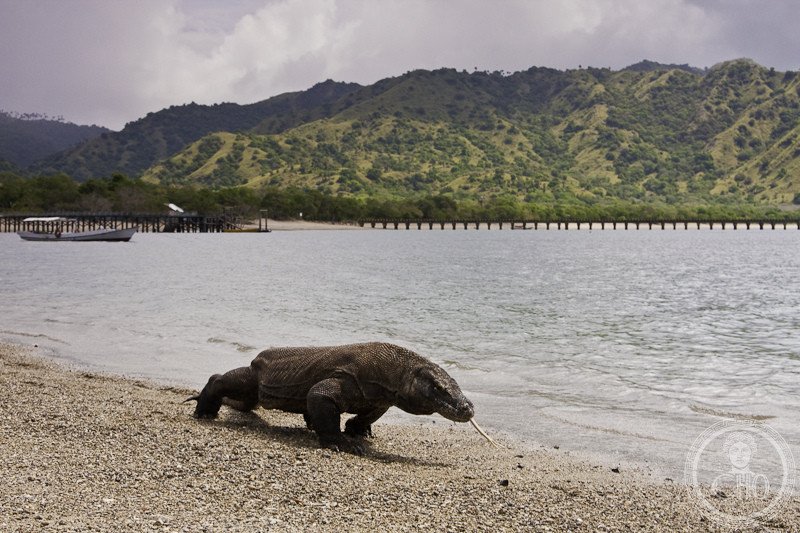
Komodo National Park
The last refuge of the world’s largest lizard and one of the most biodiverse marine ecosystems in the Coral Triangle — Komodo National Park, spread across five volcanic islands between Sumbawa and Flores in the Indonesian archipelago, protects the final surviving population of the Komodo dragon and wraps its land area in one of the most species-rich coral reef systems on Earth.
At a glance
Komodo National Park (1,733 km² of total area, approximately half of which is marine; established 1980; UNESCO WHS 1991; a Man and Biosphere Reserve since 1977) encompasses the islands of Komodo (390 km²), Rinca (198 km²), Padar, Gili Motang, and Gili Dasami, as well as the surrounding sea area with coral reefs, sea grass beds, and mangroves; the park is located in the Lesser Sunda Islands chain, between the larger islands of Sumbawa to the west and Flores to the east; the gateway city is Labuan Bajo, at the western tip of Flores Island (30–90 minutes by boat to Komodo Island; a modern tourist hub with good flight connections from Bali and Lombok); the park falls in one of the most biologically productive marine zones in the world: the convergence of the warm shallow Flores Sea with the cold deep water upwelling from the Indian Ocean creates a nutrient-rich environment that supports approximately 260 species of coral, 70 species of sponge, 1,000+ species of fish, 14 species of whale and dolphin, 9 species of dolphin, sea turtles, dugong, sharks (including whale sharks), manta rays, and the Komodo dragon on land.
Key facts
- The Komodo dragon (Varanus komodoensis): the world’s largest living lizard — the Komodo dragon (a monitor lizard in the family Varanidae; closely related to the Nile monitor, the Lace monitor, and the extinct giant Megalania of Australia, which may have reached 5–7 metres in length) is the largest living species of lizard; adult males regularly reach 2.5–3 metres in length and weigh 50–70 kg (the largest verified individual was 3.13 metres and 166 kg, but this weight included recently swallowed prey; a healthy empty adult male typically weighs 70–80 kg); the Komodo was not known to science until 1912, when the Dutch colonial administrator P.A. Ouwens published the first scientific description based on skins and a skull collected by Dutch pearl fishermen; the local Manggarai people of western Flores called the animal buaya darat (“land crocodile”) or biawak (“monitor lizard”); hunting technique: ambush from cover; the Komodo dragon detects prey primarily by smell (the forked tongue delivers scent molecules to the Jacobson’s organ; a dragon can detect a dead or dying animal from up to 10 km downwind); it attacks with a rush to the leg, biting deeply with serrated teeth and injecting venom from glands in the lower jaw (2009 discovery; the venom prevents blood clotting and causes rapid blood pressure drop); large prey that escape the initial attack are tracked over hours or days until they weaken; prey includes deer, pigs, water buffalo, goats, and occasionally humans (approximately 4–5 unprovoked attacks on humans recorded per decade); the Komodo dragon can eat up to 80% of its body weight in a single meal
- The marine environment: among the most biodiverse reefs in the Coral Triangle — the marine zone of Komodo National Park is one of the most biologically rich marine areas in the Coral Triangle (the “Amazon of the sea”; the triangular ocean area between the Philippines, Indonesia, and Papua New Guinea that contains approximately 76% of all known coral species and 37% of all known coral reef fish species in the world); the park’s position at the confluence of the Flores Sea and the Indian Ocean deep water creates exceptional conditions: cold upwelling water brings nutrients, warm surface water allows coral growth; the result is approximately 260 coral species (more coral species in a single dive site at Komodo than in the entire Caribbean Sea), 1,000+ fish species, and concentrations of pelagic megafauna unusual anywhere in the world; the manta ray cleaning stations (manta rays gather at specific cleaning stations where cleaner wrasse remove parasites; the Makassar Strait and the Manta Point on the north coast of Komodo have the highest density of oceanic manta rays in the world); dive sites like Batu Bolong, Castle Rock, and the current-swept sea mounts of the south of the park are among the best dive sites in the world
- Padar Island and the Pink Beach: the most photographed viewpoints in the park — Padar Island (the third largest island in the park; uninhabited; the Komodo dragons apparently went locally extinct here decades ago) has a famous viewpoint at the top of the island’s central ridge: the panorama reveals three coves with beaches of different colours (white, black, and pink) visible from a single point, making it one of the most dramatic landscape viewpoints in Indonesia; the Pink Beach (Pantai Merah) on Komodo Island is one of only approximately seven beaches in the world with naturally pink sand (the colour comes from fragments of red coral — Foraminifera — mixed into the white sand); its turquoise water and pink sand against the tawny dry savanna of Komodo Island make it the most photographed location in the park
- Heritage: UNESCO World Heritage Site, Komodo National Park, inscribed 1991
- GPS: -8.5500° S, 119.5000° E
History
Komodo Island was inhabited by a small community of Dutch-Malay convicts from the early 20th century (under the Dutch colonial administration of the Netherlands East Indies); scientific study of the Komodo dragon began in 1912 (P.A. Ouwens); the first live Komodo dragons were brought to European zoos in 1927; Komodo Island was declared a game reserve in 1938; the national park was established in 1980 under Indonesia’s national parks system; UNESCO WHS inscription 1991; the park has faced major challenges from illegal fishing (shark and ray finning, blast fishing, cyanide fishing) and, since 2010, from rapidly growing dive tourism; a temporary closure to tourists was proposed in 2019 but not implemented; the park authority currently manages tourist numbers through a permit and booking system.
What you see
The Komodo dragon trekking experience (organized by licensed park guides; mandatory; the guides carry forked sticks, not weapons — the stick is used to push a charging dragon away; most encounters on the Loh Liang and Banu Nggulung trails are peaceful observations of resting dragons; aggressive encounters are rare; children under 12 are not permitted on unguided trails; the best chance of seeing a feeding sequence is at dawn near the forest edge); the Pink Beach snorkelling (the beach is accessible by day-trip boat from Labuan Bajo or as part of a liveaboard trip); Padar Island viewpoint (30-minute steep climb on a well-maintained path; sunrise or sunset gives the best light over the three-coloured bays); and scuba diving (the dive sites of Batu Bolong and Castle Rock are accessible only from liveaboard boats or fast boat from Labuan Bajo; the dive conditions involve strong currents — for experienced divers only).
Practical information
- Permits and access: park entrance fee approximately IDR 150,000 (approximately USD $10) per person per day (2026 tariff); the fee structure changes periodically; the park authority also operates an online booking system for the Komodo dragon trekking permit; from Labuan Bajo, day trips by speedboat (1.5–2h to Komodo; 45 min to Rinca/Padar) start from approximately USD $50–80 per person; liveaboard dive trips (2–6 days; the best way to access the most remote sites) start from approximately USD $200–400/day all-inclusive
- Getting there: from Bali (Ngurah Rai Airport): 1h 15 min by direct flight to Labuan Bajo (Komodo Airport; served daily by Lion Air, Garuda Indonesia, and Wings Air; connections also via Lombok, Ende, and Kupang; 15–20 flights per day in high season); from Lombok: 55 min by direct flight; the ferry alternative (Sape port in Sumbawa to Labuan Bajo; approximately 8h; slow car-ferry) is a budget option but rarely used by international visitors
- Best season: the dry season (April–November) is the best for diving (best visibility; lowest rainfall; most manta ray aggregations at Manta Point); the wet season (December–March) brings heavy rain and reduced diving visibility but the park is less crowded; Komodo dragons are present and active year-round; the savanna turns green and the island landscapes are most lush in February–March
Getting there
From Bali by flight to Labuan Bajo (1h 15 min). Day trips by speedboat from Labuan Bajo: Komodo 1.5h, Rinca 45 min. GPS: -8.5500, 119.5000.
Nearby
- Flores Island and the Kelimutu Crater Lakes — 150 km east of Labuan Bajo (3h by road or 30 min by small plane to Ende then 1h 30 min by road); the most surreal volcanic landscape in Indonesia — Flores Island (the name means “flowers” in Portuguese; the island was named by the Portuguese in the 16th century for its flowering trees; approximately 375,000 inhabitants; most of the population is Catholic, making Flores unique in predominantly Muslim Indonesia) is dominated by a chain of active volcanoes; the most famous landmark is the Kelimutu volcano (1,639 metres; approximately 60 km east of Ende) with three crater lakes (Tiwu Ata Mbupu, Tiwu Ko’o Fai Nuwa Muri, and Tiwu Ata Polo) that change colour independently: one is typically turquoise, one green, and one black or red (the colours are determined by the chemical composition of the crater water, which shifts due to volcanic gas input and chemical reactions; the three lakes have changed colour multiple times since records began in the 1960s — they are among the most unusual natural objects in the world); access: 4WD road to the base, 30 min walk to the crater rim; sunrise visit is traditional and spectacular
- Raja Ampat (West Papua, Indonesia) — 1,000 km north-east of Komodo (accessible by flight from Labuan Bajo via Sorong or Manado; 3–4h total travel); the most biodiverse marine area in the world — Raja Ampat (Bahasa Indonesia: “The Four Kings”; the four main islands are Waigeo, Batanta, Salawati, and Misool) contains the world’s highest known density of marine species (over 1,508 fish species, 699 mollusc species, 537 coral species — more than the entire Caribbean Sea in a fraction of the area) and the most remote and undeveloped dive region accessible to recreational divers in the Indo-Pacific; the spectacular above-water landscape (thousands of small limestone karst islands rising from turquoise water; the same geology as Halong Bay in Vietnam) and the virtually undisturbed coral reef make Raja Ampat the single most coveted destination in world dive travel
- Lombok Island and the Gili Islands — 350 km west of Labuan Bajo (45 min by flight or 8h by ferry); the most accessible alternative to Bali for beach-and-reef travel — Lombok (an island of approximately 3.5 million people; most of the population is Sasak Muslim; the Sasak culture is distinct from Balinese Hindu culture and the island has a completely different atmosphere from Bali) has excellent surfing (Kuta Lombok and Desert Point at Bangko Bangko are two of the most famous surf breaks in Asia), diving (the Gili Islands — three small islands off the north-west coast of Lombok — are among the best reef dive sites in Indonesia outside Raja Ampat and Komodo; the turtle population of the Gilis is one of the highest in Indonesia), and the Rinjani volcano (3,726 metres; the second highest volcano in Indonesia; a 3–4 day trek to the summit and around the caldera lake Segara Anak)
Sources
- Wikipedia, Komodo National Park; Komodo dragon; Pink Beach, Komodo, accessed June 2026
- UNESCO, Komodo National Park, WHS reference 609, inscribed 1991
- Bryan Fry et al., “A central role for venom in predation by Varanus komodoensis”, Proceedings of the National Academy of Sciences, 2009
Find it on the map
See this place and what’s around it →📷 Diventa un fotografo di Cultural Heritage Online
Condividi le tue foto dei luoghi: restano pubblicate con la tua firma come autore. Più vengono viste, più ti fai conoscere — e presto un concorso premierà le foto più apprezzate.
Accedi o registrati gratis per aggiungere una foto