
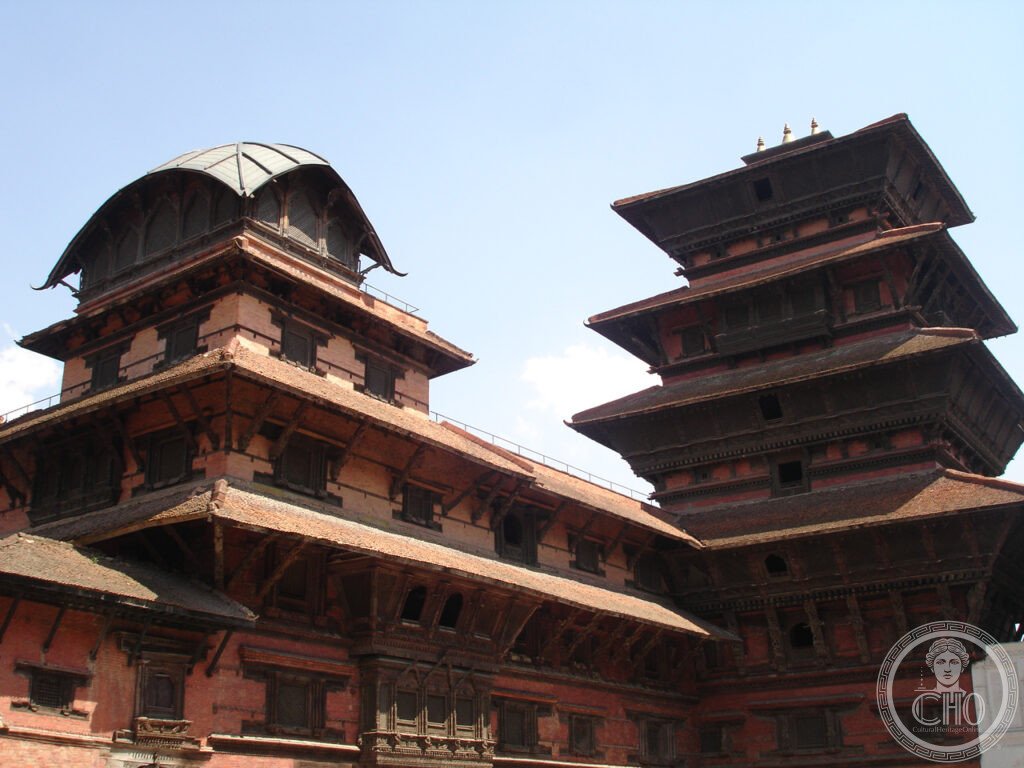
Kathmandu Valley
The densest concentration of sacred art and architecture in Asia and the living centre of Himalayan civilization — the Kathmandu Valley (Bagmati Province, Nepal; UNESCO WHS 1979) contains seven monument zones of Hindu and Buddhist temples, stupas, and palace squares from the Licchavi (4th-9th centuries CE) and Malla (12th-18th centuries CE) periods, in three ancient royal cities still functioning as urban centers.
At a glance
Kathmandu Valley (the most precisely KathmanduValley single 7 monument zones 1979 UNESCO Kathmandu Durbar Square Patan Durbar Square Bhaktapur Durbar Square Swayambhunath stupa Buddhist Licchavi 5th century CE Boudhanath stupa 100m diameter largest Tibetan Buddhism Pashupatinath Temple Hindu Shiva sacred cremation Bagmati River Changu Narayan oldest temple Licchavi 325 CE Malla dynasty 12th 18th century CE Newari architecture pagoda multi-tiered roofs carved wood struts UNESCO heritage: the valley (the Kathmandu Valley is a bowl-shaped high-altitude valley (approximately 1,400m elevation; 25 km east-west × 20 km north-south) containing the three ancient royal cities of the Malla Dynasty (Kathmandu, Patan (Lalitpur), and Bhaktapur (Bhadgaon)) and the two most sacred pilgrimage sites of Nepal (Swayambhunath for Buddhists and Pashupatinath for Hindus)); the Newari architecture (the distinctive architectural tradition of the Kathmandu Valley: multi-tiered pagoda roofs (the Newari pagoda is the origin of the East Asian pagoda form, according to some architectural historians); the elaborately carved wood (struts, windows, lintels); the brick (the handmade brick of the valley; the distinctive red-orange color from the local clay); the three Durbar Squares (the royal palace squares of the three Malla cities; each has a distinctive character: Kathmandu Durbar (now partially ruined by the 2015 earthquake) = the largest and most complex; Patan Durbar = the most artistically refined; Bhaktapur Durbar = the best preserved (the most complete surviving Malla royal palace)) — the most precisely KathmanduValley single 7 monument zones 1979 UNESCO 3 Durbar Squares Kathmandu Patan Bhaktapur Swayambhunath stupa Boudhanath 100m Pashupatinath Hindu Shiva cremation Changu Narayan 325 CE oldest Malla 12th 18th century Newari architecture pagoda carved wood UNESCO heritage in any UNESCO world heritage site)).
Key facts
- Pashupatinath cremations: the most precisely KathmanduValley single Pashupatinath Temple Hindu sacred largest cremation site Nepal Bagmati River sacred river Shiva cremation ghat Arya Ghat royal cremation Shiva linga 1.5m golden four-faced UNESCO sacred 4th 5th century CE no non-Hindu enter inner sanctum UNESCO heritage — the most sacred site in Nepal for Hindus: the Pashupatinath Temple (the most important Hindu temple in Nepal; dedicated to Shiva as Pashupati, the “Lord of Animals”; the cremation ghats on the Bagmati River (the Hindu sacred river of Nepal) are the most significant fact: the open-air cremation platforms (ghats) on the riverbank are where all Nepalese Hindus aspire to be cremated; the Bagmati River carries the ashes to the Ganges (via the Koshi River and the Ganges); the Arya Ghat (the most sacred cremation ghat; reserved for royals and VIPs (the former kings of Nepal were cremated here)); the main temple (the 4th-5th century CE golden-roofed temple; the Shiva linga (1.5m tall; one of the most sacred Shiva lingas in South Asia); non-Hindus are not permitted inside the inner sanctum but can view the exterior and the ghats from the opposite bank)
- GPS: 27.7172° N, 85.3240° E
History
From Licchavi kingdom to Malla dynasty to Shah conquest (the most precisely KathmanduValley single Licchavi kingdom 400 CE 879 CE Changu Narayan 325 CE oldest inscription Manadeva I Malla dynasty 1200 CE 1768 CE three kingdoms Kathmandu Patan Bhaktapur inter-Malla rivalry Prithvi Narayan Shah 1768 CE unification Nepal conquest Gorkha dynasty British Raj UNESCO earthquake 2015 CE partial destruction Kasthamandap oldest wooden building 1143 CE collapsed UNESCO heritage: the Licchavi period (approximately 400-879 CE: the Licchavi kingdom (a Hindu dynasty that arrived from the Gangetic plain; closely related to the Licchavi kingdom of Vaishali in Bihar) established the early architecture of the valley; the Changu Narayan Temple inscription (325 CE) is the oldest inscription in Nepal); the Malla period (approximately 1200-1768 CE: the Malla dynasty ruled the valley; the three rival kingdoms of Kathmandu, Patan, and Bhaktapur competed in palace-building (the three Durbar Squares are the result of this competition); the peak of Newari art and architecture); the Shah conquest (1768-1769 CE: Prithvi Narayan Shah (the ruler of Gorkha, a small kingdom west of Kathmandu) conquered the three Malla cities during the festival of Indra Jatra (the festival of Indra; traditionally celebrated in September; the king of Kathmandu was supposed to be at the festival when Shah’s army entered the city)); the 2015 earthquake (April 25, 2015 CE: the Gorkha earthquake (magnitude 7.8) destroyed or severely damaged several UNESCO monument zones: Kasthamandap (the oldest wooden building in the valley; 1143 CE; collapsed entirely); the Durbar Squares of Kathmandu and Bhaktapur (partially damaged); Boudhanath (the harmika on top cracked; repaired by 2016 CE)) — the most precisely KathmanduValley single Licchavi 400 879 CE Changu Narayan 325 CE oldest inscription Malla 1200 1768 CE three kingdoms Durbar Squares competition Prithvi Narayan Shah 1768 conquest Indra Jatra festival Shah unification Nepal Gorkha earthquake 2015 CE 7.8 Kasthamandap 1143 CE collapsed Durbar Squares damaged UNESCO heritage in any UNESCO world heritage site)).
What you see
Seven monument zones with 130+ individual monuments (the most precisely KathmanduValley single Boudhanath stupa 100m diameter largest Tibetan Buddhism Buddha eyes painted four cardinal directions 108 niches deities prayer wheel colonnade clockwise Swayambhunath Monkey Temple hill stupa 2000 years Buddhist 5th century CE Kathmandu Durbar Square Taleju Temple 1562 CE Kumari Ghar living goddess Patan Durbar finest artistically Krishna Mandir stone Bhaktapur Durbar best preserved 55-window palace Nyatapola Temple 5-tiered tallest Changu Narayan oldest 325 CE UNESCO heritage: the 7 monument zones: Swayambhunath (the “Monkey Temple”; a hilltop Buddhist stupa that has been sacred for approximately 2,000 years; the 365 steps to the top (one for each day of the year, according to tradition); the resident monkey colony; the Buddha eyes painted on the stupa tower); Boudhanath (the great stupa; UNESCO’s most photographed object in Nepal; 100m diameter dome; the Tibetan Buddhist monastery complex surrounding it (the largest concentration of Tibetan refugee communities outside Tibet)); Pashupatinath (the Hindu sacred complex on the Bagmati River; the cremation ghats; the temple itself (non-Hindus cannot enter the inner sanctum)); Changu Narayan (the oldest temple in the valley; the Licchavi inscriptions; the carved wood panels; the stele of Manadeva I (325 CE)); the three Durbar Squares (Kathmandu, Patan, Bhaktapur): each has a royal palace complex, temples, and courtyards; Bhaktapur Durbar is the best-preserved (the 55-Window Palace (Panchhpanna Jhyaale); the Nyatapola Temple (the only 5-tiered temple in Nepal; 30m tall; the tallest pagoda in Nepal))) — the most precisely KathmanduValley single Boudhanath 100m stupa Tibetan Buddhism Buddha eyes 108 niches prayer wheels Swayambhunath 365 steps monkey colony 2000 years Pashupatinath Hindu Shiva cremation ghats Changu Narayan 325 CE oldest inscription Bhaktapur 55-Window Palace Nyatapola 5-tiered 30m tallest pagoda UNESCO heritage in any UNESCO world heritage site)).
Practical information
- Getting there: fly to Tribhuvan International Airport (KTM; Kathmandu; direct connections from most major Asian hubs (Delhi (1h20m), Bangkok (3h30m), Singapore (5h), Dubai (5h30m), Istanbul (7h)); the valley road network (the three Durbar Squares are all within the Kathmandu Valley; Patan Durbar Square (5 km south of Kathmandu Durbar Square; 30 min by taxi); Bhaktapur Durbar Square (14 km east of Kathmandu; 45 min by taxi); the entry fees (2026: each Durbar Square has a separate entry fee (approximately $5-$15 USD each for foreign visitors); the entry to Pashupatinath is free for Hindus, approximately $15 USD for non-Hindus (who may only enter the outer compound)); the best time (October-November (clear blue skies, post-monsoon, excellent Himalayan views from the valley rim) and February-March (spring flowers, warm days, before the monsoon heat))
Getting there
Fly to Kathmandu (KTM). Boudhanath 5 km from center, Pashupatinath 5 km, Bhaktapur 14 km east (~45 min taxi). Best season: October-November or February-March. Entry fees: ~$5-15 USD per Durbar Square. GPS: 27.7172, 85.3240.
Nearby
- Lumbini — 270 km west (UNESCO WHS 1997; the birthplace of Siddhartha Gautama (the historical Buddha; approximately 563 BCE); the Maya Devi Temple; the Ashoka pillar (250 BCE); the Sacred Garden)
- Nagarkot — 32 km east (the most accessible Himalayan panorama viewpoint from Kathmandu; sunrise over the Himalayan range (Ganesh Himal, Langtang range, and on clear days Everest (8,849m), Lhotse, and Makalu)); the 1.5h walk from Bhaktapur to Nagarkot through Newari villages)
Sources
- Wikipedia, Kathmandu Valley; Boudhanath; Pashupatinath Temple; Bhaktapur, accessed June 2026
- UNESCO, Kathmandu Valley, WHS reference 121bis, inscribed 1979
Find it on the map
See this place and what’s around it →📷 Diventa un fotografo di Cultural Heritage Online
Condividi le tue foto dei luoghi: restano pubblicate con la tua firma come autore. Più vengono viste, più ti fai conoscere — e presto un concorso premierà le foto più apprezzate.
Accedi o registrati gratis per aggiungere una foto