
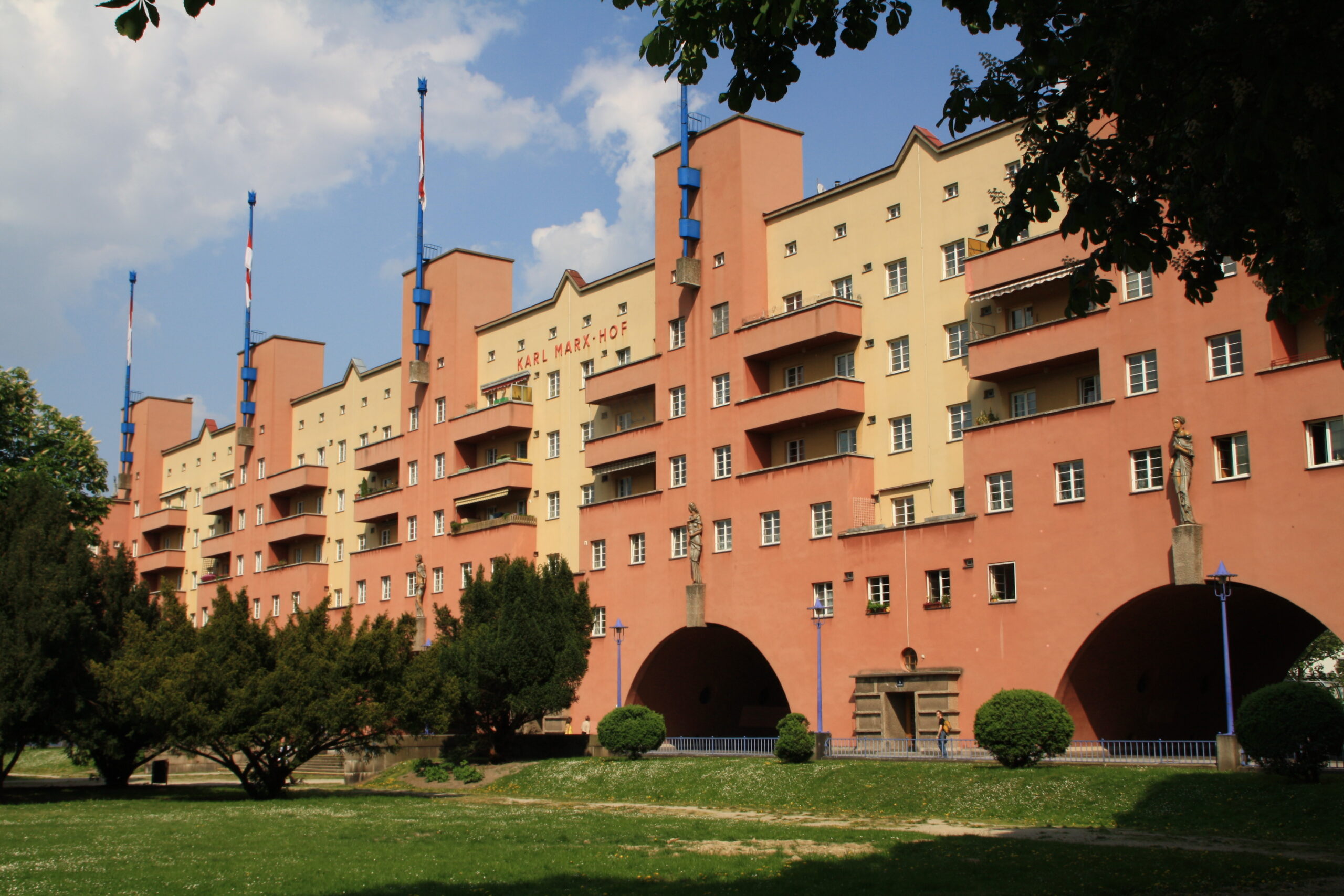
Stretching more than a kilometre along the northern edge of Vienna, Karl-Marx-Hof is one of the longest residential buildings ever constructed and the defining monument of Red Vienna — the socialist municipal programme that transformed the Austrian capital between 1919 and 1934. Designed by city architect Karl Ehn and completed in 1930 after three years of construction, the superblock houses 1,382 apartments behind a monumental facade of arched gateways, decorative towers, and vivid terracotta and ochre plasterwork. More than a housing project, it was a statement: that working-class families deserved space, light, communal gardens, laundries, a library, kindergartens, and a pharmacy within a single civic complex. The building spans four tram stops in the Heiligenstadt quarter of Döbling and has been listed as a protected monument since 1992.
At a glance
- Type
- Municipal housing superblock (Gemeindebau)
- Period
- 1927–1930
- Style
- Red Vienna / Expressionist Functionalism
- Location
- Karl-Marx-Hof 1, 1190 Vienna (Heiligenstadt, Döbling)
- Coordinates
- 48.2470° N, 16.3555° E
- Architect(s)
- Karl Ehn
Overview
Karl-Marx-Hof is the flagship achievement of Red Vienna, the progressive municipal government that governed Vienna from 1919 to 1934. The city invested heavily in publicly funded housing, constructing over 60,000 apartments during this period, and Karl-Marx-Hof was its grandest expression. At 1,100 metres in length, the complex contains 1,382 apartments arranged around a sequence of communal courtyards. Its sweeping arched entrance portals, flanking towers, and sculpted reliefs gave it an almost palatial character, signalling that social housing could be dignified, beautiful, and lasting. Today it remains a functioning residential community and a pilgrimage site for students of architecture and urban history.
History
Construction began in 1927 under the Social Democratic city government, which financed the project through a new housing tax on luxury goods and higher incomes. Architect Karl Ehn, a student of Otto Wagner, was commissioned to create not just apartments but an integrated community facility. The building was completed and inaugurated in 1930, named in honour of Karl Marx. Four years later, during the brief but brutal Austrian Civil War of February 1934, Karl-Marx-Hof became the site of armed resistance: Social Democratic militia — the Schutzbund — held out inside for several days against the Dollfuss government’s artillery before being overwhelmed. The building was damaged in the fighting and subsequently renamed under the authoritarian regime. After World War II it reverted to its original name and underwent major renovation between 1989 and 1992. It was listed as a protected architectural monument in 1992.
Architecture & Design
Karl Ehn drew on the expressionist wing of Viennese modernism to create a facade that is at once functional and theatrical. The main elevations are rendered in terracotta red and yellow ochre, punctuated by bold arched gateways up to five storeys high that frame public passageways into the inner courtyards. Towers at the corners and midpoints rise above the roofline, giving the kilometre-long block a rhythmic, almost fortified silhouette. Sculptural reliefs by Otto Hofner — depicting allegorical figures of Enlightenment, Freedom, Welfare, and the Protection of Children — decorate the central gateway. The inner courtyards are landscaped with gardens, paths, and play areas, providing residents with green space entirely within the complex. The structural system is load-bearing brick; interior layouts were designed to maximise light and ventilation in every apartment.
Cultural significance
Karl-Marx-Hof has become a global symbol of social housing at its most ambitious. It demonstrated that public architecture could be both monumental and humane, and that working-class communities deserved civic beauty as much as bourgeois neighbourhoods. The building’s role in the 1934 civil war cemented its status as a site of political memory. Today it appears in virtually every survey of twentieth-century architecture and urban planning. UNESCO has noted the broader Viennese Gemeindebau programme as an outstanding example of social urbanism; Karl-Marx-Hof remains its most photographed and visited representative. It continues to house around 2,000 residents.
Visiting today
The exterior and communal passageways of Karl-Marx-Hof are freely accessible at all times — residents live here, so visitors should be respectful of the residential community. The Waschsalon Karl-Marx-Hof, a small museum and cultural centre embedded in the building, documents the history of Red Vienna and the 1934 events. It is open Tuesday to Sunday; confirm current hours with the Wiener Wohnen housing authority. The surrounding Heiligenstadt quarter offers wine taverns (Heuriger) a short walk toward the Vienna Woods.
Getting there
Take the U4 U-Bahn line to Heiligenstadt station (end of the line), a three-minute walk from the main facade. Trams D, 1, and 2 stop directly along Karl-Marx-Hof. From Vienna city centre the journey takes approximately 20 minutes by U-Bahn. By car: limited street parking available; the A22 motorway exit Heiligenstadt is approximately 1 km away.
Sources & resources
Find it on the map
See this place and what’s around it →📷 Become a Cultural Heritage Online photographer
Share your photos of places: they stay published under your name as the author. The more they're seen, the more you get noticed — and soon a contest will reward the most appreciated photos.
Log in or sign up free to add a photoIs this page about you?
This page is read by travellers and heritage enthusiasts who find it on Google. Tell us how you are connected to this place and we will take it from there.