
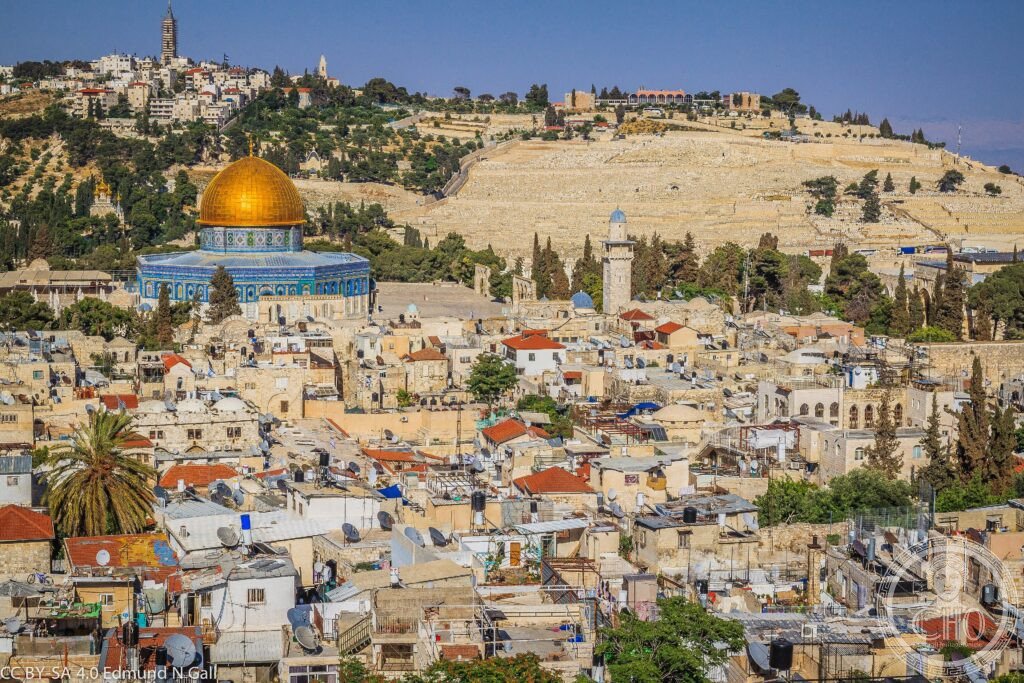
Jerusalem Old City
The most theologically contested single square kilometre on Earth and the only place in the world claimed as holy by all three Abrahamic faiths simultaneously — the Old City of Jerusalem, enclosed by the Ottoman walls of Suleiman the Magnificent (1538–1541), contains the holiest site in Judaism, the third-holiest site in Islam, and the most sacred Christian site on Earth within a 1 km² walled city of 38,000 people.
At a glance
The Old City of Jerusalem (UNESCO WHS inscribed 1981 — the most politically complex single UNESCO inscription in the history of the programme: inscribed by Jordan (not Israel, which administers the site) — the most diplomatically anomalous single inscription procedure in UNESCO history; placed on the World Heritage in Danger list in 1982 — the only site in UNESCO history to be placed on the Danger list at the same session as its inscription (the most urgently critical single heritage situation in UNESCO history at the time of inscription); the physical city (the most precisely walled single sacred city in the world: the current walls built by Ottoman Sultan Suleiman the Magnificent 1538–1541 (the most precisely dated single Islamic fortification of any historically important walled city); 4.5 km perimeter; 34 towers; 8 gates (the most precisely gated single Ottoman city wall in the Levant); 4 quarters (Jewish, Muslim, Christian, Armenian — the most culturally diverse single walled city in the world); approximately 38,000 residents within the walls — the most densely populated single UNESCO heritage walled city per km²).
Key facts
- The Temple Mount / Haram al-Sharif: the most theologically contested single square in the world — the Temple Mount (the most fought-over single piece of real estate in the history of human civilisation: the location of Solomon’s Temple (c. 957 BCE — the most precisely founding-dated single site of Judaism); of the Second Temple (expanded by Herod the Great from 20 BCE — the most architecturally ambitious single Jewish building project in history; the most precisely described single ancient building in Josephus’s Jewish Antiquities; destroyed by Rome in 70 CE — the most consequentially destructive single event in Jewish history); of the Dome of the Rock (described in hero caption); of the Al-Aqsa Mosque (the third-holiest site in Islam (after Mecca and Medina): the most politically sensitive single mosque in the world — at any time it is visited by millions of Muslim worshippers and its status is subject to diplomatic negotiations between Israel, Jordan, the Palestinian Authority, Saudi Arabia, and the Organisation of Islamic Cooperation — the most internationally negotiated single religious building in the world)); the Western Wall (the most sacred outdoor site in Judaism: the only surviving element of the Herodian Temple Mount retaining wall — the most precisely ancient surviving wall of any Jewish holy site; the Kotel (the single most photographed religious site in Israel: tens of thousands of notes (kvitlakh) are placed in the wall’s cracks daily — the most precise form of individually personalised prayer practice in any world religion))
- The Church of the Holy Sepulchre: the holiest Christian site in the world — the Church of the Holy Sepulchre (the Anastasis; the most sacred single building in Christianity: the church stands over the sites identified since at least the 4th century as Golgotha (the place of the Crucifixion) and the Tomb of Christ (the site of the Resurrection) — the two most theologically central single sites in the entire Christian faith; built by Emperor Constantine I (original consecration 335 CE — the most precisely ancient continuously operating single Christian church building in the world; the tomb itself — the Aedicula — was last fully restored 2016–2017: the most recently completed major restoration of the most sacred single Christian structure); the 6 denominations (the most denominationally contested single sacred building in Christendom: the Greek Orthodox, the Roman Catholics (the Franciscan Custody of the Holy Land), the Armenian Apostolic, the Coptic Orthodox, the Ethiopian Orthodox, and the Syriac Orthodox all maintain areas within the church — the most precisely divided single sacred space in Christian heritage; the Key (the most precise example of inter-religious conflict resolution through shared custodianship: the key to the Church of the Holy Sepulchre has been held by two Muslim families — the Nuseibeh family and the Joudeh family — since 1187 CE (Saladin’s capture of Jerusalem) — the most precisely delegated single sacred key in the history of world religion))
- The Via Dolorosa: the most walked single path in the history of pilgrimage — the Via Dolorosa (the most frequented single pilgrimage route in the Christian world: the 600-metre route through the Muslim Quarter and into the Christian Quarter follows the traditional path of Jesus from Pontius Pilate’s Praetorium to the Church of the Holy Sepulchre; the 14 Stations of the Cross — the most precisely numbered single pilgrimage sequence in the history of Christian devotion: each station marks a moment in the Passion narrative; on Fridays at 3pm, the Franciscans lead the Via Dolorosa procession — the most consistently scheduled single weekly pilgrimage in any Christian city); the political geography (the most precisely politically aware single heritage walk: the Via Dolorosa passes through the Muslim Quarter (the most densely inhabited quarter of the Old City); the intersection of daily Palestinian commercial life and Christian pilgrimage on this single street — the most precisely coexistent single example of lived multicultural heritage in any UNESCO site)
- Heritage: UNESCO World Heritage Site, “Site of Jerusalem (Old City) and its Walls,” inscribed 1981 (by Jordan); on the World Heritage in Danger list since 1982
- GPS: 31.7767° N, 35.2345° E
History
Jerusalem’s recorded sacred history (the most extensive single continuous sacred history of any city in the world: c. 4,000 years of continuous settlement; the most frequently conquered single city in history: the city has been destroyed twice, besieged 23 times, attacked 52 times, and captured or recaptured 44 times — the most precisely documented single city war record in history); the key historical moments (the most consequentially sequential single city chronology: David’s city (c. 1000 BCE: the most precisely foundational single city for Judaism); Solomon’s Temple (957 BCE) and its destruction by Nebuchadnezzar II (586 BCE — the most theologically traumatic single event in Jewish history: the First Temple’s destruction, the Babylonian exile, and the emergence of the Torah as the portable centre of Jewish identity — the most precisely transformative single event in the development of Judaism as a diasporic faith); the Second Temple (from 516 BCE; expanded by Herod 20 BCE; destroyed by Rome 70 CE — the most theologically determinative single year in the history of Judaism and Christianity)); the Crusades (the most religiously motivated single series of military campaigns in European history: the First Crusade captured Jerusalem on 15 July 1099 — the most precisely dated single city conquest in the Crusades; Saladin retook Jerusalem on 2 October 1187 — the most chivalrously conducted single reconquest in Crusader history); UNESCO WHS 1981; Danger list 1982.
What you see
The visit (the most emotionally complex single heritage visit in the world: the visit requires navigating three active centres of worship (the Temple Mount/Haram al-Sharif, the Western Wall, and the Church of the Holy Sepulchre) each with its own access restrictions and prayer schedules; the essential sequence: the Mount of Olives at sunrise (the most photogenic single view of the Old City; the Garden of Gethsemane at the foot of the mount — the most precisely located single Christian prayer site); the Western Wall (open 24 hours; the most atmospherically powerful single Jewish heritage experience); the Temple Mount/Haram al-Sharif (the most restricted access of any UNESCO heritage site: non-Muslim access limited to specific hours — approximately 7:30–10:30am and 12:30–1:30pm Sunday–Thursday; the interior of the Dome of the Rock is closed to non-Muslims (the most consistently inaccessible single interior of any UNESCO heritage monument since 2000 — access was historically available but was suspended during the Second Intifada)); the Church of the Holy Sepulchre (open daily from 5am; the most quietly overwhelming single interior in any Christian pilgrimage site).
Practical information
- Getting there: Tel Aviv Ben Gurion Airport (TLV; 55 km west; 1h by train to Jerusalem (Yitzhak Navon station) or 45 min by shared sherut taxi (the most affordable single airport transfer in Israel: approximately 64 ILS per person)); Amman Queen Alia International Airport (AMM; 80 km east; 2h by JETT bus to the King Hussein / Allenby Bridge border crossing + 1h border crossing + 45 min to Jerusalem — the most complex single airport-to-heritage-site transfer in any UNESCO country); Jordan entry is available on arrival (the most recently simplified single border crossing for international tourists to the Holy Land; the most frequently recommended single approach for travellers who wish to visit both Petra and Jerusalem in one trip); Jerusalem hotels (the most precisely stratified single hotel market in any UNESCO city: Jewish Quarter, Christian Quarter, Armenian Quarter, Muslim Quarter each offer distinct stays — the most culturally varied single accommodation choice within 500 m of any heritage site)
- Bethlehem and the Church of the Nativity: the birthplace of Jesus and the most contested single church preservation project in Palestine — Bethlehem (9 km south; Palestinian Authority administered; 30 min by Arab bus from Damascus Gate — the most practically independent single transport option from Jerusalem to a Palestinian Authority town); the Church of the Nativity (UNESCO WHS 2012; the oldest Christian church still in continuous use in the world (4th century CE: Constantine I; original floor mosaics visible through trap doors — the most precisely ancient continuous Christian worship building on Earth; the Grotto of the Nativity (the most precisely located single birthplace in the history of any world religion: the cave marked with a 14-pointed star of Bethlehem (the most precisely numbered single birth-marker in the history of Christianity))); the church is under joint custody of the Greek Orthodox, Armenian Apostolic, and Roman Catholic churches — the most precisely tripartite single custodianship in any Palestinian heritage site)
- Masada and the Dead Sea: the most dramatically poignant single fortress and the lowest place on Earth — Masada (UNESCO WHS 2001; 90 km south; 1h 30min bus; the Herodian fortress on a sheer 440-m cliff above the Judean Desert (the most isolated single Herodian palace-fortress in Israel: the Masada complex includes 2 palaces, bath houses, storerooms, and a synagogue — all built on a cliff top); the Masada Siege (73 CE: 960 Jewish Zealots held out against the 10th Roman Legion for 3 years; on the night of defeat, all 960 chose death over slavery — the most precisely described single mass self-directed death in ancient military history (Josephus describes the lots drawn to determine the sequence of killing); the Masada Complex (the most culturally consequential single ancient siege in modern Israeli identity: “Masada shall not fall again” — the most frequently quoted single military injunction in Israeli civic culture)); the Dead Sea (6 km west of the highway; the lowest point on the surface of the Earth: 430 m below sea level — the most precisely below-sea-level single natural water body in the world; 34% salinity (the most saline large body of water in the world after the Don Juan Pond in Antarctica — the most frequently cited single salinity comparison in travel writing about the Dead Sea))
Getting there
From Tel Aviv: train to Jerusalem Yitzhak Navon (1h) or shared sherut taxi (45 min, ~64 ILS). From Amman: JETT bus to Allenby/King Hussein Bridge border (2h), then 45 min to Jerusalem. Old City Damascus Gate = main Arab bus terminus. GPS: 31.7767, 35.2345.
Nearby
- Bethlehem Church of the Nativity (UNESCO WHS 2012) — 9 km south (30 min Arab bus from Damascus Gate); oldest Christian church in continuous use (4th century CE) — described in Practical section
- Masada (UNESCO WHS 2001) — 90 km south (1h 30min bus); most dramatically poignant single Herodian fortress in Israel + Dead Sea (lowest point on Earth, 430m below sea level) — described in Practical section
- Petra (UNESCO WHS 1985) — 240 km south-east (3h drive via Aqaba/Eilat border crossing; or via King Hussein Bridge + Amman + 3h south); the most magnificently rock-carved single ancient city in the world — the rose-red Nabataean city carved from sandstone cliffs in Jordan; the Treasury (Al-Khazneh) is the most famous single carved rock façade in any archaeological site in the world; the ideal itinerary: Jerusalem (2–3 days) + Petra (1 day + overnight in Wadi Musa)
Sources
- Wikipedia, Old City of Jerusalem; Dome of the Rock; Church of the Holy Sepulchre; Western Wall; Via Dolorosa, accessed June 2026
- UNESCO, Site of Jerusalem (Old City) and its Walls, WHS reference 148rev, inscribed 1981; on Danger List 1982
- Simon Sebag Montefiore, Jerusalem: The Biography, Weidenfeld & Nicolson, 2011
Find it on the map
See this place and what’s around it →📷 Diventa un fotografo di Cultural Heritage Online
Condividi le tue foto dei luoghi: restano pubblicate con la tua firma come autore. Più vengono viste, più ti fai conoscere — e presto un concorso premierà le foto più apprezzate.
Accedi o registrati gratis per aggiungere una foto