
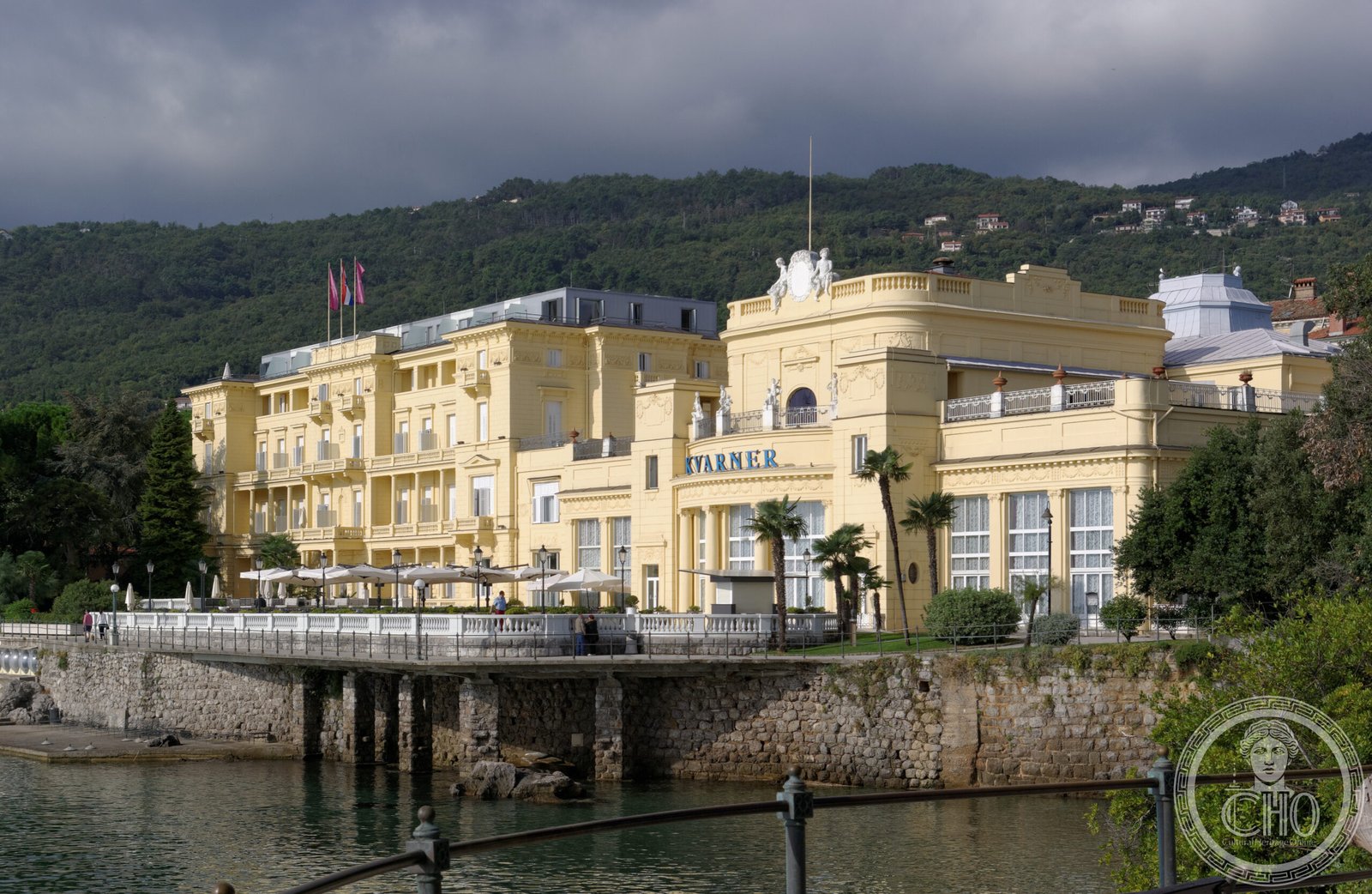
On 27 March 1884, the Austrian Southern Railway opened Hotel Kvarner and effectively invented Opatija as a resort. It was the first modern hotel on the eastern Adriatic coast, and it remains the oldest still standing.
At a glance
Hotel Kvarner was built in just nine months by Viennese architect Franz Wilhel for the Austrian Southern Railway Company (Südbahn), which was developing Opatija — then a small fishing village on the Kvarner Gulf — into a health resort accessible from Vienna by rail. The neoclassical structure originally offered 60 rooms and a warm-bath pavilion with twelve tubs equipped for hydrotherapy. Emperors, royalty, and artists followed. Today, as Remisens Premium Hotel Kvarner, it operates as a protected monument and four-star hotel, its Crystal Hall still the largest ballroom in Opatija.
Key facts
- Built: 1883–1884 by Franz Wilhel (Viennese architect)
- Style: Historicism / Neoclassical
- Status: Four-star hotel, operating as Remisens Premium Hotel Kvarner
- Address: Ulica Pava Tomašića 2, 51410 Opatija, Croatia
- GPS: 45.3346, 14.3078 — Open in Google Maps
- UNESCO/Listed: Listed protected cultural monument; major restoration completed 2014
History
The Austrian Southern Railway completed its line to Rijeka (Fiume) in 1873, and company director Friedrich Julius Schüler recognised that the mild coastal microclimate of the Kvarner Bay — shielded from northerly winds by Mount Učka — could sustain a year-round health resort accessible from Vienna in hours. Schüler commissioned Viennese architect Franz Wilhel, and the building rose in less than nine months. Hotel Quarnero, as it was originally called, opened on 27 March 1884 with 60 rooms and a hydrotherapy pavilion. What had been conceived partly as a sanatorium quickly attracted aristocratic leisure travellers. Austrian Emperor Franz Joseph I and German Emperor Wilhelm II met here. The Romanian royal couple and American dancer Isadora Duncan both stayed within its walls.
Opatija changed hands after the First World War, becoming Italian (as Abbazia) under the Treaty of Rapallo. The hotel continued operating through the Fascist and Yugoslav periods, accumulating layers of renovation without losing its neoclassical shell. The Crystal Hall — a glasshouse ballroom added in 1913 — survived as an architectural centrepiece. A comprehensive restoration was completed in 2014, returning the facade to its original appearance and upgrading the interiors to modern four-star standard.
Today the Kvarner is operated by Liburnia Riviera Hoteli d.d. Its 87 rooms and its status as the oldest hotel on the Adriatic make it the symbolic origin point of Croatian coastal tourism.
What you see
The main facade presents a composed Neoclassical elevation of two principal storeys over a rusticated base, with a symmetrical arrangement of round-arched windows, string courses, and corner quoins that reads as confident Habsburg resort architecture. The warm ochre render, restored in 2014, glows against the Adriatic light. A covered terrace at ground level steps towards the park and the sea promenade. The proportions are generous without being overbearing — designed to signal comfort and permanence rather than palace grandeur.
The Crystal Hall, appended in 1913, is the building’s most distinctive interior space: a large glazed ballroom with iron columns and an arched glass roof that floods the room with natural light. At 1,500 square metres it is the largest event space in Opatija and retains enough of its Edwardian character to suggest the opulent assembly rooms of the original resort era.
Practical information
- Hotel guests only for rooms; the Crystal Hall is open for events and can be visited by arrangement
- Best in spring (April–June) and early autumn (September–October) for mild temperatures and fewer crowds
- Guided heritage walks of Opatija’s Historicist and Secessionist architecture frequently depart from the hotel terrace
- Estimated visit time: 1–2 hours to walk the grounds, terrace, and park
Getting there
The nearest airport is Rijeka Airport (Krk Island), approximately 30 km away; transfer by taxi takes around 35 minutes. From Rijeka city centre, Opatija is 13 km west along the Lungomare coastal road; bus line 32 connects the two towns in around 30 minutes. Hotel Kvarner stands at the south end of Park Angiolina, Opatija’s historic botanical park, a 10-minute walk from the bus terminus at the town centre.
Nearby
- Park Angiolina: Opatija’s historic botanical park immediately adjacent — the oldest park on the Croatian coast, established 1845, with over 150 plant species.
- Villa Angiolina: The 1844 neoclassical villa inside Park Angiolina that preceded the hotel as Opatija’s first grand residence; now houses the Croatian Museum of Tourism.
- Lungomare: The 12 km coastal promenade running from Volosko to Lovran, passing directly in front of the hotel — one of the most scenic seafront walks on the Adriatic.
- Villa Neptun / Amadria Park: Late 19th-century spa hotel complex a short walk north along the promenade, part of the original Habsburg resort ensemble.
Sources
Find it on the map
See this place and what’s around it →📷 Become a Cultural Heritage Online photographer
Share your photos of places: they stay published under your name as the author. The more they're seen, the more you get noticed — and soon a contest will reward the most appreciated photos.
Log in or sign up free to add a photoIs this page about you?
This page is read by travellers and heritage enthusiasts who find it on Google. Tell us how you are connected to this place and we will take it from there.