
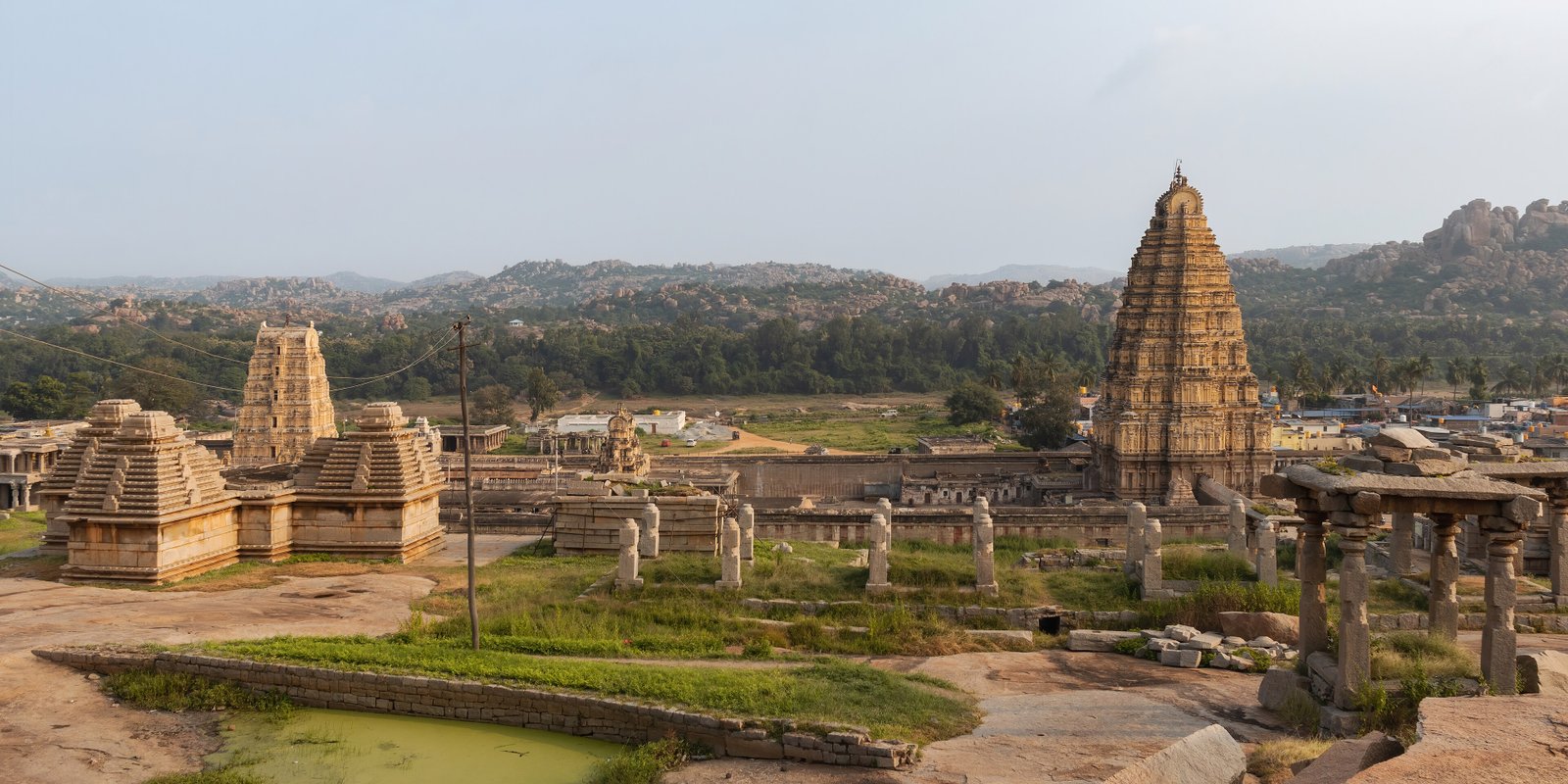
Hampi
Once home to half a million people and described by a 16th-century Portuguese traveller as rivalling Rome in size, Hampi is the 26-square-kilometre ruin field of the Vijayanagara Empire — the last great medieval Hindu kingdom of South India, sacked in 1565 and never reoccupied.
At a glance
Hampi, located on the south bank of the Tungabhadra River in present-day Vijayanagara district, Karnataka, served as the capital of the Vijayanagara Empire from the kingdom’s founding in 1336 until its catastrophic defeat at the Battle of Talikota in 1565. The 26-square-kilometre UNESCO World Heritage site contains over 1,600 surviving structures including active temples, royal enclosures, market streets, elephant stables, water pavilions, and the extraordinary granite landscape of the Deccan plateau, where rounded boulders the size of houses rise in seemingly random piles above the river plain. The Portuguese merchant Domingo Paes visited in 1520 and wrote that Hampi was “as large as Rome and very beautiful to the sight” — an estimate consistent with the archaeological evidence for a population of 400,000 to 500,000 at the city’s peak. The Virupaksha Temple, dedicated to Shiva and believed to have been in continuous worship since at least the 7th century, remains an active pilgrimage site today.
Key facts
- Founded: 1336 AD (Vijayanagara Empire, by brothers Harihara I and Bukka Raya I)
- Destroyed: 1565 AD (Battle of Talikota; sacked by Deccan Sultanate coalition)
- UNESCO inscription: 1986
- Scale: 26 sq km; over 1,600 surviving monuments
- Peak population: 400,000–500,000 (early 16th century)
- Key monuments: Virupaksha Temple (active), Vittala Temple complex and Stone Chariot, Lotus Mahal, Elephant Stables, Queen’s Bath, Hazara Rama Temple
- Access: Hampi Archaeological Zone; most sites open 08:00–17:30; Vittala Temple complex requires separate entry (INR 40 / foreigners INR 600 approx.)
History
The Vijayanagara Empire was founded in 1336 by Harihara I and his brother Bukka Raya I, two brothers from the Sangama dynasty who had served as ministers in the Kampili kingdom before its defeat by the Delhi Sultanate. According to tradition, a Shaivite sage named Vidyaranya guided them to a site on the rocky south bank of the Tungabhadra where a sage named Vidyaranya received a divine vision, and the brothers established their capital there, calling it Vijayanagara — “City of Victory.” The location was strategic: surrounded on three sides by the Tungabhadra and its tributaries, and on the fourth by concentric rings of granite ridges that formed natural fortification lines, the city was virtually impregnable to the cavalry-based armies of the Deccan.
The empire expanded through the 14th and 15th centuries under successive dynasties — Sangama, Saluva, and Tuluva — eventually controlling most of peninsular India south of the Krishna River. Under Emperor Krishnadevaraya (r. 1509–1529), considered the greatest of the Vijayanagara rulers, the kingdom reached its territorial and cultural peak. Krishnadevaraya was a poet, musician, and military strategist who composed works in Telugu and Sanskrit, patronised the construction of the Vittala and Hazara Rama temple complexes at Hampi, and received at his court the Portuguese envoy Domingos Paes, whose detailed account of the city’s markets, processions, and palace rituals is one of the most vivid records of a pre-modern South Asian city. The empire maintained maritime trade connections with Persia, Arabia, China, and Portugal, exporting cotton textiles and receiving horses — critical military assets for an inland kingdom.
The empire’s end came at the Battle of Talikota on 23 January 1565, when a coalition of the five Deccan Sultanates — Bijapur, Ahmadnagar, Bidar, Berar, and Golconda — united against Vijayanagara for the first time. The Vijayanagara army was defeated in part because two Muslim generals serving it defected to the Sultanate coalition at a critical moment. Emperor Aliya Rama Raya was captured and beheaded on the battlefield. The Sultanate forces then marched on Hampi and spent six months systematically dismantling the city — smashing sculptures, melting bronze, collapsing roofs — before withdrawing. The city was never reoccupied. Within a generation of its destruction, the jungle and the granite had begun to reclaim it. The Virupaksha Temple, protected by an enduring Shaivite community, was the sole major structure maintained continuously through the subsequent centuries.
What you see
The Vittala Temple complex, built in the 15th and 16th centuries in the north of the archaeological zone, represents the apex of Vijayanagara architectural ambition. The main Vittala shrine sits on a raised platform and is surrounded by 56 musical pillars — monolithic columns of granite that produce distinct tones when tapped, each tuned to a different note through variations in cross-section and mass. In front of the temple stands the Stone Chariot, a shrine to Garuda (Vishnu’s vehicle) built in the form of a stone cart with wheels that once rotated on their axles. The chariot’s combination of symbolic movement and absolute permanence is the single most photographed object in Hampi, and its image appears on the Indian 50-rupee note. The broader complex includes corridors with narrative friezes of elephants, horses, and royal processions running along their base at ankle height — a pictorial census of 16th-century court life.
The landscape is as much a monument as the structures within it. The Deccan granite boulders that surround and punctuate the archaeological zone are among the oldest exposed rock surfaces on Earth, formed roughly 2.5 billion years ago and rounded by differential weathering rather than glaciation. The Tungabhadra River, which bends sharply around the northern edge of the site, was the city’s lifeline and defence; the Vijayanagara engineers canalized it with a sophisticated aqueduct and reservoir system that irrigated the surrounding agricultural land. Walking between the Vittala complex and the Virupaksha Temple along the ancient bazaar street — a colonnaded avenue 750 metres long whose shops once sold flowers, coconuts, and cloth for temple offerings — the stone bases of the market stalls are still visible, and the scale of the original urban fabric becomes clear.
Practical information
- Opening hours: Most sites 08:00–17:30; Virupaksha Temple open at dawn for morning puja (~06:00)
- Best time to visit: October–February (temperatures 20–32°C, low humidity); avoid March–June (peak heat, up to 42°C)
- Duration: Minimum 2 full days to cover the main sites; 3 days allows for the Anegundi fort on the north bank and more remote temple clusters
- Tip: The site has no single logical circuit; rent a bicycle (available at Hampi Bazaar, ~INR 150/day) or hire an auto-rickshaw for the day (negotiate ~INR 600–800). The Vittala complex requires a separate entry ticket and has battery-operated vehicle transport from the gate — private vehicles are not allowed inside.
Getting there
Hosapete Junction (HPT) is the nearest railway station, 13 km from Hampi, with train connections to Bengaluru (5–6 hours), Hubli, and Goa. Bengaluru’s Kempegowda International Airport (BLR) is approximately 350 km southeast; overnight trains and buses connect to Hosapete. Hubli Airport (HBX) is 160 km west and serves some domestic routes. From Hosapete, autos and cabs reach Hampi Bazaar (the main visitor village on the south bank) in 20–30 minutes. A coracle ferry or road crossing via Anegundi bridge connects to the north bank ruins.
Nearby
- Anegundi (across the river, north bank) — ancient Kishkindha of the Ramayana; walled village with smaller Vijayanagara-era temples and fort ruins; quieter than the main zone
- Badami (140 km northwest) — Chalukya-era cave temples cut into red sandstone cliffs, 6th–8th centuries AD; outstanding early South Indian rock-cut sculpture
- Pattadakal (120 km northwest) — UNESCO-listed group of 8th-century Chalukya temples, including both Dravidian and Nagara styles; the experimental synthesis that produced the later Vijayanagara style
- Daroji Bear Sanctuary (15 km south) — sloth bear reserve in rocky terrain similar to Hampi; viewing platform at feeding time (sunset)
Sources
- Wikipedia, “Hampi” — en.wikipedia.org/wiki/Hampi
- UNESCO World Heritage Centre, “Group of Monuments at Hampi” — whc.unesco.org/en/list/241
- Fritz, J.M. & Michell, G. (2001). New Light on Hampi: Recent Research at Vijayanagara. MARG Publications.
- Sewell, R. (1900). A Forgotten Empire (Vijayanagar): A Contribution to the History of India. Swan Sonnenschein & Co.
Find it on the map
See this place and what’s around it →📷 Diventa un fotografo di Cultural Heritage Online
Condividi le tue foto dei luoghi: restano pubblicate con la tua firma come autore. Più vengono viste, più ti fai conoscere — e presto un concorso premierà le foto più apprezzate.
Accedi o registrati gratis per aggiungere una foto