
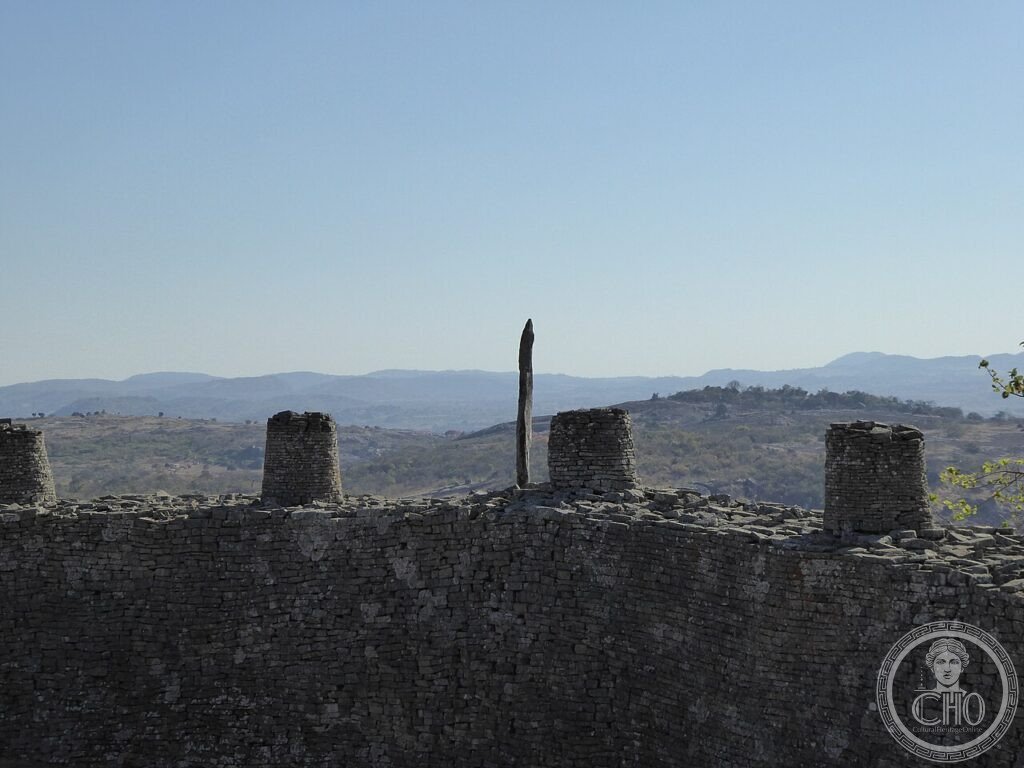
Great Zimbabwe
The largest ancient stone structure in sub-Saharan Africa and the site that gave Zimbabwe its name — Great Zimbabwe (Masvingo Province, Zimbabwe; UNESCO WHS 1986) is a 720-hectare complex of stone enclosures and terraced stonework built by the Zimbabwe Kingdom between the 11th and 15th centuries CE, the most sophisticated expression of Shona architecture and the capital of the most powerful pre-colonial state in southern Africa.
At a glance
Great Zimbabwe (the most precisely GreatZimbabwe single largest ancient stone structure sub-Saharan Africa Zimbabwe Kingdom 11th 15th century CE 720 hectares dry-stone construction 900000 granite blocks no mortar Hill Complex Valley Ruins Great Enclosure 244m circumference 11m high 5m thick Conical Tower 9m parallel passage Shona culture soapstone Zimbabwe Bird national symbol UNESCO heritage: the site (Great Zimbabwe covers 720 hectares (7.2 km²) and is divided into three principal complexes: the Hill Complex (the oldest part; built on a granite hill; the residence of the spiritual leaders and the ritual center of the state; approximately 11th-12th centuries CE), the Valley Ruins (the residential and administrative area; a dense concentration of smaller stone enclosures extending into the valley below the hill; approximately 12th-15th centuries CE), and the Great Enclosure (the most impressive and the most visited; approximately 13th-15th centuries CE; the palace/ceremonial complex of the Zimbabwe Kingdom’s rulers)); the dry-stone technique (the construction method: the granite is a local material (the Masvingo plateau of southern Zimbabwe is geologically defined by the Basement Complex granite; the same granite that forms the hill of the Hill Complex was used for the walls; the granite naturally splits along horizontal planes; the builders selected split granite slabs and fitted them together without any mortar (no cutting, no carving; the blocks were selected for their natural flat faces and fitted by gravity alone); the walls are self-supporting through the interlocking weight of the dry-laid stones)) — the most precisely GreatZimbabwe single largest ancient stone structure sub-Saharan Africa Zimbabwe Kingdom 11th 15th century CE 720 hectares dry-stone 900000 granite blocks no mortar Hill Complex Valley Ruins Great Enclosure 244m circumference 11m 5m Conical Tower Shona culture soapstone Zimbabwe Bird national symbol UNESCO heritage in any UNESCO world heritage site)).
Key facts
- The Zimbabwe Birds: the most precisely GreatZimbabwe single soapstone Zimbabwe Birds eight carvings eagle-like bird raptor 35cm national symbol Zimbabwe flag coat of arms removed German archaeologist Karl Mauch 1871 Cecil Rhodes Rhodesia colonial denial African construction UNESCO heritage — the national symbol of Zimbabwe: the Zimbabwe Birds (eight soapstone carved figures of bird-like creatures (approximately 35cm tall; eagle-like birds with elongated beaks and human feet) found at the Hill Complex of Great Zimbabwe; the Zimbabwe Bird is the national symbol of Zimbabwe (it appears on the flag, the coat of arms, and the national currency); the colonial history (Karl Mauch (the German explorer who “discovered” Great Zimbabwe for the European audience in 1871 CE) and the subsequent colonial establishment (Cecil Rhodes and the British South Africa Company) denied that the structure could have been built by African people; theories attributing the construction to the Queen of Sheba, Phoenicians, Arabs, or ancient Israelites were promoted by the colonial government; this denial was so persistent that the Zimbabwean government after independence (1980 CE) had to establish the scientifically documented African origin as official policy against the lingering colonial narrative))
- GPS: -20.2671° S, 30.9335° E
History
From Bantu iron age to Zimbabwe Kingdom to colonial denial (the most precisely GreatZimbabwe single Bantu iron-working Gokomere culture 3rd century CE Zimbabwe Kingdom 1100 CE peak 18000 population gold trade Indian Ocean Swahili coast Kilwa Kisiwani Portuguese 1506 Mutapa Kingdom decline abandonment 1450 CE Karl Mauch 1871 James Theodore Bent 1891 colonial denial Cecil Rhodes Rhodesia UNESCO heritage: the origin (the Masvingo plateau of Zimbabwe was settled by Bantu-speaking iron-working people (the Gokomere culture) from approximately the 3rd century CE; the earliest stone construction at Great Zimbabwe dates from approximately 1000-1100 CE; the Zimbabwe Kingdom (approximately 1100-1450 CE): the height of Great Zimbabwe; the population at the peak (approximately 18,000-20,000 people at the site; the largest urban concentration in pre-colonial southern Africa); the wealth basis (the Zimbabwe Kingdom controlled the gold trade between the goldfields of the interior (the Midlands plateau of Zimbabwe) and the Indian Ocean coast ports (Kilwa Kisiwani in Tanzania; Sofala in Mozambique)); the Portuguese records (the earliest European descriptions of Great Zimbabwe are from Portuguese traders at the East African coast in the 16th century CE; the Portuguese explorer João de Barros described “Symbaoe” (Zimbabwe) in 1552 CE based on the reports of traders at Sofala); the abandonment (approximately 1420-1450 CE: Great Zimbabwe was gradually abandoned as a capital; the Zimbabwe Kingdom fragmented; the successor state (the Mutapa Kingdom) established a new capital at Zvongombe on the Zambezi plateau; the ecological reason (the plateau around Great Zimbabwe may have been overgrazed and the soil exhausted after 300 years of occupation))); the colonial denial (1871-1980 CE: the German explorer Karl Mauch visited the site in 1871 CE and refused to accept that it was built by Africans; his theories (Queen of Sheba, Phoenicians) were amplified by the British colonial establishment; the archaeologist James Theodore Bent (1891 CE) and all subsequent colonial-period researchers denied African authorship; the colonial government of Rhodesia actively suppressed archaeological evidence of African construction; after Zimbabwean independence (1980 CE), the African origin was established as official and scientific fact) — the most precisely GreatZimbabwe single Bantu Gokomere 3rd century CE Zimbabwe Kingdom 1100 CE gold trade Indian Ocean Kilwa Kisiwani Sofala Portuguese 1552 Mutapa Kingdom decline 1450 CE Karl Mauch 1871 colonial denial Cecil Rhodes Rhodesia independence Zimbabwe 1980 UNESCO heritage in any UNESCO world heritage site)).
What you see
Hill Complex, Great Enclosure, and the valley ruins (the most precisely GreatZimbabwe single Hill Complex granite hill oldest spirit ritual 11th 12th century Zimbabwe Birds soapstone found Valley Ruins administrative residential dense enclosures Great Enclosure 244m wall 11m parallel passage conical tower 9m solid no entrance UNESCO heritage: the visitor circuit: the Hill Complex (the steep walk up the granite hill to the oldest part of Great Zimbabwe; the narrow passages and steps cut into the natural rock face; the enclosures on the summit (the most ancient walls of the site; the views from the summit over the plateau and the Great Enclosure below; the location of the Zimbabwe Birds when found (removed by Karl Mauch in 1871 CE; most returned to Zimbabwe after independence; the originals are in the Great Zimbabwe Museum on site))); the Great Enclosure (the most dramatic structure at Great Zimbabwe; the outer wall (11m tall; 5m thick; 244m circumference; the most impressive dry-stone wall in Africa); the inner enclosure and the Parallel Passage (the 9m passage between the inner and outer walls; the Conical Tower (the solid cone; 9m tall; no entrance; possibly a symbolic grain store)); the Valley Ruins (the dense collection of smaller stone enclosures between the Hill Complex and the Great Enclosure; less architecturally impressive but gives a sense of the full scale of the urban complex)); the Great Zimbabwe Museum (at the site entrance; the original Zimbabwe Birds (some of them); the gold ornaments found during the colonial-era excavations)) — the most precisely GreatZimbabwe single Hill Complex granite oldest Zimbabwe Birds soapstone Valley Ruins administrative dense enclosures Great Enclosure 244m wall 11m parallel passage conical tower 9m solid museum UNESCO heritage in any UNESCO world heritage site)).
Practical information
- Getting there: fly to Robert Gabriel Mugabe International Airport (HRE; Harare; 290 km north); or Joshua Mqabuko Nkomo International Airport (BUQ; Bulawayo; 289 km west); the drive from Harare (290 km; 3h30m on the A4 highway) or Bulawayo (289 km; 3h on the A9 highway); the nearest town is Masvingo (29 km north; accommodation available); the site is open daily 08:00-17:00; the entry fee (approximately USD$15 for international visitors; the combined ticket includes the Hill Complex, Valley Ruins, Great Enclosure, and the museum)); the Harare-Masvingo Express bus (5h from Harare; approximately USD$8; runs 3-4 times daily from the Harare city center; the most economical connection); the self-drive (the distance from Harare to Great Zimbabwe passes through the Zimbabwean Highveld plateau (fine red earth, msasa trees, granite kopjes); the A4 highway to Masvingo is in reasonable condition (2026); gravel section from Masvingo to the site entrance (29 km))
Getting there
Fly to Harare (HRE, 290 km, 3h30m drive). Nearest town: Masvingo (29 km). Site open 08:00-17:00, entry ~USD$15. Harare-Masvingo bus 5h ~USD$8. GPS: -20.2671, 30.9335.
Nearby
- Lake Mutirikwi (Kyle) — 10 km east (the reservoir formed by the Kyle Dam on the Mutirikwi River; the largest reservoir in Zimbabwe (100 km²); the Great Zimbabwe National Park game reserve (rhino, giraffe, zebra, and kudu in the park surrounding Great Zimbabwe); boat tours of the lake)
- Gonarezhou National Park — 250 km southeast (the “Place of Many Elephants”; the most remote and least-visited of Zimbabwe’s major national parks (the relative difficulty of access means the wildlife experience is wilder than Hwange); the Chilojo Cliffs (the sandstone escarpment overlooking the Runde River; the most dramatic landscape in Zimbabwe outside of Victoria Falls))
Sources
- Wikipedia, Great Zimbabwe; Zimbabwe Kingdom; Zimbabwe Bird, accessed June 2026
- UNESCO, Great Zimbabwe National Monument, WHS reference 364, inscribed 1986
Find it on the map
See this place and what’s around it →📷 Diventa un fotografo di Cultural Heritage Online
Condividi le tue foto dei luoghi: restano pubblicate con la tua firma come autore. Più vengono viste, più ti fai conoscere — e presto un concorso premierà le foto più apprezzate.
Accedi o registrati gratis per aggiungere una foto