
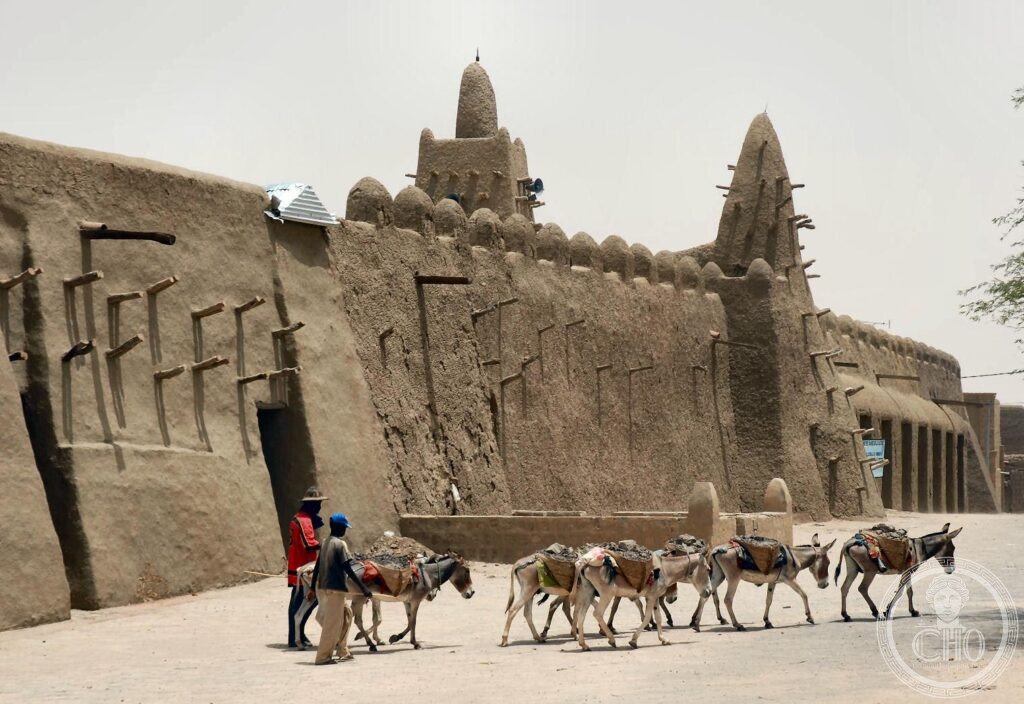
Timbuktu was the medieval hinge between the Sahara’s caravan routes and the trading cities of the Niger, a place where gold, salt and books moved in equal measure. Its three mud-brick mosques and its archives of hand-copied manuscripts still stand as evidence of a West African centre of Islamic scholarship that once rivalled any in the Muslim world.
At a glance
Timbuktu sits near the northern bend of the Niger River, at the point where Saharan trade routes meet the agricultural lands of the Sudanic belt. It began around 1100 CE as a seasonal camp of Tuareg nomads and grew into a permanent trading post for salt carried down from the Sahara and gold carried up from the forests further south.
The city passed through three distinct periods of prominence: as a cultural outpost of the Mali Empire following Mansa Musa’s pilgrimage to Mecca, as the intellectual capital of the Songhay Empire with its university and Quranic schools, and finally into decline after a Moroccan invasion broke up its community of scholars. Its three historic mosques and its collections of manuscripts are listed by UNESCO.
Key facts
- Location: Timbuktu, Tombouctou Region, Mali, close to the Niger River’s northern bend (16.7735° N, -3.0074° E).
- Founding: established as a Tuareg seasonal camp around 1100 CE.
- Mansa Musa’s pilgrimage: the Mali emperor’s 1324 Hajj to Mecca brought vast quantities of gold with his travelling court and, on his return, funded the building of the Djinguereber Mosque.
- Architect: the Andalusian architect Abu Ishaq Ibrahim es-Saheli designed the Djinguereber Mosque and the royal palace, introducing the flat-roofed mud-brick style that spread across the West African Sahel.
- Manuscripts: Timbuktu holds a major collection of handwritten documents on astronomy, mathematics, medicine, law, history and philosophy, produced by local scholars between the 13th and 17th centuries.
- Heritage status: inscribed as a UNESCO World Heritage Site in 1988.
History
Timbuktu’s earliest role was as a seasonal trading camp at the desert’s edge, where Tuareg traders exchanged Saharan salt mined at Taoudenni for gold brought from further south. It became a permanent settlement as this trade grew.
The city’s fortunes changed decisively in 1324, when Mansa Musa of the Mali Empire passed through on his return from Mecca and ordered the construction of the Djinguereber Mosque, establishing Timbuktu as a centre of Islamic culture. Under the Songhay Empire that followed, the city reached its intellectual peak: the Sankore Mosque developed into a university, thousands of students studied at its Quranic schools, and books became one of the city’s most valuable traded goods.
This era ended in 1591, when the Saadian Sultan Ahmad al-Mansur of Morocco sent an army equipped with firearms across the Sahara. The Songhay forces, facing gunpowder weapons for the first time, were defeated, and Moroccan occupiers deported dozens of Timbuktu’s leading scholars, including the historian Ahmad Baba, to Marrakech in chains. The city’s scholarly tradition never fully recovered.
What you see
Three medieval mosques still stand in Timbuktu. The Djinguereber Mosque, the largest and oldest of the three, is built of mud brick with three minarets topped by wooden ostrich-egg finials, symbols with meanings in local Islamic culture. Wooden beam-ends project from its walls at regular intervals; these are not ornamental but functional, forming permanent scaffolding for the mosque’s annual replastering, a communal event carried out each spring with music and shared meals.
The Sankore Mosque, once the seat of Timbuktu’s university, is notable for its stepped pyramid minaret, an unusual form for a mosque, and remains in active use. The smaller Sidi Yahia Mosque is known locally for its sealed northern door, said to have been shut under a prophecy of catastrophe and only forced open by French colonial soldiers in 1894, an event locals still associate with the city’s later decline.
Beyond the mosques, Timbuktu is dotted with the mausoleums of Islamic scholars and Sufi leaders, giving the city its nickname, the City of 333 Saints. Some of these shrines were damaged during the Islamist occupation of 2012 and have since been partly restored with UNESCO support.
Practical information
- Manuscripts access: the Ahmed Baba Institute for Higher Islamic Studies and Research holds and has digitised a substantial portion of the surviving manuscripts; visiting arrangements should be checked with the institute directly.
- Site conditions: the mosques remain active places of worship and community life, and visitors should expect local customs around access to be respected.
- Security and travel advice: conditions in the region can change; travellers should consult official government and UNESCO channels before planning a visit.
Getting there
Timbuktu is reached either by air from Bamako or by river, travelling down the Niger by pinasse, a traditional long wooden motor canoe, from the river port of Mopti. Current routes, schedules and safety conditions should be confirmed through official travel and government advisories before departure.
Nearby
- Taoudenni — roughly 700 km north, the historic salt-mining site that supplied Timbuktu’s caravan trade.
- Mopti — downriver on the Niger, the usual starting point for pinasse boats travelling to Timbuktu.
- Bamako — Mali’s capital, the usual point of departure for onward travel to Timbuktu.
Sources
- UNESCO
- Ahmed Baba Institute for Higher Islamic Studies and Research
Find it on the map
See this place and what’s around it →📷 Become a Cultural Heritage Online photographer
Share your photos of places: they stay published under your name as the author. The more they're seen, the more you get noticed — and soon a contest will reward the most appreciated photos.
Log in or sign up free to add a photoIs this page about you?
This page is read by travellers and heritage enthusiasts who find it on Google. Tell us how you are connected to this place and we will take it from there.