
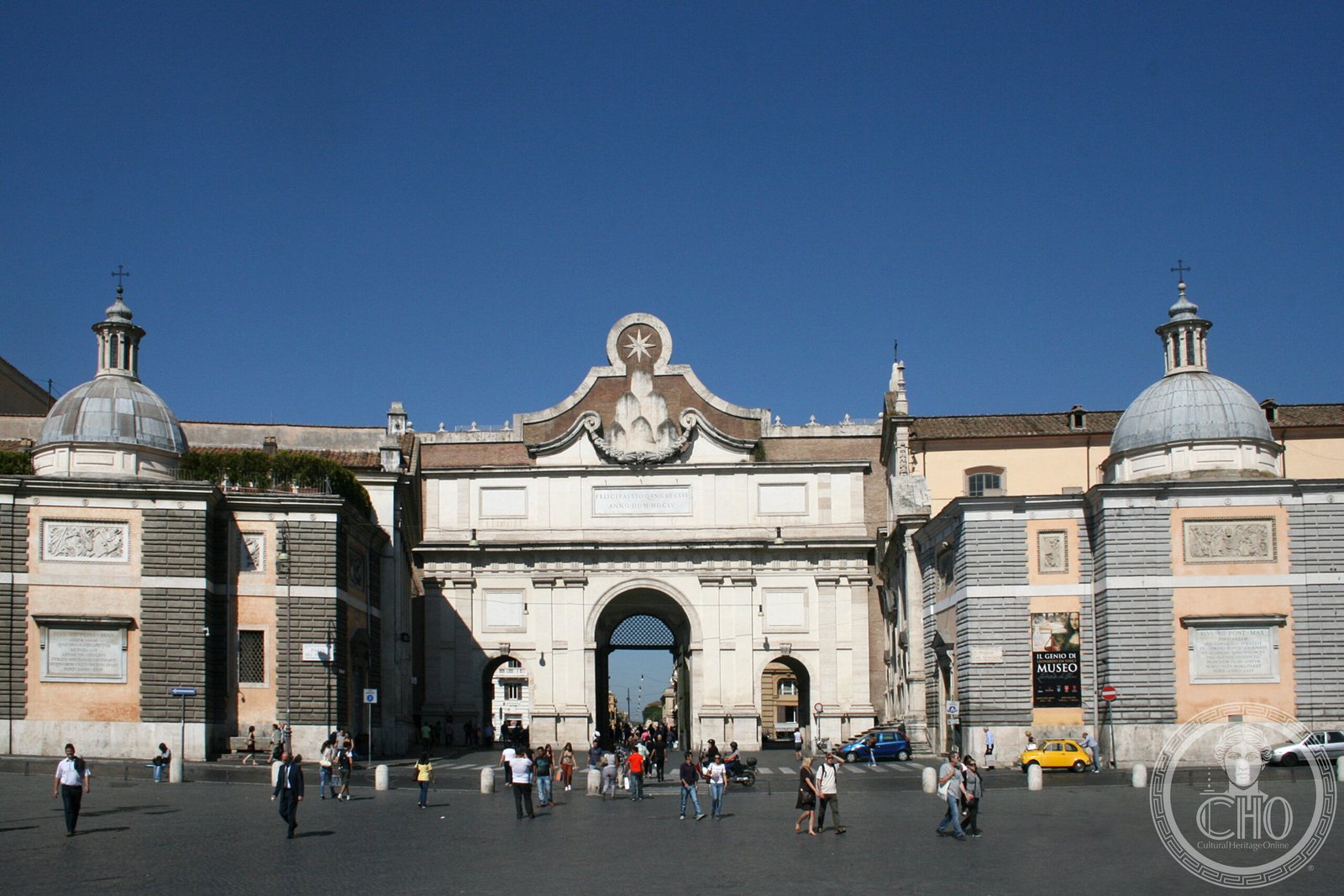
Gate of the People – Porta Flaminia
The Porta del Popolo, also known as the Porta Flaminia, is a monumental city gate set within the Aurelian Walls of Rome. It stands at the southern end of Piazza del Popolo, marking the historic threshold between the great northern road into Rome and the city’s ceremonial heart. Its inner face was remodelled by Gian Lorenzo Bernini in 1655 to welcome Queen Christina of Sweden on her celebrated conversion to Catholicism.
At a glance
- Type
- City gate within the Aurelian Walls
- Period
- Original gate 3rd century AD (Aurelian Walls); outer facade redesigned by Giacomo della Porta c. 1561–1565; inner face by Gian Lorenzo Bernini 1655
- Style
- Roman defensive architecture with Renaissance and Baroque additions
- Location
- Piazza del Popolo, Rome, Italy
- Coordinates
- 41.9115° N, 12.4760° E
Overview
The Porta del Popolo marks the point where the ancient Via Flaminia entered Rome, a road that connected the capital to the Adriatic coast of northern Italy. The gate sits between Piazza del Popolo and Piazzale Flaminio, forming a symbolic boundary between the city and the road to the north. For centuries it was the principal entry point for travellers, pilgrims, and dignitaries arriving from northern Europe, making it one of Rome’s most historically trafficked thresholds.
History
The original Porta Flaminia was incorporated into the Aurelian Walls constructed between 271 and 275 AD under Emperor Aurelian, replacing an earlier Republican-era gateway. The outer facade was redesigned in travertine around 1561–1565 by Giacomo della Porta under Pope Pius IV, giving it the Renaissance appearance visible from the piazza today. In 1655, Pope Alexander VII commissioned Gian Lorenzo Bernini to restyle the inner face as part of the ceremonial reception of Queen Christina of Sweden, who had abdicated her throne and converted to Catholicism. The carved inscription on the inner arch — Felici Faustoque Ingressui (“For a happy and auspicious entry”) — commemorates that event.
What you see
The outer face of the gate presents a classical Renaissance composition: a large central arch flanked by two smaller pedestrian arches, with Doric pilasters and a pronounced entablature bearing the papal coat of arms of Pius IV. The inner Baroque face designed by Bernini is lighter and more festive in character, with Corinthian pilasters and decorative relief panels. The gate is flanked by two round towers from the original Aurelian circuit, still visible from Piazzale Flaminio. Overhead, the crowning heraldic decoration of the Chigi family — Alexander VII’s lineage — ties the gate firmly to its 1655 refurbishment.
Cultural significance
The Porta del Popolo has been a threshold of political and spiritual theatre throughout Rome’s modern history, receiving popes, monarchs, and ambassadors arriving from the north. It is protected as part of the Aurelian Walls archaeological complex, listed among Rome’s most important ancient monuments. The juxtaposition of its two faces — one Renaissance, one Baroque — makes it a rare document of three distinct architectural moments within a single Roman gateway.
Practical information
- Address
- Piazza del Popolo, 00187 Roma RM, Italy
- Access
- Freely visible from the piazza at all times; no entry fee to view the exterior
- Hours
- Exterior always accessible; check official sources for any interior or wall access programmes
Getting there
The gate is served by Metro Line A (Flaminio station), a short walk from the station exit onto Piazza del Popolo. Numerous bus lines stop at Piazzale Flaminio. Tram line 2 also terminates at Piazzale Flaminio. The piazza is within comfortable walking distance of the Spanish Steps and the Prati district.
Sources & resources
Find it on the map
See this place and what’s around it →Historical events at this place (2)
📷 Diventa un fotografo di Cultural Heritage Online
Condividi le tue foto dei luoghi: restano pubblicate con la tua firma come autore. Più vengono viste, più ti fai conoscere — e presto un concorso premierà le foto più apprezzate.
Accedi o registrati gratis per aggiungere una foto