
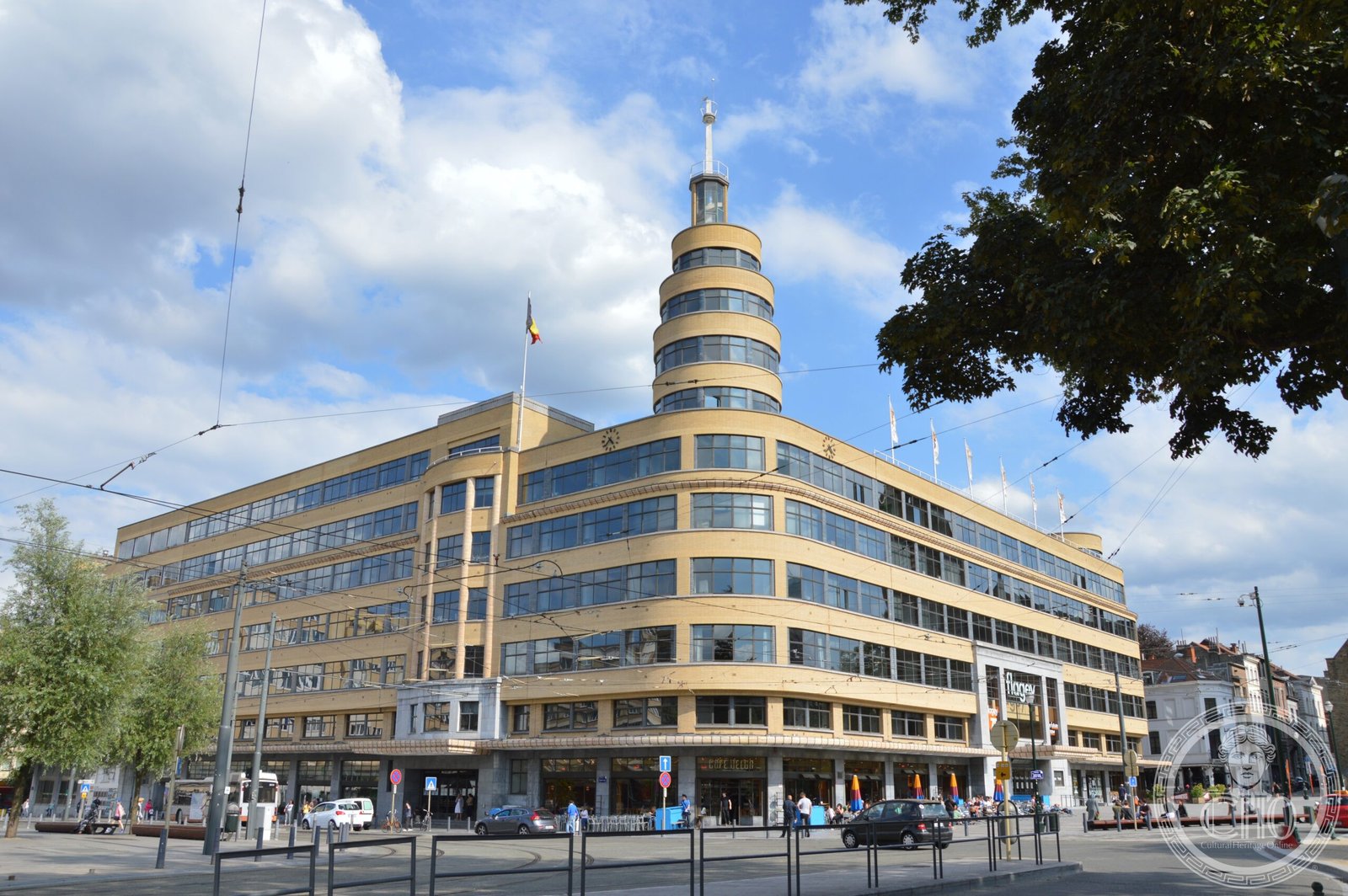
The Flagey Building — known to Belgians as the Maison de la Radio — rises above the Place Flagey in Ixelles, Brussels, as one of Europe’s most distinctive examples of Streamline Moderne architecture. Completed in 1938 to house the Institut National de Radiodiffusion (INR), the building’s bold horizontal banding, curved prow facade and nautical silhouette earned it the popular nickname “the ocean liner.” After decades of neglect and a spirited public campaign to save it from demolition, the landmark was meticulously restored and reopened in 2002 as a world-class concert and cultural venue, anchoring one of Brussels’ most vibrant creative neighbourhoods.
At a glance
- Style
- Streamline Moderne
- Built
- 1935–1938
- Architect
- Joseph Diongre
- Location
- Place Sainte-Croix, Ixelles, Brussels, Belgium
- Original use
- National broadcasting institute (INR)
- Current use
- Concert hall and cultural centre
- Heritage status
- Listed monument, Brussels Capital Region
- Coordinates
- 50.8282° N, 4.3713° E
Overview
Standing at the edge of Place Flagey in the Ixelles commune of Brussels, the Flagey Building is a landmark of interwar European design. Commissioned by the Institut National de Radiodiffusion to serve as Belgium’s state broadcasting headquarters, the structure was designed by architect Joseph Diongre and completed in 1938. Its streamlined horizontals, sweeping curved facade and mast-like tower made it instantly recognisable — and earned it the affectionate nickname “the ocean liner.” Today it functions as a major concert hall and arts venue, contributing to Ixelles’ reputation as one of Brussels’ most culturally alive districts.
History
The Institut National de Radiodiffusion was created in 1930 to manage Belgian public broadcasting, and by mid-decade had outgrown its makeshift facilities. A prominent site on the newly landscaped Place Sainte-Croix (now Place Flagey) was selected, and Joseph Diongre was appointed to design a purpose-built broadcasting palace. Construction ran from 1935 to 1938. The INR operated the building until Belgian broadcasting was restructured in 1960, after which it passed through various ownership phases. By the 1990s the building stood largely derelict and a real-estate developer sought permission to demolish it. A sustained public campaign — including a petition signed by tens of thousands — secured its listing as a protected monument. Restoration was completed in 2002, and the building reopened as Flagey, a cultural complex comprising concert halls, a cinema and a cafe.
Architecture & Design
Joseph Diongre conceived the Flagey Building as a bold statement of Streamline Moderne, the aerodynamic variant of Art Deco that flourished in the 1930s. The building’s elongated, ship-like profile — wide at the centre, tapered at the curved prow — channels the machine-age fascination with speed and motion. Continuous horizontal window bands wrap the facades, reinforcing the nautical illusion. A slender vertical mast and central tower provide counterpoint to the dominant horizontals. The interior was equally ambitious: large broadcast studios with carefully calculated acoustics, elegant public halls and Art Deco detailing in metalwork and glazing. During restoration, the studios were converted into concert spaces that have become celebrated for their acoustic quality, with the principal hall seating approximately 750 listeners.
Cultural significance
The Flagey Building is woven into Belgian collective memory. For decades the INR broadcast pioneering programmes here that reached the entire nation; the building was literally the voice of Belgium. Its near-demolition in the 1990s galvanised a grassroots heritage movement and is frequently cited as a turning point in Belgian public attitudes towards modernist architectural conservation. Today Flagey is a democratic cultural hub — programming classical and jazz concerts, world music, film screenings and community events — that continues to draw Brusselois from across the language divide, making it as much a civic institution as an arts venue.
Visiting today
Flagey is open daily with a lively programme of concerts, film screenings and events. The complex includes a cafe-restaurant on the ground floor that is popular with locals even outside performance times. Tickets for concerts vary in price and can be booked via the Flagey website. The building’s exterior and public ground-floor areas are accessible for free. Guided architectural tours are offered periodically; check the Flagey website for the current schedule.
Getting there
Flagey occupies Place Sainte-Croix in Ixelles, about 2 km south-east of Brussels city centre. The nearest tram stops are Flagey (lines 81 and 83), a two-minute walk from the building. Multiple bus lines also serve the square. By metro, take line 2 or 6 to Louise station and walk 15 minutes, or transfer to tram 81. Cycling is easy on Brussels’ network of cycle lanes; bike-share stations are located on the square. Paid car parking is available nearby.
Sources & resources
Find it on the map
See this place and what’s around it →Record researched and written by Luigi De Marchi for Cultural Heritage Online, 2026.
📷 Become a Cultural Heritage Online photographer
Share your photos of places: they stay published under your name as the author. The more they're seen, the more you get noticed — and soon a contest will reward the most appreciated photos.
Log in or sign up free to add a photoIs this page about you?
This page is read by travellers and heritage enthusiasts who find it on Google. Tell us how you are connected to this place and we will take it from there.