

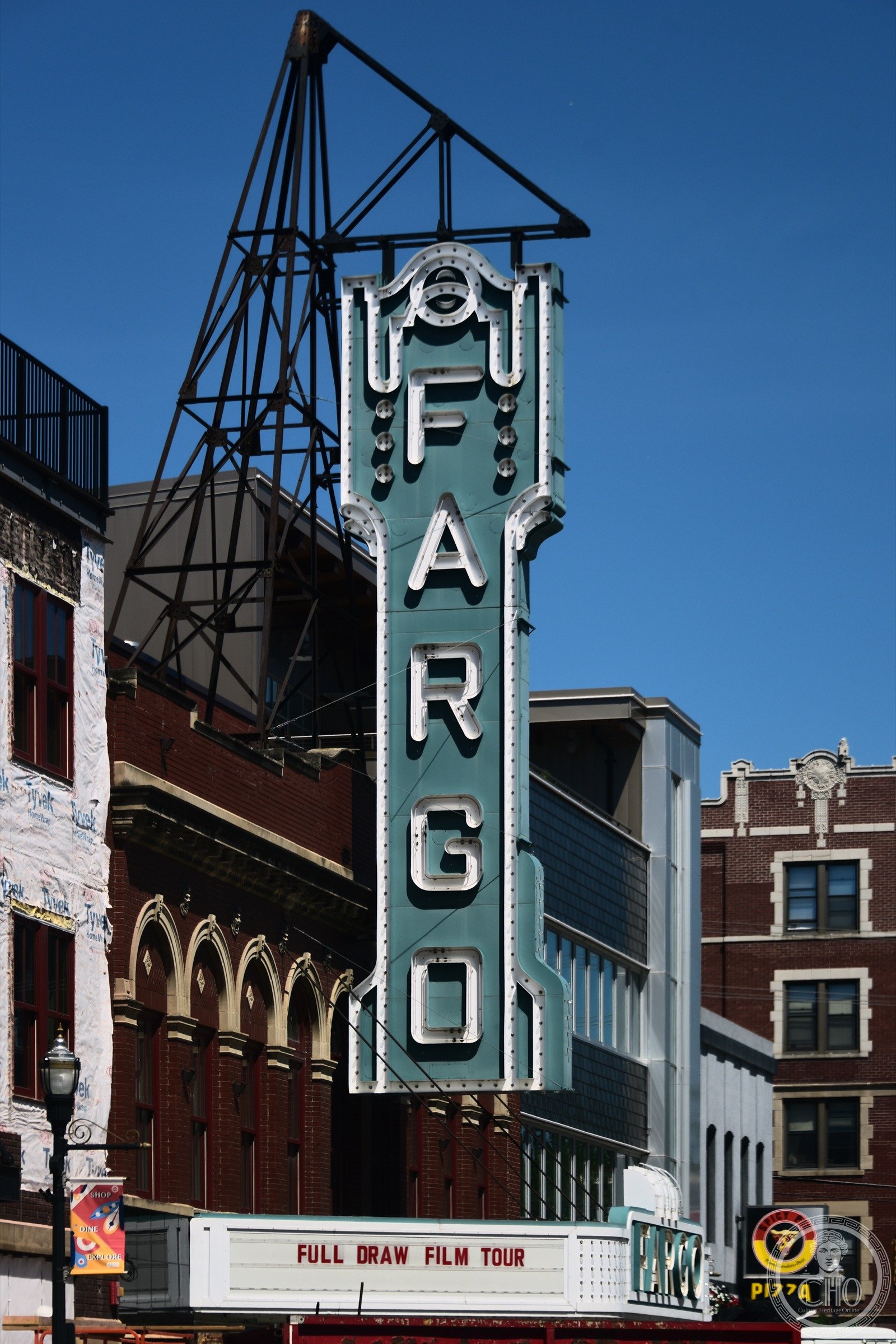
On Broadway in downtown Fargo — the largest city in the state and the commercial hub of the upper Great Plains — the Fargo Theatre has provided a continuous thread of cultural life since 1926, its Art Deco facade a landmark on North Dakota’s main commercial street and its screen and stage a gathering point for a community defined by the vast horizontal landscape around it.
At a glance
The Fargo Theatre at 314 Broadway North is the cultural heart of downtown Fargo and the finest surviving Art Deco theater in North Dakota. Opened in 1926, it established itself as the premier entertainment venue of the northern Great Plains during the silent film era and the subsequent transition to sound cinema — a position it maintained through the great decades of American moviegoing before adapting to the changing entertainment landscape of the late twentieth century. Operated since the 1990s as a nonprofit arts organization dedicated to film, performance, and community programming, the Fargo Theatre has found its second life as an independent cinema and performing arts venue, its Broadway facade as recognizable to Fargo residents as any landmark in the city.
Key facts
- Address: 314 Broadway North, Fargo, ND 58102
- Opened: 1926
- Style: Art Deco
- Current use: Nonprofit performing arts center; independent film, live performance, special events
- Designation: National Register of Historic Places
History
Fargo in the 1920s was the largest and most commercially dynamic city in North Dakota — a regional center for the wheat, cattle, and railroad trades that had built the Great Plains economy. The city sat astride the Red River of the North, which forms the border between North Dakota and Minnesota, at the crossing point of two transcontinental railroads. Broadway, running north-south through the city’s commercial core, concentrated the retail and entertainment establishments that served the surrounding agricultural region.
The Fargo Theatre was built into this environment as a first-class entertainment venue: a movie palace designed to bring the best in cinema and live performance to audiences across the northern plains. In an era when the nearest major city was Minneapolis, more than 200 miles to the southeast, the Fargo Theatre represented access to the cultural world — a building whose architectural ambition communicated that Fargo took culture seriously, that the people of the northern plains deserved a theater as fine as any in larger cities.
The theater served as Fargo’s premier cinema through the golden age of American moviegoing, screening first-run Hollywood films and hosting live shows for decades. The decline of the downtown cinema and the rise of suburban multiplexes brought changes in ownership and use through the latter half of the twentieth century. The Fargo Theatre was ultimately saved and reimagined by a nonprofit organization that has operated it since the 1990s as a center for independent film, art cinema, and live performance — a mission that has given the theater a distinguished second act as a cultural institution rather than a commercial venue.
What you see
The Broadway facade presents the Fargo Theatre’s Art Deco identity clearly: a composition of ornamental terra cotta panels and decorative metalwork with the vertical emphasis characteristic of the Art Deco idiom, capped by a sign element and marquee that has been the building’s street presence since the 1920s. At night, the illuminated marquee extends the theater’s presence down the length of Broadway’s commercial corridor.
The auditorium interior has been adapted over the decades while maintaining its original character as a 1920s movie palace — intimate in scale compared to the great urban theaters, but rich in decorative detail appropriate to a building that represented serious cultural ambition on the northern plains. The independent cinema programming that the theater hosts today fits the intimate scale well, presenting films in the environment of craft and attention to experience that single-screen theaters uniquely provide.
Practical information
- Programming: Independent and art-house film, documentary, live performance, and special events; check fargotheatre.com for schedule
- Broadway District: The Fargo Theatre anchors a revitalized stretch of downtown Broadway with restaurants, bars, and small businesses; the area is compact and walkable
- Parking: Street parking and public parking ramps available downtown; the theater is accessible by downtown Fargo’s bus routes
Getting there
Fargo is the largest city in North Dakota, 225 miles northwest of Minneapolis on Interstate 94. Hector International Airport (FAR) provides regional air service. Amtrak’s Empire Builder stops at Fargo station on its Chicago–Seattle/Portland route; the train station is about a mile from downtown Broadway. The theater is in the heart of the walkable downtown district, easily reached from downtown hotels.
Nearby
- Fargo–Moorhead Cultural Center (Plains Art Museum) — the regional art museum housed in a converted warehouse in downtown Fargo, with collections focused on works by artists of the Great Plains and the Upper Midwest; a short walk from the theater
- Red River of the North — the river that forms the border between North Dakota and Minnesota flows past downtown Fargo; the riverwalk and Lindenwood Park offer access to the river and its characteristic flat-water landscape
- North Dakota State University — the state’s land-grant university, located two miles north of downtown; NDSU’s campus includes the Reineke Fine Arts Center and the NDSU Art Galleries
- Hjemkomst Center, Moorhead MN — just across the Red River in Moorhead, Minnesota, the Hjemkomst Center houses a full-scale replica Viking ship and a collection focused on Scandinavian heritage — reflecting the significant Norwegian and Swedish settlement that shaped both Fargo-Moorhead and the surrounding region
Sources
- National Register of Historic Places, Fargo Theatre nomination
- Fargo Theatre, institutional history
- State Historical Society of North Dakota architectural records
- Fargo Forum archives — downtown history coverage
- North Dakota Heritage Center & State Museum documentation
Find it on the map
See this place and what’s around it →Record researched and written by Luigi De Marchi for Cultural Heritage Online, 2026.
📷 Become a Cultural Heritage Online photographer
Share your photos of places: they stay published under your name as the author. The more they're seen, the more you get noticed — and soon a contest will reward the most appreciated photos.
Log in or sign up free to add a photoIs this page about you?
This page is read by travellers and heritage enthusiasts who find it on Google. Tell us how you are connected to this place and we will take it from there.