
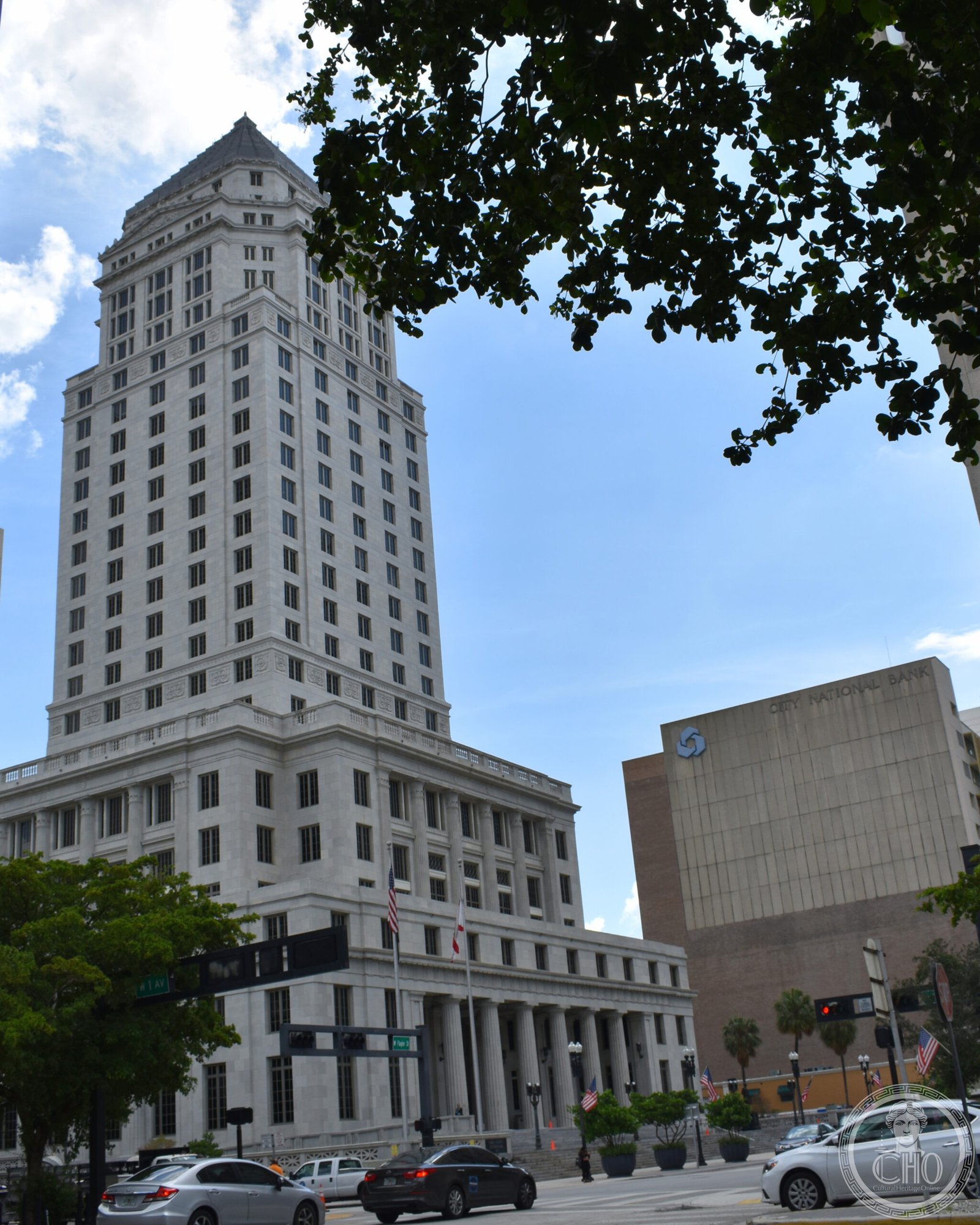
A. Ten Eyck Brown’s 28-story Art Deco courthouse tower, completed in 1928 at the corner of Flagler Street and Miami Avenue, was the tallest building in Florida for more than two decades and set the civic ambition of Miami’s first golden era against the Biscayne Bay skyline.
At a glance
The Dade County Courthouse at 73 West Flagler Street opened in 1928, the product of a Florida building boom that was already beginning to slow under the weight of the 1926 hurricane and the onset of the Depression. At 28 stories and approximately 319 feet, it was the tallest building in Florida at its completion, and it held that distinction until the early 1950s. Designed by A. Ten Eyck Brown in a mode that combined classical civic architecture with Art Deco ornament and silhouette, the building expressed the ambition of a county that had seen its population multiply several times over in the preceding decade. Its stepped pyramidal crown, decorated with eagles and geometric reliefs in limestone, became the defining feature of Miami’s downtown skyline for a generation.
Key facts
- Opened: 1928
- Architect: A. Ten Eyck Brown (State Architect of Florida)
- Style: Art Deco / Neoclassical — limestone and granite, stepped crown, eagle ornament
- Height: 28 stories, approximately 319 feet (97 m)
- Status at completion: tallest building in Florida until the early 1950s
- Address: 73 West Flagler Street, Miami, FL 33130
- GPS: 25.7748°N, 80.1942°W
- Status: National Register of Historic Places; active courthouse
History
Miami in the mid-1920s was one of the fastest-growing cities in the United States. The Florida land boom had brought hundreds of thousands of migrants south, real estate speculation was running at a pace that later analysts would recognize as unsustainable, and the infrastructure of civic life — courts, government, utilities — was struggling to keep pace. The decision to build a new county courthouse of genuine civic grandeur was a statement of confidence in Miami’s future at precisely the moment when that future was most in question.
A. Ten Eyck Brown, Florida’s State Architect, brought to the commission the classicizing vocabulary of the period — a base of granite, limestone shaft, and an upper section that narrowed in progressive setbacks toward the pyramid crown — combined with the Art Deco ornamental language that gave the building its visual energy. The eagles at the crown, sculpted in high relief, announced civic authority; the geometric ornament at the spandrels and cornice levels gave the building a modernity appropriate to a city that was reinventing itself. The courthouse opened in 1928, a year before the stock market crash, and it would serve the county’s courts continuously through the Depression, the Second World War, and the explosive postwar growth that transformed Miami from a regional city into an international metropolis.
The building was listed on the National Register of Historic Places and has been subject to ongoing preservation discussions as Miami-Dade County considers its long-term future. As a working courthouse, it continues to see daily public use and remains the visual anchor of the West Flagler Street civic corridor.
What you see
The Flagler Street facade reads as a composition in three registers: a wide granite base with the classical entrance portico, marked by paired columns and a stone pediment; the limestone shaft of the tower, rising in a succession of setback planes articulated by continuous vertical piers; and the stepped pyramidal crown that narrows in four setbacks to the building’s pinnacle. The eagles at each corner of the crown — carved in limestone in high relief — are the building’s most recognizable ornamental feature, visible from the Brickell corridor to the south and from the upper decks of cruise ships in PortMiami to the east.
At street level, the Flagler Street entrance is framed by a classical stone surround with deep-cut ornamental reliefs. The lobby interior carries the civic vocabulary — high ceilings in plaster with coffered panels, marble wainscoting and terrazzo floors — that Brown established across Florida’s state building projects in this period. The courtroom floors above preserve much of their original millwork and plaster ornament.
Practical information
- Access: 73 West Flagler Street, Miami FL 33130 — active courthouse; public access to the lobby and lower floors during business hours (Monday–Friday, 8 am–5 pm); photo ID may be required
- Exterior: freely viewable from Flagler Street and Miami Avenue at all times
- Transit: Miami-Dade Metromover, Government Center station — one block east on NW 1st Street
- Time needed: 20–30 minutes for exterior documentation; allow extra time for courthouse security screening if entering
Getting there
The Dade County Courthouse is the visual anchor of Miami’s civic core, one block north of the Miami-Dade Metromover at Government Center station. Miami International Airport (MIA) is approximately 8 miles west via the 836 expressway — 25–35 minutes by car; the Miami Airport MIA-MIC Metrorail link connects to the Metromover at Government Center. Fort Lauderdale-Hollywood International (FLL) is approximately 28 miles north via I-95. By car, the courthouse is directly accessible from I-95 southbound at the downtown Miami exits; parking garages are available on the surrounding blocks. Bayfront Park is five blocks northeast; the Pérez Art Museum Miami (PAMM) at Museum Park is thirteen blocks north on Biscayne Boulevard.
Nearby
- Pérez Art Museum Miami (1983/2013) — Herzog & de Meuron’s landmark museum of modern and contemporary art at 1103 Biscayne Boulevard, thirteen blocks north at Museum Park on Biscayne Bay — the anchor of the Museum Park cultural district.
- Freedom Tower (1925) — the Mediterranean Revival landmark at 600 Biscayne Boulevard, five blocks east — built as the Miami News building, later the processing centre for Cuban exiles in the 1960s, now a museum.
- Bayfront Park — the 32-acre waterfront park along Biscayne Bay, five blocks east — home to the amphitheater and a range of public programming.
- Miami-Dade Cultural Center — the Philip Johnson-designed civic complex two blocks west on Flagler Street, housing the HistoryMiami Museum and the Miami-Dade Public Library main branch.
Sources
- National Register of Historic Places nomination, Dade County Courthouse, Miami
- HistoryMiami Museum archives — Miami building boom documentation
- Seth Bramson, Miami: The Magic City — civic architecture context
- Florida Division of Historical Resources records — A. Ten Eyck Brown commissions
- Miami Herald archives — courthouse opening coverage (1928)
Find it on the map
See this place and what’s around it →📷 Become a Cultural Heritage Online photographer
Share your photos of places: they stay published under your name as the author. The more they're seen, the more you get noticed — and soon a contest will reward the most appreciated photos.
Log in or sign up free to add a photoIs this page about you?
This page is read by travellers and heritage enthusiasts who find it on Google. Tell us how you are connected to this place and we will take it from there.